A paper drafted by the Equality, Diversity and Inclusion unit of the Public Appointments Service would appear to imply that meeting targets for the recruitment of persons born outside of Ireland into the public service will require positive discrimination to address what they identify as current underrepresentation.
That may mean that, to increase the percentage of non-Irish born public servants, the Public Appointments Service may need to ensure the public service favours the recruitment of persons who were born outside of Ireland.
The document, along with other related documents and emails, was released on June 27 to Ken Foxe under the Freedom of Information Act. It is entitled Equality Diversity & Inclusion Unit 1 Citizenship Eligibility Criteria in the Civil Service A Barrier to Opportunity, Inclusion & Integration.
That implication can be garnered by the fact that the paper highlights the disparity between the 17% “non-Irish born” enumerated in Census 2022 and the fact that just 3% of those employed in the public or civil service were born outside of the country. The percentage of non-Irish born residents has increased since 2022 and the document recognises that this will likely “continue to rise.”
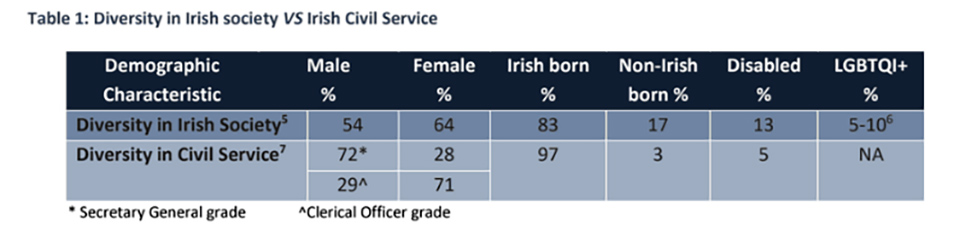
While the paper does not explicitly set as a target the bringing of the two numbers to “equality” they certainly wish it to move closer, if not to attain the same levels across both categories. They refer in the document to a total of 350,000 people working in the public service and that this is projected to grow at an annual level of 3.6% per year until 2031.
That would suggest – including over 10,000 retirements, particularly in higher grades, over the same period – that increasing the percentage of non-Irish born public servants would require that the Public Appointments Service ensures that all parts of the public service, including the Gardaí and Defence Forces, will favour the recruitment of persons who were born outside of Ireland.
Again, while that is nowhere stated explicitly, the recommendations of the Equality, Diversity and Inclusion unit with regards to “broadening the citizenship eligibility” clearly has this in mind.
Among their recommendations were the extension of eligibility to more than 300,000 immigrants with Stamp 4 permission; in addition to 58,000 spouses and partners of persons with critical skills work permits; and to more than 90,000 persons with Stamp 1 permits and 4,700 with Stamp 5 permits.
That this is not simply a pragmatic or logistical solution to recruitment is underlined by the statement that “a broadening of citizenship eligibility” would “send a clear message that the Irish civil service is committed to removing the structural barriers faced by underrepresented groups.” Which again implies that this underrepresentation will have to be proactively redressed. There is only one way to do that.
Lest anyone think that this is just some bunch of public servants with a passion for “equality” shooting the breeze and that their papers and recommendations are probably destined for the Minister’s interstitial bin, the extension of recruitment to the public service of Stamp 4 permission holders came into effect in April this year following the circulation of the EDI paper.
The EDI also has its equalitarian eye on the “undocumented” who they refer to in Annex 1 as potential future civil servants, and to “international protection applicants who have been granted a labour market permission.” The now amnestied “undocumented” – basically persons who have been resident in the state illegally – are referred to in rather un-public service speak as those “living on the margins of society and subject to discrimination and exploitation”.
That clear ideological, and indeed political bias, is also evident in the text of the EDI paper. The aim of the public service is no longer apparently primarily to ensure that public administration works effectively but to “create a more diverse, innovative and inclusive public service, one that delivers for all of Ireland’s communities.”
Although perhaps this does not hold for the Irish speaking community who warrant not one single mention in the entire 19 pages devoted to ensuring that persons – many of them not even yet resident in the state – whose need to be treated equally, and far more than equally actually, is the apple of the EDI’s eye.
Is the EDI even aware of the supposed responsibility of the state public service to ensure that Irish speakers can access services through the language?
We are told that the public service “does not reflect the diversity in wider Irish society,” and the EDI rues the fact that the extent of this dreadful injustice is not even fully known because “equality data is not collected across government departments in a systematic, harmonised way.”
As we pointed out previously with regard to other wings of the EDI movement in universities and elsewhere, there is no one more obsessed with the Victorian entomologist’s desire to categorise every creature according to various shapes and colours than the apostles of inclusion.
The person who is in charge of all of this as the Head of the Equality, Diversity and Inclusion unit at the Public Appointments Service is Siobhán McKenna. According to her Linkedin page she has previously worked with the Greater London Authority, and as a trustee of the Coram Family and Childcare Trust.
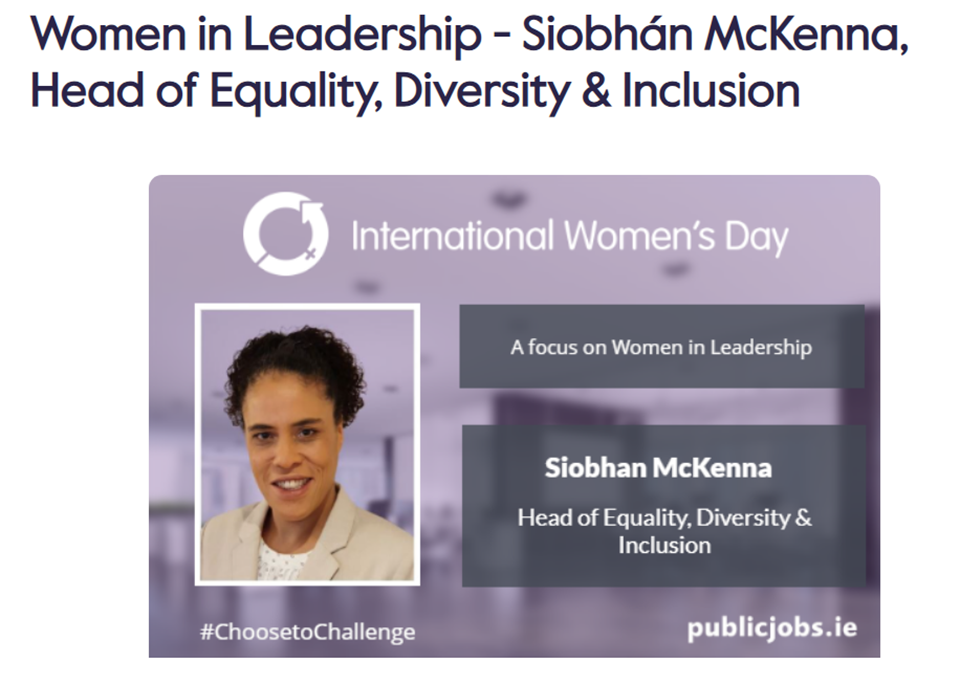
McKenna also worked for three years between 2005 and 2008 for the George Soros Open Society Foundation, and for two years prior to that as an assistant to the Soros/Open Society International Advocacy Director. Her job involved “Networking and capacity building of Non-Governmental Organisations across the OSI-Soros Foundation network.”
She also, in an interview with public.jobs.ie, listed among female leaders who inspire her Democratic Congresswomen Ilhan Omar and Alexandria Octavio Cortez who would be considered to be on the far left of the Democratic Party. McKenna cited the fact that “They are fierce and unapologetic in their mission to make America a better place, particularly for the most vulnerable in their society.”
Perhaps I am being naïve, but whatever happened to civil servants maintaining political neutrality in their official roles? Surely too, McKenna’s views and background raise questions about whether she might be the right person to be recommending how the Irish public service ought to be radically transformed in line with an ideologically driven project to promote “diversity”? Even if that has seemingly become the default position of the entire political establishment.
