An Irish farming group has called for an “independent investigation” into what it described as possible “misappropriation of funds” in relation to “undue lobbying activities” it believes may have been carried out by environmental NGOs that received EU funding.
The Irish Natura and Hill Farmers Association (INHFA) said their call came “following a statement last week from the EU Commission that acknowledged how funding for the EU LIFE programme may have funded “undue lobbying activities” by environmental NGOs”.
The European Court of Auditors also issued a report which found a lack of transparency in EU funding awarded to NGOs – saying “certain advocacy activities were funded by the Commission in a way that was not fully transparent.”
“EU funding for NGOs is too opaque and suffers from a lack of transparency,” said Laima Andrikiene, the lead auditor on the report. “We are not talking about peanuts here,” she added, referring to the billions of euro involved.
INHFA National President Vincent Roddy expressed major concern around the relationship between the EU Commission and the environmental pillar, before adding, that the “statement by the commission should not come as a surprise to many as this issue has been in the public domain for some time.”
Indeed, he continued “the decision by the commission to issue their statement at the same time of the Trump tariffs and the judgement against Marine Le Pen would indicate that they are trying to limit the damage by getting the story out when the media and public are otherwise distracted.”
While the link between the use of EU funding for lobbying purposes first started to surface last autumn, the INHFA had pointed to a link as far back as May of last year, they said. “At this time there was an opinion poll conducted in six countries opposed to the Nature Restoration Law (Netherlands, Sweden, Finland, Poland, Hungary and Italy) that showed high support levels for nature restoration.
“The fact that the opinion poll was only conducted in these countries indicated clear intent around its objectives which was a point we detailed at the time” added the INHFA President.
However, the main issue relating to the opinion poll was, Roddy stated, that “the body that commissioned the poll, namely #RestoreNature were supported through the EU LIFE Programme and the European Commission.”
He said this “is detailed in the first page of their website where they acknowledge financial support from MAVA Foundation, the European Commission and the EU LIFE Programme.”
While the commission may well maintain that this financial support doesn’t necessarily mean they are supportive of the polling it should be recognised, Roddy stated, “that these opinion polls definitely benefited EU institutions including the commission in helping to get the Nature Restoration Law (NRL) passed.”
As an independent executive arm of the European Union with responsibility to implement decisions reached by the European Parliament and Council of the EU, it is, the farm leader stated, “vital that the Commission remain independent and should not in any way be seen to influence policy at Member State level especially when it is policy that they have been so invested in.”
The INHFA President stressed that “the concerns outlined by a number of MEPs and others must not be brushed aside which is why we are calling for an independent enquiry to establish all the facts.”
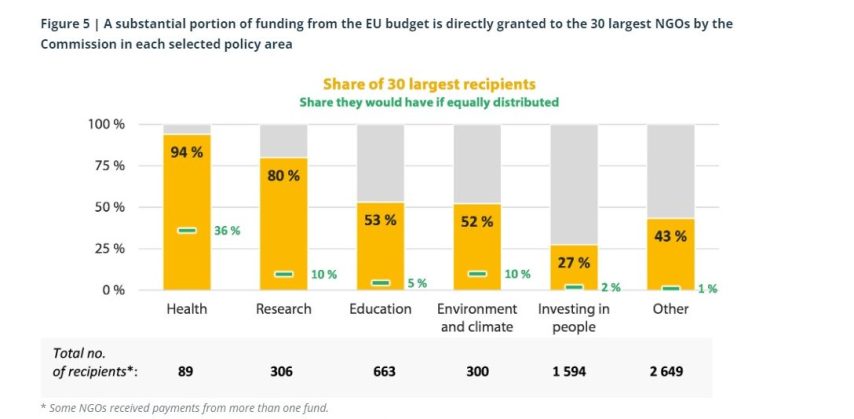
The audit by the European Court of Auditors showed that just 30 NGOs received more than 40% of the EU funding granted to the sector, with that proportion worth €3.3 billion in the 2014-2023 period.
“Notwithstanding the limitations of the financial data available, our analysis shows that a large part of EU funding granted to NGOs under direct management went to a small number of NGOs. Of over 4,400 NGOs, 30 received more than 40% of total funds during the 2014-2023 period (i.e. €3.3 billion),” the report found.
It found (see below) that the 30 largest NGOs, for example, received 52% of the funding allocated to the “Environment and climate” policy area – and that the same groups would have received just 10% of same had the funds been equally distributed amongst all the recipients.
“Overall, we found that there is no reliable overview of EU funding granted to NGOs,” the auditors reported. “This information is published on multiple systems, websites and databases, resulting in a fragmented approach, which hampers transparency and limits insights into the role of NGOs in EU policy-making and programme implementation.”
“Moreover, without this information, it is more difficult to assess whether EU funds are overly concentrated on a small number of NGOs and whether such concentration aligns with EU policy objectives,” the report added.
The ECA added they found that, despite improvements, “the transparency of EU funding granted to NGOs has been hampered by inconsistent classification of NGOs and issues impacting data quality. We also found that the Commission and other bodies do not proactively check recipients’ compliance with EU values, and that certain advocacy activities were funded by the Commission in a way that was not fully transparent.”
“Transparency gives citizens the information they need to hold public decision-makers to account,” the ECA said. “Public transparency is about providing citizens with proper information so that they can hold public decision-makers to account. This means that fulfilling transparency requirements includes knowing not only to whom, why and for what purpose EU funds were granted, but also how they were used, the amounts involved, and whether fund recipients respect EU values.”
The auditors also found issues with disclosure – saying that NGOs were receiving operating grants but that this financed “various activities which may include advocacy – and also with entities in receipt of funding being incorrectly described as NGOs, saying that in their sample, eight entities were incorrectly marked as NGOs.
Giving an “example of a research institute being marked as an NGO even though it is dependent on government”, the ECA revealed.