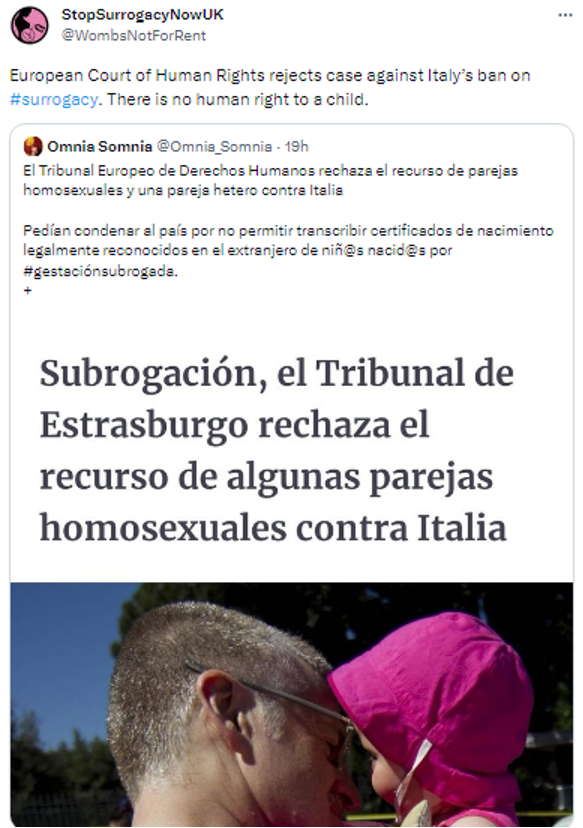
On Thursday, the European Court of Human Rights (ECHR) rejected an appeal by several Italian citizens against Italian legislation on surrogacy.
Italian law restricts the ability of people who have acquired children through surrogate parents in other countries from registering them in Italy.
The legislation effectively means that only a biological parent can be granted full parental rights. In relation to surrogacy that means that only the male donor, and not their partner, could be recognised legally as the parent of the child.
While this has been reported as an attack on gay male couples, it equally applies to the female partner of a male donor who has paid another woman to have the child. Indeed, supporters of surrogacy admit that around 90% of surrogate parents in Italy are heterosexual couples.
In March, the government of Giorgia Meloni tabled a new law that would ban Italian citizens from paying to have a child born to a surrogate mother in another country.
Proposed penalties would extend the existing ban and penalties on surrogacy in Italy itself, which carries sanctions of up to two years in prison and fines up to €1 million. The law is currently before the lower house of the Italian parliament.
Domestic surrogacy is banned in Italy, as it is in Ireland, so effectively supporters of surrogacy -which uses women in poorer countries – tacitly recognise the fundamental moral and ethical flaws inherent in the entire concept.
If it is not okay to pay Mary in the local authority house down the road to have your child, then it ought not to be okay to pay Irina in a Ukrainian village to have your child. And that is without addressing the rather questionable role played by the agencies who organise and make a lot of money from the practice.
As Gript has reported previously, the Irish state – unlike the Italians – seems perfectly happy to accommodate such hypocrisy and double standards. As John McGuirk stated in regard to this, what we have is a situation in which there is “literally one rule for Irish women, and another for the poor women in the third world.”
The Italian supporters of surrogacy had predictably played up the LGBTQ+ angle, hoping that it would be a clinching argument especially in the broader EU context. In a widely broadcast appeal against the Italian law carried by Reuters one of the surrogate children of a gay couple declared that: “We do not need a mother to live.” Well, you kind of do and that applies across the entire animal kingdom.
The ECHR has taken a different view. The Court found against three separate appeals. The decision states that the Italian legislation is not in contravention of Article 8 of the European Convention on Human Rights which declares that “Everyone has the right to respect for his private and family life, his home and his correspondence,” but which also excludes instances where a democratic state might claim that such restrictions are necessary on various grounds including “the protection of health or morals.”
That is a crucial ruling, as it upholds the right of European states based on legal codes evolved over several millennia and particularly during the Christian era to protect those mores and traditions against subjective and ideologically based assaults.
This can be interpreted as asserting that no-one can claim that they have a “right” to have a child in circumstances such as surrogacy, which supersedes not only every other traditional right including the rights of children and biological parents, but also the right to protect the moral foundation of western society.
The ECHR also ruled that any claim on the part of surrogate couples of a right to have a child is more than adequately served by the legal right to adopt a child. They rejected the rather weak and banal argument on behalf of some of those who took the case that adoption was too expensive, too lengthy and placed undue strains on same sex couples.
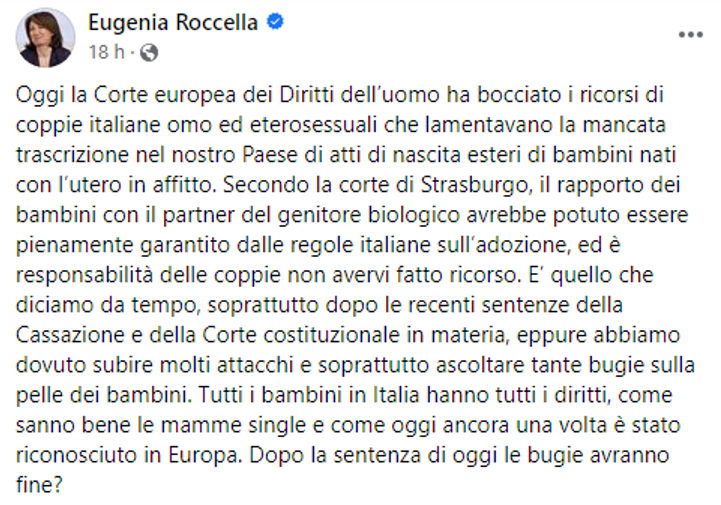
The Italian Minister for the Family, Eugenia Roccella posted her response, which noted the Court ruling and concluded with the assertion that “All children in Italy have all the rights, as single mothers know well and as today it has once again been recognized in Europe,” and challenging the opponents of Italian law to declare: “Will the lies end after today’s ruling?”
Interestingly, Roccella later declared that “L’aborto non é un diritto” – “Abortion is not a right,” a signal that the Italians are determined to challenge the left liberal consensus within the EU on many fronts. Avanti!
It will be interesting to see in what way, if any, the Irish state, normally ultra-sensitive to decisions made in Brussels or by the Court in Strasbourg, will take heed of the ruling.
I did refer to the ECHR upholding the right of western states to defend the bases of order that has long protected Europe – as a family based Christian civilisation not as a centralised federal state – from barbarism including the barbarism of the Nazis and Communists.
That defence rests, however, on the willingness of those entrusted with political and moral authority fulfilling their responsibility to defend that order. The Italians and the Poles and the Hungarians and others clearly understand that.
So too do the growing forces of opposition to vacuous left liberalism within the EU. Ireland remains somewhat behind that curve unfortunately. Perhaps that may change, as it is changing elsewhere.
