Over the weekend, data released by Dublin City Council to Independent councillor Gavin Pepper gave a pretty astonishing insight into the impact of immigration on the social housing waiting lists.
It also raises further questions about whether those who enter the asylum process, where existing IPAS centres have been full to capacity for years, are now being represented in homeless figures, and being added to already crowded and lengthy lists for social housing.
The absence of transparency in relation to housing data from most of the county councils is appalling – and it is only due to the dogged determination shown by a handful of councillors and TDs that any of this important information is available to the public, even though it is then often ignored by most of the media. That’s a scandal in itself.
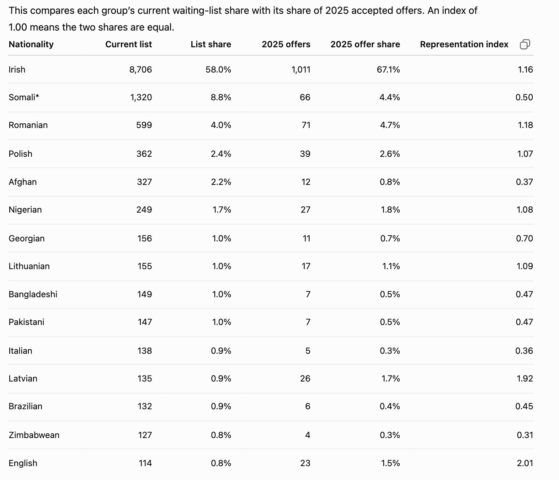
Most readers seemed shocked to learn that 42% of all households on the Dublin social housing list were not Irish – with many asking why such high numbers of those in the non-Irish category were Somalian, because almost 9% of people on the Council’s list for housing are from that country.
With a total of 15,005 households waiting on social housing, some 8,706 or 58% are Irish – while 6,299 or 42% are non-Irish.
The data released by the council showed that Somali households alone account for 1,320 applicants or 8.8% of the entire list, while Romanian households account for 599 of those on the list or 4% of the total.
Source: DCC/Cllr Gavin Pepper
Hundreds of Polish (362) are also on the housing waiting list, as are 327 Afghans and 249 Nigerians and 156 Georgians. The full list, as grouped by nationality, seems to include all of the countries of the world
Yet, non-citizens in Ireland are only entitled to apply for social housing if they have a legal and long-term right to live in the State. Is it the case that the 42% of those on the housing list who are not Irish have gained citizenship or been granted a right to stay? Is this more of what we expect to see given that citizenship has been given out like Smarties, and deportations remain ridiculously low.
Patchy data from the Department of Justice does not suggest that citizenship has been granted to large numbers of applicants from Somalia – though we are told that while over 20% (1,188) of those attending the latest citizenship ceremonies were from India, 462 were from Romania. Analysis of figures obtained by Carol Nolan TD last year showed that between 2011 and 2024, some 24,094 Nigerians were granted citizenships, but Somalians were not present in significant numbers.
SOMALIANS COMING THROUGH IPAS
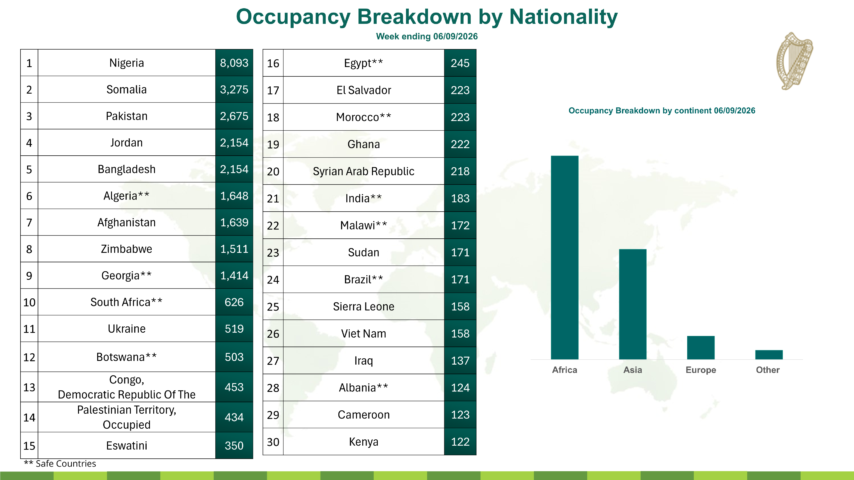
Where we do see large numbers of Somalians arriving is through the international protection services. That would seem to explain the difference between the 2022 Census – which records just 2,150 people who spoke Somali or identified with Somali migration backgrounds living in Ireland – and the numbers we are now seeing cropping up on housing waiting lists and in IPAS centres.
As shown in the table below, for the week ending 6th September this year, 3,275 Somalians were being accommodated in asylum centres – in sharp contrast to the 421 persons from that country in IPAS accommodation in December 2021. That’s almost an eight-fold increase.
Source: IPAS/DoJ
In July, my indefatigable colleague, Matt Treacy, reviewed the trend in the IPAS system, and he noted: “Somalia barely registered among the main countries of origin before Covid. There were 167 in 2020 but that had jumped to 1,568 by 2022.”
The total number of arrivals since 2020 stands at 8,105 and that has been boosted by a high percentage of successful family reunification applications. There would appear to be a positive correlation between the restriction on Somali applications in other European states and the exponential growth in applications here.
The Irish state had the distinction in 2024 of being the recipient of the 6th highest number of Somali asylum applications in the world and the third highest in the EU behind Germany, France and Greece. The Irish per capita rate is well above any of our fellow EU member states.
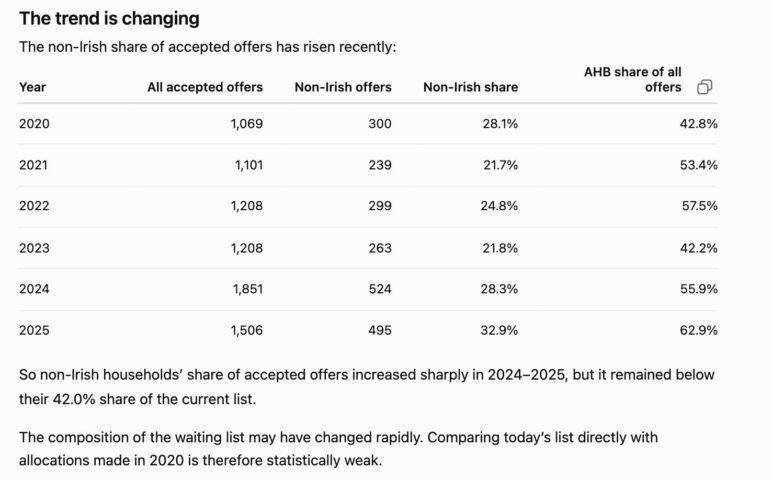
We also know from the Dublin City Council data that the number of housing offers accepted by Somalians have increased sharply – with all non-Irish accepted offers also increasing and the share of housing being offered by Approved Housing Bodies also increasing, which is of some concern in relation to transparency as the AHB’s are not subject to FOIs or other methods of interrogation.
Source@ DCC/Cllr Gavin Pepper
However, we do know from the reports of one AHB, the De Paul organisation, that in 2025 they assisted 3,929 persons to move from IPAS accommodation into social housing – which meant that 70% of those De Paul assisted with housing were people who came here claiming asylum.
And we also know that IPAS accommodation has been full to bursting for at least two years now, with the total of around 33,000 accommodation places remaining pretty consistent even as tens of thousands of additional claimants have arrived – mostly economic migrants claiming asylum if past patterns are to be relied on.
The idea that all of this is not impacting on housing is ludicrous. Just as the unprecedented numbers of legal migrants are putting enormous pressure on the need for new homes, it is now undeniable that the asylum system – and specifically the pull factors that reckless successive governments and put in place and even emphasised – is bringing additional sustained pressure to bear on social housing and homeless services.
As Matt Treacy also uncovered from DePaul’s figures, 7,282 heads of households who were allocated social housing in 2024 were persons who had been through the asylum system – and 70% with leave to remain rather than having been granted refugee status. Have those numbers increased further in the 20 months that have passed since? The public have a right to know.
Independent Ireland Councillor, Linda de Courcy, also noted this year that data released under FOI shows that non-Irish households were up to 1.4 times more likely to get a house or apartment than an Irish household based on housing allocation in 2024 in the Fingal County Council area.
It’s long past time for an open, honest and transparent reckoning of what is happening in relation to the scarcest of all Irish resources – housing, and whether, as Cllr Pepper said at the weekend, Irish people are being prioritised in their own country.