Independent Ireland Councillor, Linda de Courcy, has said that data released under FOI shows that non-Irish households were up to 1.4 times more likely to get a house or apartment than an Irish household based on housing allocation in 2024 in the Fingal County Council area.
The Clondalkin-based councillor told Gript that it was her belief that “councils are actively discriminating against Irish people when it comes to housing,” saying this was “disgraceful”.
“Many of us have known this was true for a long time, we now have proof,” she said, adding that she did not believe “the three other Dublin councils [who] are saying they don’t keep stats on ethnicity”.
She said it made her “pretty angry to see the data in black and white” and that the “other Dublin councils have not released the data, but it is safe to assume the situation is similar.”
“I have another question into [South Dublin County Council] asking for a breakdown by demographic. They can’t keep hiding the data, Irish people have the right to know,” Cllr de Courcy added.
The data was obtained by FOI by The Transparency Objective, which says it seeks to shed light on Irish public policy through meticulous analysis of official data.
“Using official Freedom of Information data and published waiting list statistics, this report examines how social housing allocations in Fingal compare with the composition of the qualified housing wait list. The report presents the available evidence and highlights areas where greater transparency would improve public understanding,” it says in a report released on the information received.
The allocation figures were obtained from records released by Fingal County Council under the FOI. The records classify allocations under four citizenship categories: Irish, EEA citizen, Non-EEA citizen and UK.
“For the broader comparison, EEA, non-EEA and UK citizens have also been grouped together as non-Irish citizens. This combined category is used only to allow comparison with the Summary of Social Housing Assessments, which records households according to whether the head of household is an Irish or non-Irish national,” the report explains.
It notes that limitations include that the 2024 waiting-list figure is a point-in-time assessment and that the 2024 waiting-list composition should not be treated as the applicant composition for every earlier year.
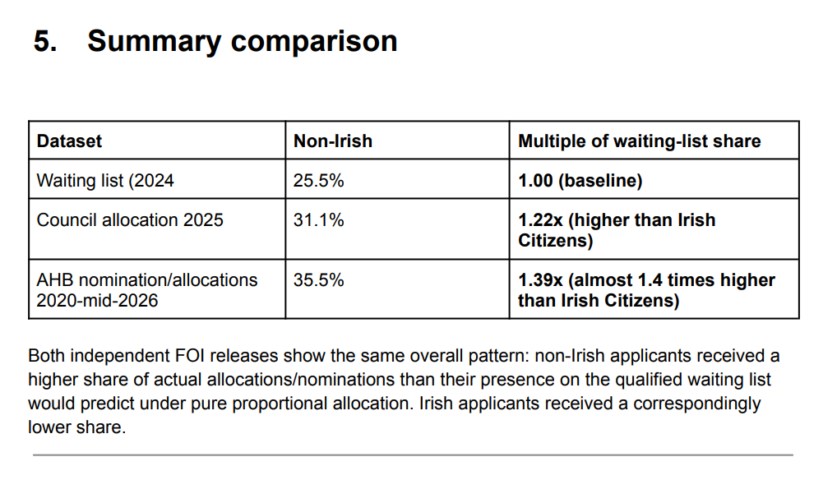
However, the report says its key findings were that while Non-Irish households made up just 25.5% on the housing waiting list, they accounted for 35.5% of Approved Housing Board (AHB) allocations.
Irish households, on the other hand, made up 74.5% of the waiting list but just 64.5% of AHB housing allocations.
“Non-Irish households accounted for 35.5% of AHB allocations while representing 25.5% of the waiting list. Their allocation share was therefore almost 1.4 times their waiting list share,” the report found.
In regard to Council allocations, the FOI data also showed that a higher proportional allocation went to non-Irish applicants, coming in at 1.22 higher than Irish citizens.
Source: The Transparency Objective.
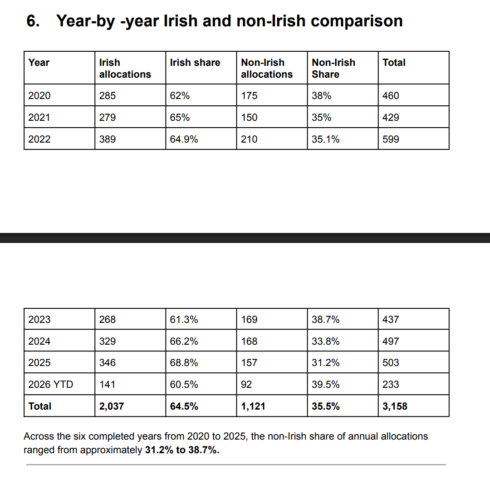
A year by year comparison between Irish and non-Irish allocations, showed that the non-Irish allocations were disproportionally higher every year, though the 2026 figures are presumed to be for the year to date.
Source: The Transparency Objective
In December 2024, National Party Councillor Patrick Quinlan proposed a motion asking Fingal County Council to report on how many of the people currently awaiting housing from the Council are foreign nationals.
He pointed out that, in 2011, figures released to Fine Gael Councillor Kieran Dennison showed that 51% of applicants for housing were foreign nationals. The council voted 28 to 1 against releasing the updated figures.
Cllr Quinlan’s motion sought that “That the Chief Executive provides an update on the number of individuals of non Irish nationality and of non-EU nationality on the social housing list.”
He was told that: “As part of the Social Housing Assessment process, applicants are requested to provide details of their nationality, citizen status and residency permission, amongst a range of other information. Whilst this information is contained in each individual application form (of which there are 14,465 active applications on file), this data is not collated as there is no statutory requirement nor identifiable benefit to do so. Accordingly, this information is not readily available, and it is considered that the significant time that would be involved in the collation of same would represent an unjustifiable use of public resources.
Commenting on the figures released by The Transparency Objective, Cllr Quinlan said that it was “very obvious that the Irish people are not being put first”.
“I’ve effectively been seeking this type of information since 2020 because we need this data broken down, not just by citizenship, but by nationality,” he said. “Irish citizenship has been given out so freely in the last two decades, like confetti really, with a ceremony now taking place two or three times a year,” he added.
“I put a motion forward at Fingal County Council that sought to ring fence housing and supports for Irish nationals, but it wasn’t even seconded. We have a housing crisis driven by immigration, but its very obvious that the Irish people are not being put first,” he said.
Cllr Quinlan also said he was concerned that standing orders may be altered proposed to prevent real debate at the Council. “I’m not about to let that happen,” he said.