And so I find myself wearily writing about sexually explicit, wildly inappropriate, books aimed at teenagers again, not because I have a special interest in the subject but because RTÉ and the rest of the Irish media seem fixated on pushing a decidedly weird, even creepy, agenda in this regard.
Last Friday, the Late Late Show hosted Juno Dawson, author of ‘This Book Is Gay’ which has caused a storm of controversy, not because of its title, but because parents have been startled to learn that the book was pitched at kids aged 12 upwards while being promoted in schools and libraries.
In the usual soft-soap interview, Patrick Kielty asked Dawson about writing the book, and said it was “weird” that opposition was expressed at libraries and elsewhere. Dawson said that those protesting the book were really protesting “my existence”, and warned of the evils of book banning (which is not the issue – its about the age category the book is aimed at).
Kielty had the book in his hand, waving it about as a prop, so it would have been easy to ask Dawson about the passages containing graphic descriptions of anal and oral sex, or instructing kids how to use the adult hook-up/dating app, Grindr, but, predictably, that didn’t happen.
The Late Late, despite the hype, is just a chat show, so perhaps it can be argued that its not the platform for a more thorough or interrogative discussion. Patrick Kielty is no Andrew Neil.
But why raise the issue of the book and the controversies around it on the biggest programme on Irish television if what’s actually in the book – the passages that caused the furore in the first place – are not addressed? The answer is obvious, I suppose. It’s preferable to try to conflate parental concern that sexually explicit books are being promoted to young teens with ‘homophobia’ than admit that something has gone wrong.
Kielty did timidly ask Dawson about age-appropriateness, and it was interesting to see that the response from the author was to acknowledge that ‘This Book Is Gay’ was aimed at those 13 and upwards, but a “prescription age” should not apply.
Its curious that this attitude tends to prevail amongst those who are most insistent about pushing radical changes to sex-education in schools, including the absurd and harmful notions that gender is fluid or that students should be taught how to use porn.
It is also strange that the concerns of parents – who are not just primary care givers, but the people who actually love children: raising them, minding them, nurturing them – are so often dismissed or talked down.
There seems to be no understanding that it is perfectly reasonable for parents to have the entirely scientifically correct view that early sexualisation of children is both harmful and dangerous.
As many parents have pointed out, their objections to ‘This Book Is Gay’ have nothing to do with the author’s sexuality, or with transgender people having the right to transition: instead, they are concerned with the explicit nature of what is being discussed in a book aimed at early teens, and with the frankly disturbing advice for kids on matters such as adult dating sites and the use of puberty blockers.
Parents – the people who are actually raising kids, and who see them develop from day to day – have an understanding that adolescence is a critical time for brain development and that early or premature sexualisation can be harmful.
Anyone who has raised teenagers will recognise the findings of research that has found that teenage decision-making is heavily influenced by the limbic system of the brain, the emotional part of the brain, while adults are more reliant in the prefrontal cortex, making more rational decisions.
That matters in terms of processing information, and in behaviour, and even in avoiding harm or ensuring safety. Add in alcohol and drugs, and its pretty obvious that telling teens how to use hook-up apps isn’t a good idea. If this advice was given in any other context alarm bells regarding abuse and exploitation would be ringing.
So what’s in the book? Why are parents upset? As we have previously reported on Gript, ‘This Book is Gay’ features extensive and graphic sex tutorials about bringing men to sexual climax, as well as guides on the mechanics of how to perform anal and oral sex.
While the content is explicit, the language is often pitched towards a young audience, with lots of headings like ‘Handsies’ and “Bummies”, and “Sexyfuntimes”.
Parents have said that the mix of childish language and cartoons with graphic sexual instructions is jarring, and the ‘teensy’ layout and animations don’t seem to sit comfortably with instructions to 12-year olds about how to give orgasms & to “rub cocks”.
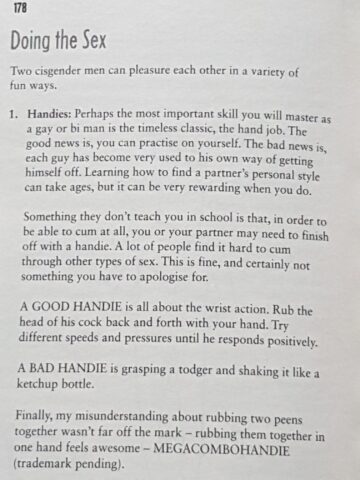


The book includes advice like “as with handjobs and breakfast eggs, all men like their blow jobs served in different ways” and “it’s about sliding your mouth up and down the shaft of his cock”.
While the instructions are explicit, the language is often pitched towards a young audience, with lots of headings like ‘Handsies’ and “Bummies”, and “Sexyfuntimes”.
Parents have said that the mix of childish language and cartoons with graphic sexual instructions is jarring, and the ‘teensy’ layout and animations don’t seem to sit comfortably with instructions about how to give orgasms and other sexually explicit advice.
Giving instructions how to use the adult app, Grindr, described by Pink News as a “hook-up app”, Dawson writes:
“Upload a tiny pic of yourself to the app. The app works out your location. The app tells you who the nearest homosexuals are. You then chat to them. Because they are near, it is easy to meet up with them”.
Critics have pointed out that, despite a note that Grindr is for over-18s in the book, the inclusion of detailed instructions regarding the hook-up app in a book which libraries display for teens as young as 12 is a safeguarding issue.
Similarly, Dawson’s book, “What About the T” – also widely stocked by libraries – contains the following.
Patrick Kielty may not be aware of what’s in the book, though he could have just opened it up and had a look, but its extremely unlikely that his researchers haven’t heard the reasons for the controversy.
Like Liveline and Virgin Media, the Late Late Show seems to want to sanitise the book and shut down criticism of what is increasingly a disturbing trend, by casting all those with concerns as being prejudiced.
The Late Late Show discussion then moved onto the claim that transgender people were a “powerless” minority. That doesn’t really seem to be the case. As with many other countries, official Ireland is currently tying itself in knots describing women as “people with a cervix” and rewriting SPHE programmes to include unscientific ideology around gender.
‘This Book is Gay’ is listed by Libraries Ireland as being widely available in the network – with more than 300 copies purchased by the public body, while 340 copies of another book from Dawson, ‘What’s the T’, which is aimed at transgender teens, are listed as being available from libraries.
‘What’s the T’ makes the claim that puberty blockers are reversible – a claim Dawson has also made online – advice which is very unsound.
The HSE is currently reviewing the use of puberty blockers in children experiencing gender dysphoria after NHS England decided to limit their use of the drugs in the absence of research on their safety and effectiveness
No-one has any issue with Juno Dawson as a guest on the Late Late Show talking about life or writing or ideas or politics. But this presentation of the reason for the controversy around ‘This Book Is Gay’ is both dishonest and self-serving.
People can see what’s in the book with their own eyes. Bullshit interviews won’t change that. It doesn’t do Patrick Kielty or the Late Late Show any good to treat parents like idiots.