Irish Leaving Cert students are being subjected to yet more one-sided propaganda within the school curriculum, and if they don’t affirm unproven absurdities, then they could theoretically get marked down in exams and lose points.
One of the recent questions on the Leaving Cert Politics and Society paper reads: “Describe two ways we see patriarchy in the world today”.
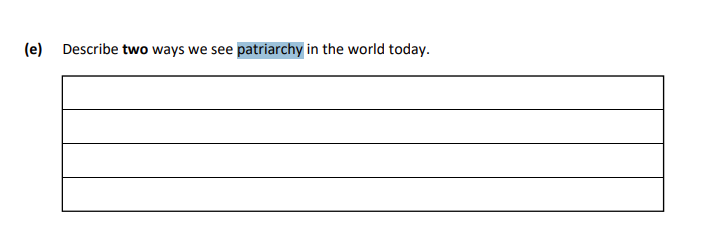
Now at first glance, one might want to charitably assume that the people behind this are referring to reasonable critiques of actual patriarchies around the world, such as the brutality that women and girls are subjected to in countries like Afghanistan or places like the Congo. That of course, would be a perfectly reasonable thing to discuss in a politics module, I don’t think anybody sensible would have a major issue with students being informed about such harsh realities in our troubled world.
But we know that that’s not the angle that Irish educators are taking in schools – at least not solely – because we have the actual classroom resources which are officially recommended for teachers by the State’s National Council for Curriculum and Assessment. We have the extremely radical documents which are, according to the State, “very classroom friendly”, and contain wall-to-wall madness, without putting too fine a point on it.
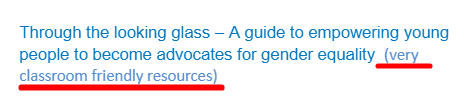
This document “Through the looking glass” was created by the “Notional” Women’s Council of Ireland, who, of course, receive hundreds of thousands of euros in Government funding every year to agitate for radical madness supposedly on behalf of women, despite not even knowing what a woman is themselves.
This is, after all, the same group who, in the context of cervical check policy, advocated for use of the language “’women, transgender men, intersex and non-binary people with a cervix’.” So, in essence, they think your uncle can get cervical cancer in his cervix. That’s the kind of group you’re dealing with.
And in their document, which is officially recommended by the State for Irish classrooms, it directly says that Ireland is a patriarchy:
So when the exam talks about patriarchy, it’s clear that they aren’t referring to women getting caned in the public square in Yemen. They’re talking about County Roscommon. They’re claiming that this country that we live in is a patriarchy and that this is a relevant concept here.
Incidentally, as a side note, this document also explicitly teaches kids about cross-dressers and drag queens.
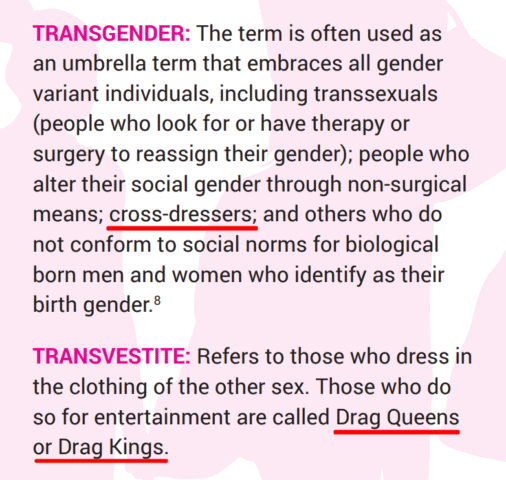
And remember, according to the State curriculum body, this resource is “very classroom friendly”, which is worth throwing in there. The same document also teaches children that they should engage in activism and lobbying, so no harm throwing in a nice dose of the aul’ political indoctrination while we’re at it.
But regardless, the main point is, if you are a Leaving Cert student sitting your exam, you have to give multiple examples of how society is a patriarchy. And the sub-text of this is that society, as a whole, is holding back women from achieving power in areas like, say, politics.
Of course this argument is reduced to laughable balderdash, when you consider the fact that women are more than 50% of potential voters in society, and have had a vote since the foundation of the State. The Irish public have elected three female presidents, including the one currently sitting in Áras an Uachtaráin. The majority of the Irish public sought fit to make out first citizen a woman as far back as 36 years ago. So, self-evidently, the public don’t have any kind of particular antipathy towards electing female politicians in principle. The majority of people are more than happy to vote for women if they like the candidate.
If anything, women in politics are given advantages that men are not given. For example, the country has a politics gender quota, where parties must run a certain number of woman candidates in order to receive full State funding under law, and this has been in place since 2012. Naturally, no such rule applies to men.
The State fully funds the See Her Elected campaign NGO, or “SHE”, which tries to help get women elected to local councils And moreover, at the last local election, the Government gave over €230,000 to Irish political parties to support, quote, “an increased number of women candidates and people of diversity”.
As an aside, when I asked the Department what the hell a “person of diversity” is exactly, they didn’t have any kind of exhaustive list, so it seems like they are giving out taxpayer money based on a criteria that they aren’t even fully sure of themselves.
For example, is a left-handed person a “person of diversity”? If I run a Mormon candidate, does that qualify me for funding? You’d think that if you have a Government scheme that involves giving out public money, they’d have some kind of objective standard that they’re using to award the cash, but apparently they’re just making it up as they go along.
But regardless: the point is, if anything, women actually have advantages and artificial boosts in politics that men do not have. So the only way you can say that the gender disparity in politics is a result of sexism is if you’re saying the public are wrong in their votes and that you don’t actually like democracy.
Every few years, voters, male and female alike, go to the polls and elect the people they feel best represent them. It is actually outrageous to turn around and say “Actually your vote was wrong, and you’re a pack of misogynists for daring to cast your ballots in that way.” There are all sorts of reasons why our politics is the way it is, one of them being, men and women are different and generally have different interests.
I know that might be a shocking and outrageous thing to say, and that I should be consigned to a gulag on Spike Island to be subjected to 30 years of hard labour for daring to state such things publicly. But in general, most women find the idea of a political career less appealing than most men, which is their right. Men and women, by and large, have different interests and gravitate to different professions, because we are different. My wife is not me, and I am not my wife.
According to the latest CSO figures, 85% of primary school teachers in Ireland are women, and 70% of secondary school teachers are women. Moreover, 90% of nurses are female, and less than 10% are male. Does that mean schools and hospitals are biased against men and have a vendetta against them? Are we going to have a campaign to make 50% of teachers and nurses male? Or is that just what naturally happens when individuals make decisions based on their own skills and preferences?
Is it not at least conceivable that there are other factors at play for the differing gender representations in different jobs, like many women not being as assertive in job interviews as men, as found in a Harvard study?
Pew research centre has also shown that women tend to prioritise family life over their careers more than men. Which is absolutely fine and again, their absolute right.
Moreover, far less women choose to go into high level business degrees than men. And this has nothing to do with points or being unable to get into such courses, by the way – women tend to do better than males academically, and many of them simply decide they are less interested in business than their male counterparts.
Unless you’re a radical liberal, most people accept that men and women aren’t the same, as we have all observed first-hand in our own lived experience. So I don’t know why we’d expect any profession to be 50/50 when it comes to gender. It doesn’t indicate anything about oppression or sexism or people being unfairly held back by “the system” – this is all conspiracy theory-level fanfiction promulgated by out-of-touch ideologues with too much time on their hands who are desperate for a whinge. And now, this tripe has even found its way into the school system.
The sooner we can get this kind of corrosive activism out of education, the better.