In his introduction to the GAA report on its response to the impact of radical demographic change, the outgoing President of the Association, Jarlath Burns, states that “It is impossible to imagine an Ireland that does not have the GAA as a central part of it.”
It is not impossible at all.
The founders of the GAA in 1884 established the Association and codified the rules in response to the very real danger that Irish sports might disappear. Douglas Hyde, one of the founders of the Gaelic League/Conradh na Gaeilge, foresaw a similar fate for the Irish language. Irish traditional music was later in a similarly perilous condition before people like Comhaltas and others took a hand.
The GAA and Conradh were among the organisations that helped to foster the national consciousness which underlay the partially successful revolution that led to the creation of the Irish state in 1922. If there was a demographic element to the threats identified by Cusack, Hyde and others it was emigration.
That is still a factor, although migration of young people from rural parts of the country is not specifically cited as the reason for the notable fall off in numbers playing and the declining numbers of children in the 0 – 5 age cohort which is specifically highlighted in the report, No One Shouted Stop – Until Now: The GAA’s Response to Ireland’s Demographic Shift.
Just as in John Healy’s 1968 book, from which the report takes its title, the stark reality is that if there are no young adults then there will be no children. The report does cite the falling birth rate as a factor and the main reason for that is that tens of thousands of young women and men are not here anymore.
The report states that the “decline in the number of births has been slightly offset by an increase in the number of young children born overseas migrating to Ireland.” What they do not refer to is that an increasing proportion of children are born to migrant parents which creates a further problem for the GAA down the line.
The GAA’s loss to emigration has been the GAA’s gain across the world where there are now 500 clubs with thousands of players. While a common trope is that this is due to the uptake of the games among people with no Irish heritage, the fact is that the GAA would not have grown so well were it not for Irish emigrants.
If there is such an uptake by people of other than Irish heritage abroad, it is certainly not reflected here as very few people who have come here from overseas have any interest in the GAA. You need only look at the attendances at matches and the team sheets. Most of the exceptions are known for the very reason that they are exceptions.
The report tacitly admits this lack of engagement where it recognises that “The strong Irish identity of the GAA can make it more appealing to people who grew up in Ireland and understand the culture. But this same identity can discourage migrants, who may not know about the games or may not feel that the GAA is for them.”
They claim that this “shows both a weakness and an opportunity for the GAA; the chance to grow its reach, be more inclusive, and make Gaelic games a stronger part of life in fast changing city communities.”
Which begs the question as to how you can become “more inclusive” and retain a “strong Irish identity.” They revert to the cherished default comfort blanket of “inclusive programmes, ensuring equitable access and targeted support for underrepresented communities, including migrants and women.”
Failing to recognise that if people do not wish to be “included” in a thing then you cannot force them to be included. The GAA knows this already as specific reference to the marginalisation of the Association in urban areas directly refers to “low penetration in diverse areas.”
Ironically it attributes this to the fact of “Recruitment limited to traditional GAA families” which was always, in my experience, the core strength of the GAA. Certainly so in Dublin, where anglicisation had a head start on other parts of the country. Strong families are the basis of strong communities because they are the ones who form the backbone of those communities.
This failure to diversify apparently is a contributor to “cultural relevance decline.” On the contrary, the overweening obsession with ‘diversity’ is rapidly ensuring cultural irrelevance and decline across almost the entire society.
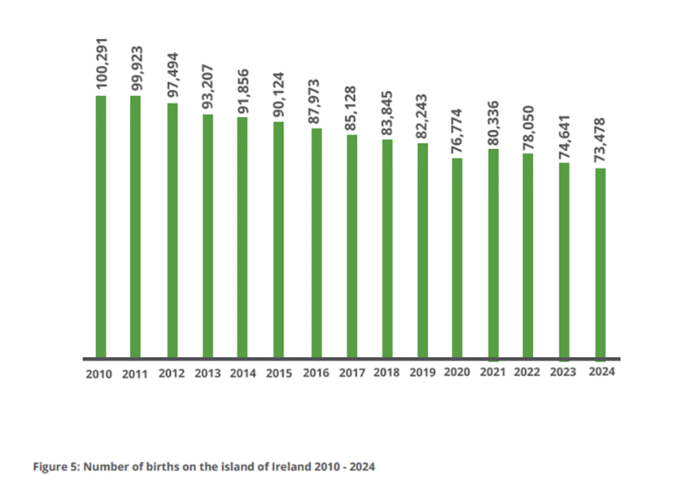
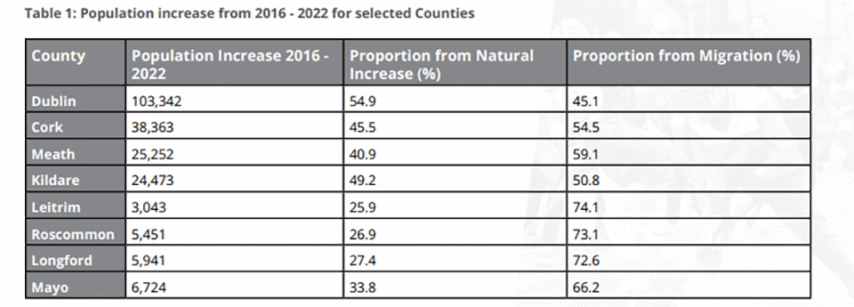
At least the GAA is recognising that mass immigration is a problem. The tables above say more than thousands of words. The same cannot be said of other parts of what was once a national movement.
The Irish trade unions are full on cheer leaders; Sinn Féin, with the same roots as the GAA and Conradh na Gaeilge, has echoed that unthinking approval; and none of the language organisations, as far as I am aware, have publicly recognised the link between the rise in exemptions from Irish and immigration.
It is not the fault of immigrants if they have no interest in the culture of Ireland. Why would they? A large part of those who come here, either as applicants for International Protection or to work or study come here for the very reason that Ireland is an Anglophone society.
They are far more interested in the English Premier League than the GAA, or the League of Ireland for that matter, whose crowds are similarly as “undiverse” as those for hurling and football.
In the north, the 2022 Census there showed that where immigrants chose another identity other than their own that 80% choose ‘British’ and just 12.5% identified as Irish. Not much hope there for the silly notion that immigration might help to form part of an unlikely majority for Irish unity in a Border Poll.
That Ireland is perceived to be so much in the Anglosphere is the product of our colonial history and also our own failure to embrace our own culture and to ensure that it became the bedrock of the new state. Or – and this is clearly the tacit fear of the GAA report – that our sports, language, music and other distinct and unique parts of that culture are not reduced to just another ‘ethnic’ minority thing.
The stark reality is that unless the demographic trend is halted and reversed, then the GAA will become a symbol of the marginalisation of everything that is uniquely Irish. They, unlike any of our other great ‘institutions’ have at least recognised that.