Irish nationalists have always had a rather touching but naïve belief that there is some mystical quality in the air or water here that will transform complete strangers with no connection to the place into Gaelic speaking camán-wielding patriots.
Historically there is some small basis to that given that the descendants of the original Norman conquistadors did for the most part, outside of Dublin and the larger towns and ports, become Hiberniores Hibernis ipsis – Níos Gaelaí ná na Gaeil féin – More Irish than the Irish themselves.
That, however, was due to several factors. Mainly, the relatively small numbers of Norman settlers, and their separation from and conflict with an anarchic English polity. It was above all due to the resilience of the native Gaelic language and culture into which they were assimilated and of which culture men of Norman descent such as Seathrún Céitinn and Piaras Feiritéar became outstanding literary exemplars.
There was also the fact that from the 16th century most of the Norman strain outside of the Pale shared the Catholic faith of the Gael despite the brutal attempts to enforce the Protestant Reformation tied to a new expropriation and more substantial settlement from England, Wales and Scotland.
Such naivety survived the disaster of the 1790s and underlay the notion shared by Pearse that British-identifying Protestants were living under some sort of delusion and that they could be dissuaded from this not least by appealing to their “good business sense.” Partition and the history of Northern Ireland rather undermines that fantasy.
That illusion has partly been replaced by a new one: that mass immigration into Ireland will strengthen the desire for Irish unity, and might even provide the critical mass that could swing a hoped for – and still unlikely even to be held – border poll within the six county area towards support for unification with the rest of the island.
As we have pointed out before, all electoral evidence since the Good Friday Agreement proves that this is an illusion. The balance between the support for pro-Union parties and pro-Unity parties has barely shifted over the course of more than a quarter of a century.
More alarming for Irish nationalists is that there is no evidence that the “new Northern Irish” are any more likely to support Irish unity than the population as a whole. Indeed, what evidence we have of the immigrant demographic would suggest the opposite.
That is clear from some of the breakdowns which can be gleaned from a search of the 2021 Census carried out in Northern Ireland. I have done some analysis of how different ethnically and nationally identified groups of immigrants identify themselves within the existing categories and the evidence suggests that there is no basis for believing that a majority of immigrants would be likely to vote for a united Ireland were a poll to be held on that issue.
Migration into Northern Ireland has to date been at a much lower level than within the Republic. Of a population of 1,903,175 enumerated in 2021, 86.5% were born in the six counties. Most of those born elsewhere were people who have moved from Britain and the Republic. Just 124,282 or 6.5% had been born in other European countries or countries outside of Europe.
The ten years previous to the 2021 Census had seen the largest expansion of the population. That was mostly concentrated in Belfast – which accounted for over half of the new arrivals – and is mostly persons who have come to live in Northern Ireland from outside of Ireland and Britain. That is likely to continue to expand although population growth since 2021 appears to be relatively modest, at just under 40,000 in the past three years.
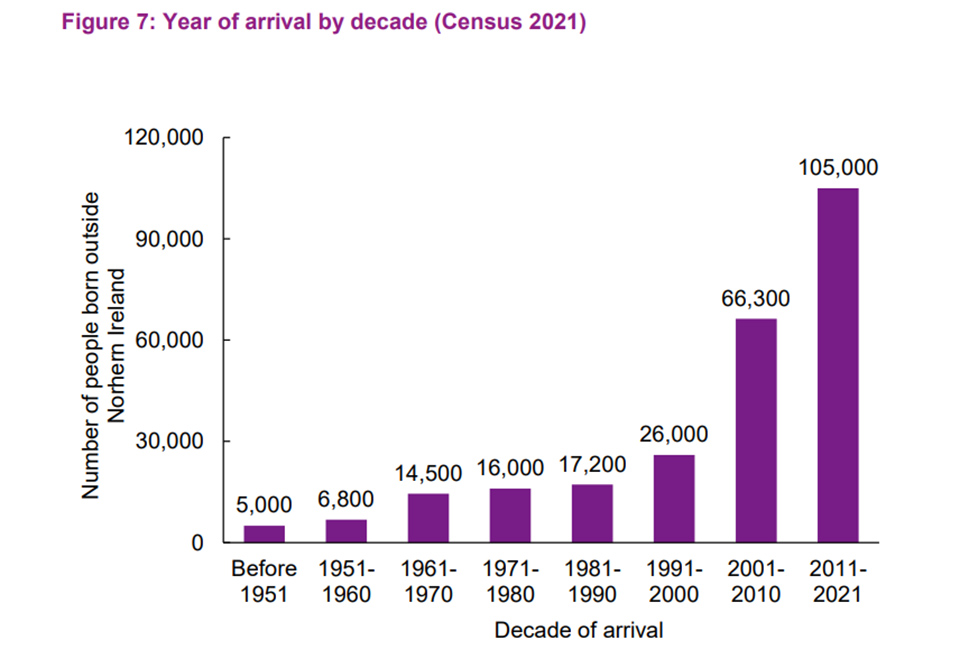
The Flexible Table Builder linked on the Census 2021 site allowed me to do a search regarding how members of different and national groups identified themselves under the options presented which included ‘British only;’ ‘Irish only;’ ‘Northern Irish only;’ ‘British/Northern Irish,’ or ‘Other.
To begin with, from the perspective of how a border poll might break down given a choice between remaining in the United Kingdom and opting for Irish unity, the main national identities were British only – 31.6%; Irish only 29.1%; Northern Irish only – 19.8% and British and Northern Irish – 8%.
That would point to a defeat of any proposal for unification within the partitioned area by somewhere in the region of the same ratio as the electoral evidence of at least 60:40.
Unfortunately for nationalists, the prospects of that being altered by increased inward migration are slim if the national identities of the main ethnic and national groups who chose one or other of the main options is any indication. Indeed, greater numbers of immigrants is likely to lessen the chances of there being a future majority in favour of unity.
While the majority of the main groups opted for the ‘other’ option, presumably identifying as Polish, Indian, Nigerian and so on, of those who chose one of the main categories 81% chose British as opposed to just 12.5% who picked Irish as their adopted identity. Almost the same number – 12% – chose the combination of British and Northern Irish.
Which, if we were to take this as a straw poll, would likely suggest that immigrants to Northern Ireland would vote to remain in the United Kingdom if that is ever to be put to a poll and that is unlikely.
This might be much to the relief of Sinn Féin, who can continue to drag it out every now and again as a “look over there” demand to maintain the pretense that they are proactively working towards unity.
The stark reality is that what attracts immigrants to Ireland, either north or south of the border, is that we are overwhelmingly an Anglophone and Anglocentric country. We take in large numbers of English- speaking Asians and Africans whose cultural lodestone is the Premiership and English popular culture – apart altogether from the linguistic advantages they have that they would not in most other European states.
The notion that mass immigration is going to do otherwise than further dilute Irish culture, including the language, Gaelic games, music and so on is utterly naive – as is also the fantasy that Poles and Nigerians and Ukrainians are nascent Wrap the Green Flag Round Me Boys republicans. Irish unity, if it is to be achieved, will have to be built on a firmer foundation than ideologised myths.