The deadliest natural disaster in the history of the United States took place in September of the year 1900, when the Galveston Hurricane made landfall just around the border of Texas and Louisiana. To this day, nobody knows precisely how many people it killed – estimates range between 6,000 dead and double that number.
We do know what it did: The city of Galveston was essentially blown off the map entirely, flattened by winds that reached – and stayed for hours at – 145 miles per hour. An extract from the Wikipedia article on the Galveston Hurricane reads as follows:
“The dead bodies were so numerous that burying all of them was impossible. Initially, bodies were collected by “dead gangs” and then given to 50 African American men – who were forcibly recruited at gunpoint – to load them onto a barge. About 700 bodies were taken out to sea to be dumped. However, after gulf currents washed many of the bodies back onto the beach, a new solution was needed. Funeral pyres were set up on the beaches, or wherever dead bodies were found, and burned day and night for several weeks after the storm. The authorities passed out free whiskey to sustain the distraught men conscripted for the gruesome work of collecting and burning the dead.”
The Galveston Hurricane is of course merely the deadliest to hit the United States. Other countries in that part of the world have suffered greater losses: In 1780, a great but unnamed Hurricane obliterated 22,000 lives in the lesser Antilles. In more recent times, Hurricane Mitch killed over 11,000 people in Central America in 1998. In 1974, Hurricane Fifi did for 8,000 lives, mainly in the Honduras. And, as with all things in the Caribbean, Haiti has had its share of killer hurricanes – most prominently Hurricane Flora in 1963, which accounted for over 7,000 deaths. The list goes on.
You might note two things here: First that the US death toll to hurricanes has generally fallen off over time, and secondly that poorer countries tend to suffer more deaths. This can be reasonably explained by the fact that in modern Galveston Texas, as in much of Florida, homes and buildings are built to standards capable of withstanding Hurricane-force winds, while in poorer countries this is not the case.
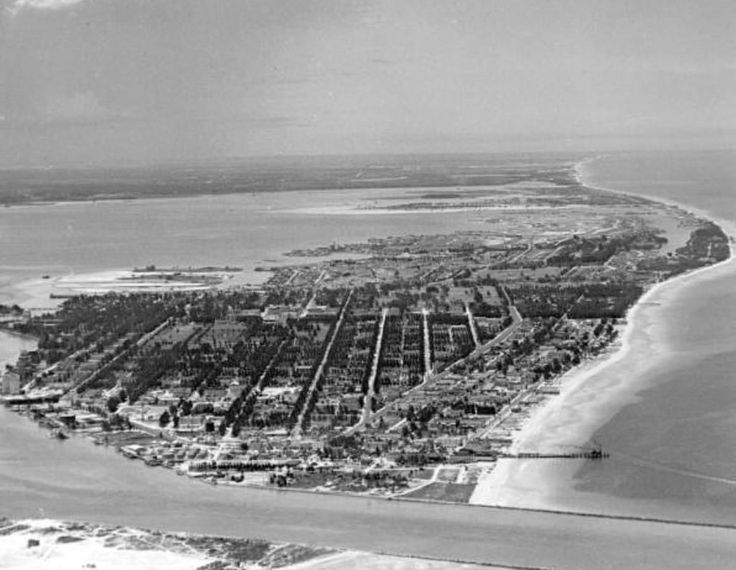
There is another factor to consider, when thinking about the relative deadliness and danger of Hurricanes over time: Population trends. Below, I present to you two photographs. The first is a photograph of what we today call Miami beach, taken in 1900.
And here is a photograph of Miami beach taken in recent years. You might notice a difference.
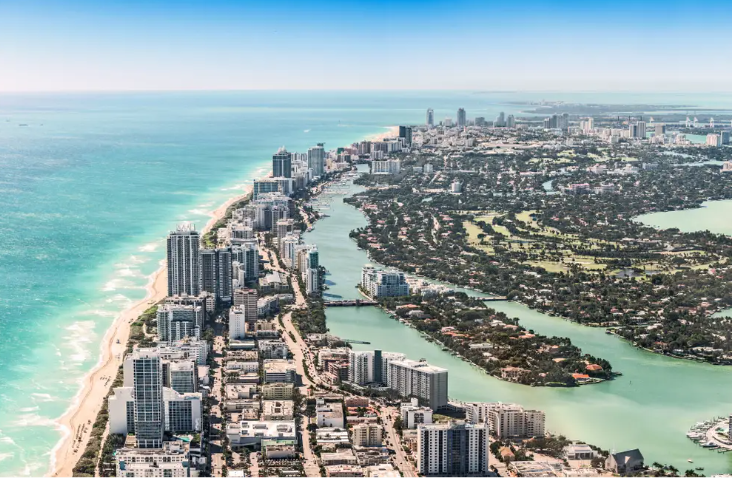
Put simply, population trends have dramatically changed, as have lifestyles. This is one reason that the costs of Hurricanes have risen over time – more people simply now live (and choose freely to live) in the paths of Hurricanes and where Hurricanes do the most damage – near the coasts. If it appears as if Hurricanes are causing more trouble than they used to, then that is at least in part because humans have decided to spend more time sitting right in the middle of their paths.
Of course, these factors are not, as a general rule, considered worthy of journalistic consideration. Here’s the Irish Times yesterday:
“(hurricane) Milton became the third-fastest intensifying storm on record in the Atlantic, growing from a Category 1 to a Category 5 in less than 24 hours.
“These extremely warm sea surface temperatures provide the fuel necessary for the rapid intensification that we saw taking place to occur,” said climate scientist Daniel Gilford of Climate Central, a non-profit research group. “We know that as human beings increase the amount of greenhouse gasses in the atmosphere, largely by burning fossil fuels, we are increasing that temperature all around the planet.”
Note what Mr. Gilford says there, and what he doesn’t say: He says the world is warming and that warm ocean surface temperatures cause Hurricanes. This is, of course, true: There’s a reason that Hurricane season comes at the same time every year, and that reason is that the sea surface is generally at its warmest at the end of the summer. Nothing Gilford tells the Irish Times is untrue, per se, but none of it is directly relevant.
Indeed, if Gilford was on to something and the seas were consistently getting hotter, producing worse and worse hurricanes, we might expect to see this happening every year. But we do not. Indeed, the Atlantic Hurricane seasons with the most hurricanes are reasonably random, since 1850:
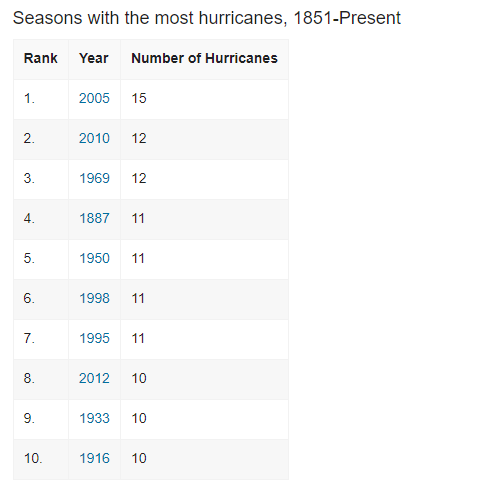
There is of course a reasonable case to be made that there are man-made impacts on the climate that are causing it to change. That, however, is not the same as journalism on climate change, which has a consistent pattern – everything is attributed to climate change, all the time, at every opportunity.
The public should be even more sceptical of that kind of journalism than they increasingly, and thankfully, are. Especially since, as we now know, the Government is literally paying the Irish media to shoehorn climate change in to their coverage as much as possible.