A decade of major tax breaks are among a set of interesting measures recently proposed by the Portuguese government to dissuade young people from leaving the country. In recent years, Portugal has battled with an exodus of young talent, due to low salaries and a youth unemployment rate which remains among the highest in Europe.
The problem is so bad that an estimated 30% of Portuguese natives aged between 15 and 39 – roughly 850,000 people – left the country at some point and now live abroad, data from the country’s Emigration Observatory shows. Portugal has long had the highest emigration rate as a proportion of population in the European Union bloc.
In total, over 20% of the population (more than two million people) now live abroad, with an estimated 485,000 Portuguese workers having left their home country between 2011 and 2014 in search of better living and working conditions.
While there are some signs that things are improving, with the overall unemployment rate falling to 6.1% in the second quarter of this year, it remained almost four times higher for young people, at 22%.
Still, Portugal’s Prime Minister, in August, made the last-ditch plea, “It’s worth believing in Portugal.” Maybe it’s too little, much too late, but credit where credit is due. The Portuguese centre-right government is at least trying to do something helpful to stem the country’s brain drain through the ambitious tax exemptions, which would see young workers pay 0% income tax for their first year of work – something virtually unheard of.
Under the scheme, which forms part of the country’s 2025 budget, young people earning up to €28,000 a year would have a 100% tax exemption in the first year of work (the average salary is around €20,000). This would drop to a 75 per cent tax break from the second to fourth year, a 50 per cent reduction in income tax between the fifth and seventh years of work, and 25 per cent from the eighth to the 10th year of working.
Prime Minister Luís Montenegro’s government said the €646 million bonanza scheme could help between 350,000 to 400,000 young people, many of whom demonstrably feel they have no choice but to leave. And it is cheaper than an alternative, now axed plan to cap taxes, which was rumoured to cost €1bn.
Reading about the Portuguese situation, it’s hard not to compare it to Ireland, where young people are being pushed en masse from our shores. We hear a lot about the woes of Portugal and less economically developed nations, but it’s worth remembering the depressing plight of our own young people in a nation whose young people are among the most educated in the world.
How have we reached a tipping point, where 50% of non-consultant hospital doctors are leaving the country? That’s according to our embattled HSE. At the same time, it’s worth noting that an OECD study recently recorded a dramatic increase in the number of non-Irish doctors working in Ireland. Fine Gael recently pointed to these studies as proof of the “alarming exodus” of Irish talent while presiding over the policies which have enabled this all-consuming crisis.
Meanwhile, many overworked young teachers would have to double their pay to be able to buy a typical house. They are likely thinking, at this stage, what’s the point? The teacher shortage nationwide is rumoured to have only gotten worse and it’s not hard to see why. A major new survey from the INTO and other bodies last month revealed there were almost 1,000 unfilled teaching vacancies in primary and special schools up and down Ireland, with principals finding it impossible to fill posts.
CEO of the Irish Primary Principals Network (IPPN) Páiric Clerkin, recently insisted that the root cause of the problem is the housing crisis.
The organisation has called for an infrastructural fund to be created to invest in accommodation for key workers, including teachers, in urban areas such as Dublin to help battle chronic staffing shortages which show no sign of abating. We reported just last week that average monthly rents in Dublin are now €2,476, making the capital city, which should be a hive of opportunity and fun and promise for young professionals, virtually unlivable. And it’s not just Dublin that’s the problem – rent nationwide is up 46% on pre-Covid levels.
Why anyone should be surprised that 40% of those aged 25 to 34 are still living in their childhood bedrooms (according to this EU study) escapes me.
And recent statistics from the CSO show that emigration from Ireland has climbed to its highest rate since 2015. A staggering 69,000 people left Ireland in the year to April, 10,600 of whom flew halfway across the world to Australia – the highest annual number since 2013 when, it’s worth remembering, we were not long into the recovery from the worst recession on record. As reported in August, Irish emigration to Australia was up over 126%, more than doubling over 12 months.
Damning research from the National Youth Council last Spring found that 70% of young people aged 18-24 were considering emigrating. Separate polling from Ireland Thinks has shown that emigrating is considered a tangible option by more than half of young people in the State. A significant portion, 16%, previously said they would like to leave, but wouldn’t do so. It’s not a good picture.
I speak as someone in my late twenties when I say it’s dire out there. We may be the generation most intent on painting a rosy picture of bottomless brunches and flashy hen-dos and foreign holidays on Instagram, but we are the generation who, increasingly, don’t have a penny to our names. The house price to wage ratio has rocketed. Housing prices have outpaced wages, and the gap is only widening, leaving even those making a good wage concluding that Ireland is no country for young men and women.
I look with admiration on those in my age bracket who are – it sounds strange to say it – defying the odds by marrying and having children. It’s a poor indictment of our society when having babies at the peak of your fertility and vitality is considered something brave, actually counter-cultural.
I know of many friends in their twenties and early thirties who have had babies recently, who are still living at home with their parents, baby and partner in tow. Soon-to-be married friends will either be renting for the foreseeable or continuing to live at home with their significant other if fortunate enough to have the room. True independence is a pipe dream for very many of our youth, and these predicaments – which would have been unthinkable for our parents – are now normal.
At age thirty, my parents were both teachers and could afford a three bed house and four children. But now, especially in our towns and cities, even those in high-earning couples are nowhere near getting a family home. Those on a steady but unspectacular wage back in the 1990s could afford a home in an average, but what would probably now be considered, aspirational suburb.
Poll after poll show that young people would like to have children – but it is financially difficult, even insurmountable to many. The short reason being that many remain unwillingly in the box-room generation. That, or paying half of their wages to be stuck in tiny flats, feeling unable to give children the kind of upbringing they themselves had.
It’s one of the reasons we are facing a fertility time-bomb. This country saw a 5% decrease in births from 2022-2023 alone. I read with sadness a recent tweet from economist Dan O’Brien that the number of 0-4 year-olds in Ireland is down 20% from the 2012 peak. Yet our politicians tell us we’ve come a long way? That we’re more progressive and forward-thinking and better off as a county? We’re only going backwards, and fast.
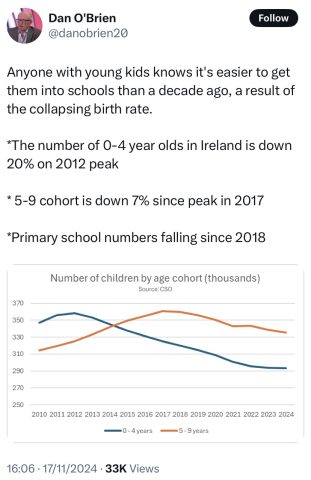
Peadar Tóibín’s Aontú has gone to great lengths to point out that primary school numbers have been falling since 2018, and I wholeheartedly agree that this should be seen as alarming, and sad. Because behind the demographic doom is a quiet tragedy of people having either none, or far fewer, children because they can’t afford the house.
Taking all of this into account (throw in the dark nights and bad weather, compared to the sunny, golden beaches of Aus) the case for living in Ireland, as a young person, is dwindling.
While Portugal has long had its problems, affordable rents and pleasant weather have lured in foreigners, including the Irish. It’s interesting that the number of Irish choosing to live there has soared by more than 416% since 2013.
Portuguese border and immigration authorities recently reported that Irish citizens calling Portugal home increased from 805 in 2013 to 4,159 in 2023. It’s inevitable that the tax incentives proposed by the Portuguese government (which will also apply to non-citizens) will be uber attractive to the mobile young, who increasingly put being able to work from anywhere as a priority when looking for jobs. (So much so that research from earlier this year showed that half of Irish workers would be willing to turn down a job offer if it didn’t come with an option to work from home).
When it comes to our own fleeing young people, it’s little wonder Australia is calling. And Canada. And New Zealand. And the UK. And maybe even Portugal.
As the election talking shop enters its second week, I’ve yet to see a manifesto which includes a set of policies which would, in practise, go some way in stopping the youth haemorrhage from our shores. We talk often about the very real immigration crisis, but we must also consider the risk that we will face an all-out emigration crisis, one which has perhaps already begun. The government must compete to keep young people here.
Something similar to the soon-to-be adopted tax proposals from the Portuguese could be our last shot at stopping our own disillusioned youth from packing their bags.