Information supplied last week to Aontú leader and TD for Meath West, Peadar Tóibín reveals that two thirds of those who have applied for asylum in the Irish state over the past five years have failed to do so at point of entry.
Official figures show that almost 66% of the 28,117 persons who applied for asylum in the Irish state between the beginning of 2019 and June 2023 did not make any application for asylum at a designated point of entry or through some ‘other’ normal channel, but instead only later ‘subsequently elected’ to present themselves to the International Protection Office in Dublin.
There are surely questions to be raised around such a large number of applicants presenting in this fashion, in particular whether they have been advised to do so by NGOs who are familiar with the system. We previously referred to the claim made by the European border agency, FRONTEX, on the role played by NGOs in facilitating what is at the end of the day illegal immigration. There are no known claims, however, that any Irish based NGOs are among those which have been accused of effectively collaborating with criminal traffickers.
These are accounted for in the statistics as airports and sea ports, with a small number – just 219 or less that 1% of the total – who apply in some ‘other’ manner.
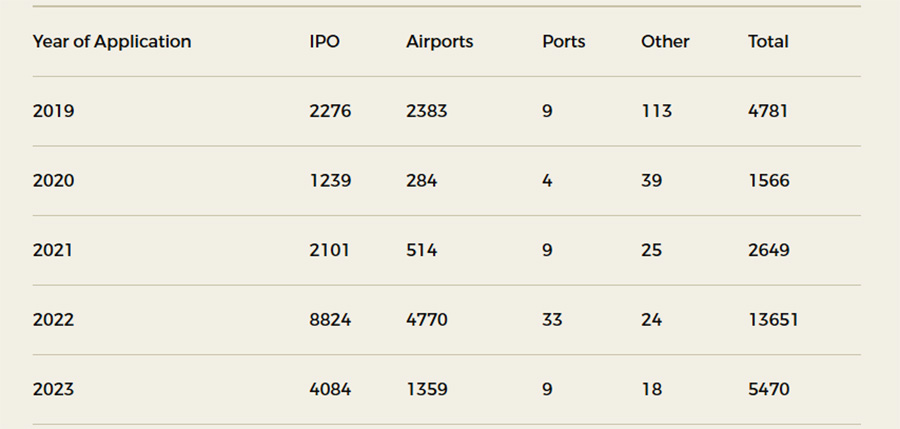
Tóibín had specifically asked Minister for Justice, Helen McEntee, for the number of people who had travelled into the 26 county jurisdiction from Northern Ireland in order to “apply for asylum.”
While the Minister stated that “information on how a person enters the country when not through a designated port is not recorded,” it is possible to gain some picture of what is going on.
While subtracting the number of those who have applied for asylum at point of entry from the total number of asylum applications does not supply an accurate number of those who have crossed the border from the north, it does provide some clue as to the numbers involved.
It is in any event clear that substantial numbers of people who apply to the International Protection Office have obviously travelled here from Northern Ireland having been able to make the journey there from other parts of what is technically the same legal jurisdiction of the United Kingdom without their being required to present any documentation for that purpose other than a boat or plane ticket.
These items appear to magically disappear when people apply for asylum south of the border.
Which, of course, means that that they either failed to make an application for asylum in the UK, as they ought to be obliged to under the Dublin Convention, or that they have made a previous application on arrival in the UK but then decided that the Republic of Ireland offers better opportunities, particularly for the large majority of those seeking asylum who have travelled from a country in which there are no wars nor other human rights crisis to justify their being granted protection in either the UK or in Ireland.
Those genuinely seeking asylum tend to be less likely to “shop around” from one safe country to another.
What the official figures show is that of the 28,117 persons who applied for asylum in the Irish state between the beginning of 2019 and June 2023, 18,524 managed to avoid making any application at a designated point of entry or through some ‘other’ normal channel, but instead subsequently presented themselves to the International Protection Office in Dublin.

How they came to be here, or indeed how long they had been here prior to making such an application is a matter of conjecture. It is a fair surmise, however, that they either entered the jurisdiction illegally, or that they arrived in Ireland for some other reason and subsequently decided to apply for asylum. Large numbers have obviously travelled here from Northern Ireland, Scotland, England and Wales.
Minister McEntee’s response to Deputy Tóibín is a good example of the delicacy with which Departmental officials account for such anomalies. Thus, the overall number of applications includes both the third of those who apply at point of entry and those “subsequently applying for international protection coming across a land border or when someone who has been residing in the country subsequently elects to apply for international protection.”
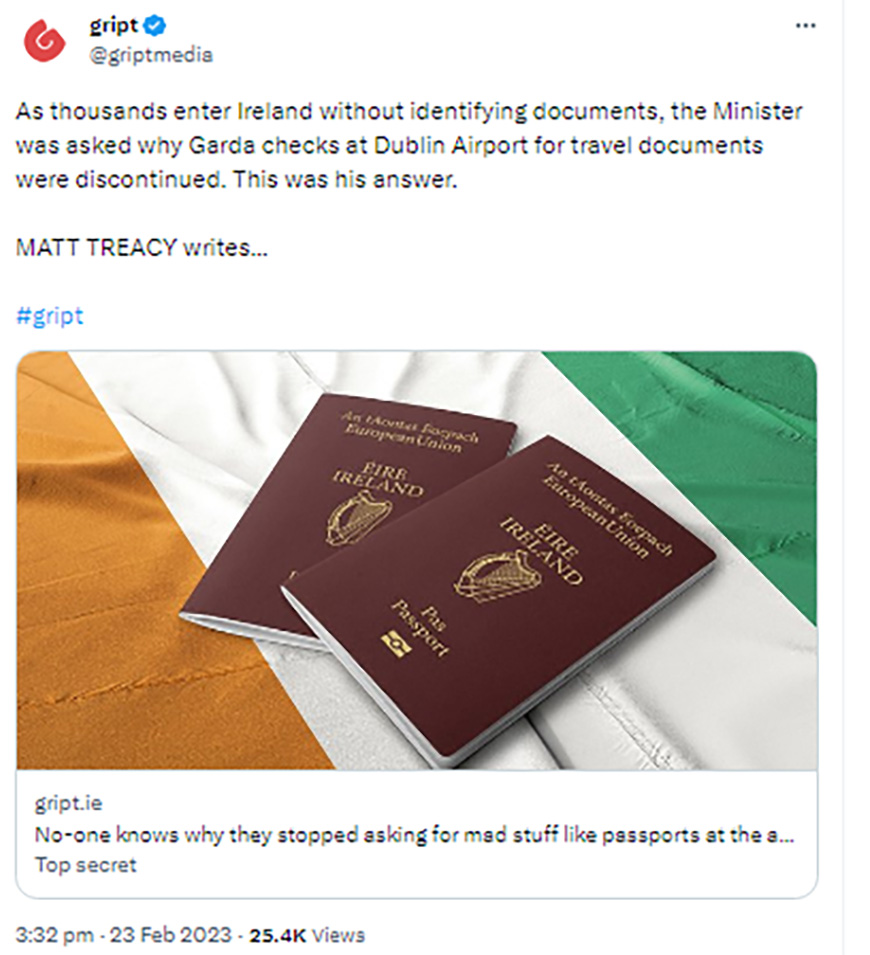
What is clear – and statistics on people who arrive without any with “false or no documentation,” a total of 5,074 between January and November 2022 alone, which Gript and others have accessed through Freedom of Information and Dáil questions, confirm this – is that the Minister and her Department are in effect referring to large numbers of illegal immigrants.
The related statistics on those who have applied for amnesty and on the numbers of people detected who fall into the category of illegal immigrants also back up this perception. And to return to Deputy Tóibín’s specific question, it is apparent that large numbers of those who do enter the country illegally cross the border between the two jurisdictions on the island.
Similarly, the official statistics on the number of deportations which take place in comparison both to the likely numbers of illegal immigrants the numbers of those issued with deportation orders in comparison to those who actually leave – just 11% between 2018 and May 2023 – indicate that it is a problem that the Irish state has so far failed to tackle in a meaningful manner.
