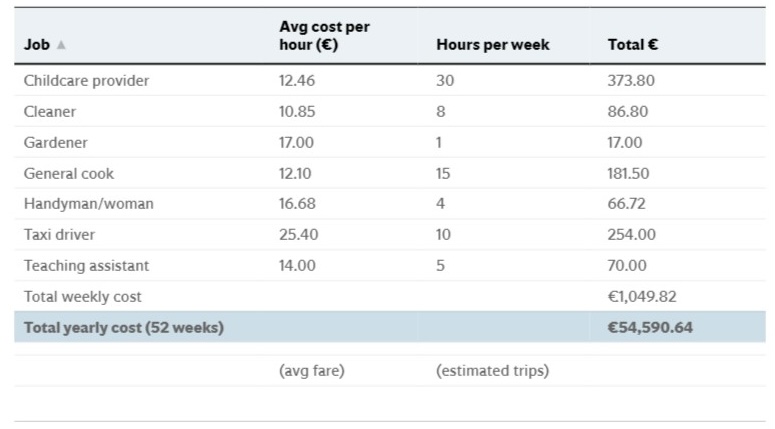
A new study has estimated the cost of employing someone to do the work performed by a parent full-time in the home at around €54,590 per year – and also found that value is under-estimated by more than 90% of people surveyed.
The research, from life insurance and pension provider Royal London Ireland, estimated the monetary value by researching the cost of employing someone to do the everyday jobs of a of a full-time parent, including cooking, cleaning and bringing children to various activities, using live wage data.
That value increased up from the €53,480 estimated in 2022, today’s report found.
The annual ‘survey found that more than 90% of people underestimated the value of the work of a parent full-time in the home, with only 8% valuing the job at over €50k.
The survey of 1,000 adults estimated the potential salary of a stay-at-home parent at an average of €30,547 in 2023, an increase of €2,087 or 7.3% compared to 2022, the report said.
The study found that women are more likely to accurately estimate the value of stay-at-home parent duties.
272,318 people in Ireland recorded their principal economic status as ‘looking after the home or family” – with women making up 90% of those who ticked that option in Census 2022,
“Each year we ask the same question and each year we’ve found that most people underestimate the likely ‘salary’ of a stay-at-home mam or dad,” said Karen O’Flaherty, Senior Propositions Executive of Royal London Ireland.
“While the role of the stay-at-home parent is often described as ‘priceless’, it is interesting to see how some people can misconceive the role of a stay-at-home parent and the financial cost,” Ms O’Flaherty said.
“The work done by stay-at-home parents is often referred to as “invisible labour” because it takes place within the home and is not as visible or measurable as paid work outside the home. Interestingly, our evaluation of what it would cost to employ someone to perform the duties of a stay-at-home parent was 79pc greater than the salary estimated by our respondents at €30,547. That highlights just how many people may not be fully aware of the multifaceted responsibilities made by stay-at-home mams and dads,” she added.
“It’s understandable that, without doing the calculations, many people, particularly those without children, may not accurately estimate what the cost would be to replace the stay-at-home parent. An accurate evaluation of this cost, from a financial planning perspective, is an important figure to contemplate by every family. If something were to happen to a stay-at-home parent, stopping them from be able to carry out this vital role, or if they were to pass away unexpectedly, their loved ones could be left with a large financial gap to fill during what would already be a very difficult time. And while money can never replace a parent, having adequate financial protection in place can help provide families with a financial safety net to meet some of these parenting costs,” she said.
A recent survey of US women conducted by Motherly, an advocacy group, fond that a quarter of American mothers now identify as stay-at-home parents—a significant rise from 15% in 2022,
The most common motivation for the mothers surveyed was wanting to stay home with children.
A 2016 survey by Amárach for Iona Institute found that only 17% of mothers with children under the age of 17 would opt for full-time work if given a totally free choice.
Respondents also were far more likely to say that women who work in the home are undervalued by society compared with women who work outside the home.
When asked, ‘If money were no object, and you were free to do whatever you wanted, would you stay at home, would you work full time or would you work part time?’:
- 35 percent of women with children under 17 said they would prefer to stay-at-home full time
- 48 percent would opt to work part time
- 17 percent would opt to work full time outside the home.
The respective figures for men were 18 percent, 45 percent and 37 percent, the survey found.
Respondents were also asked: ‘Which does society value more, women who work in the home, women who work outside the home, or both equally’?
16 percent said women in the home were valued more, 37 percent said women who work outside the home are valued more, while 46 percent said both are valued equally.