A since-deleted Twitter comment by Tipperary singer Gemma Hayes has provoked a good deal of comment since it was posted yesterday afternoon. While the legal issues regarding travel within the EU and the previous history of convicted murderer, Jozef Puska, are more complicated than portrayed, they are surely more pertinent than the attempts to use the murder as a bludgeon to make completely unrelated points that suit a particular political agenda.
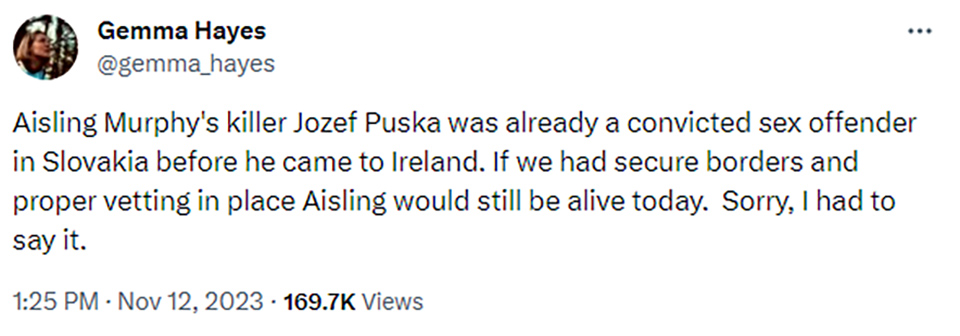
The vast bulk of the responses seem to be supportive other than the predictable accusations of racism, and so on.
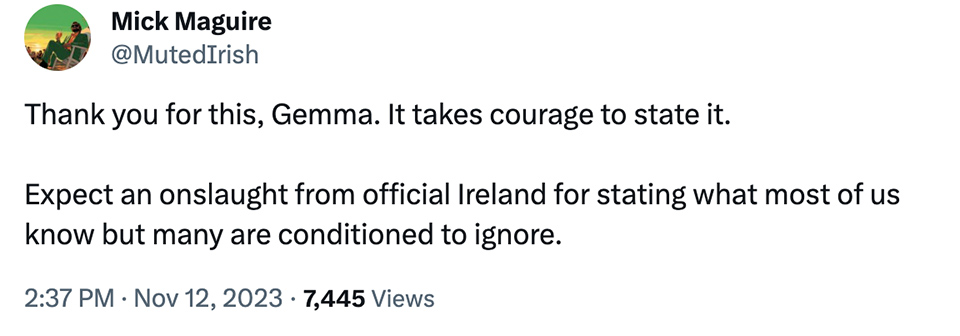
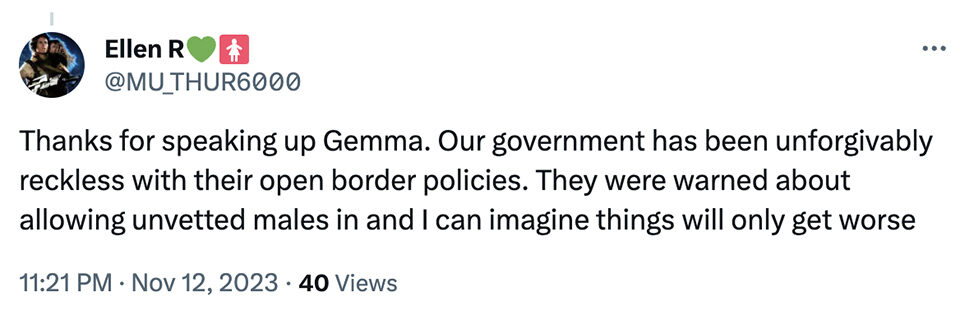
It is perhaps symptomatic of the nature of the public discourse in Ireland that being well known in a sphere unconnected to that formal debate guarantees attention for broaching subjects when few others dare to speak out.
The reason being, of course, that as some of the reaction has indicated, there is the likelihood that anyone thinking or speaking outside of the box around which are placed ever vigilant and censorious gatekeepers will bring with it the threat of condemnation and even punitive sanctions unless the dissident quickly apologises. We saw this previously with Kellie Harrington who commented on the rape and murder of a child in France.
What is evident in all of these controversies is that the grim reality of what was being referred to is mostly quickly lost in a pile on that insists on semantics and “facts” that they are notably promiscuously remiss in applying to their own efforts to bend such dreadful events to their own purpose and benefit.
In this instance, for example, it is quite clear that the reasons Puska murdered Ashling Murphy had nothing whatsoever to do with the Catholic Church, single sex education, the GAA, some uniquely strain of Irish “toxic masculinity,” or even the rearing of boys by their parents who of course are themselves the product of a “deeply conservative society.”
Some of the respondents appeared to be more concerned about “freedom of movement,” something that few of its proponents in the context of the EU and migration had any problem in supporting being curtailed during the Covid lockdowns.
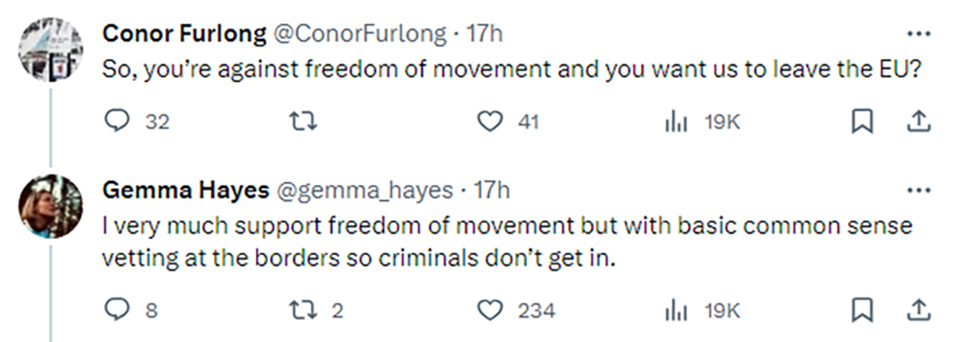
It is unfortunately true that the current rules within the EU allow very few means to restrict anyone travelling to another state, but they do exist, Some states require that serious offenders register in their new abode, and there is of course the provision to deport people, including EU citizens as has happened in a small number of cases here, as we previously documented.
There is a substantial section of the still in force Immigration Act (1999) which in Section 3 sets out a whole range of provisions for the deportation of individuals including those who have been convicted of criminal actions within the state, but also even to be applied, in Section 3 (3) i to a person “whose deportation would, in the opinion of the Minister, be conducive to the common good.”
Section 3 (6) expands on this to refer to a list of considerations that would need to be examined when determining whether a person might be deported; including their employment record, their character and conduct both within and outside of the state including possible convictions, as well as “considerations of national security and public policy.”
The fact that the Irish state fails to apply all of this rigorously does not evade the fact that there is considerable scope for deporting any non-national whose presence here might be adjudged to be contrary to the common good of those already here.
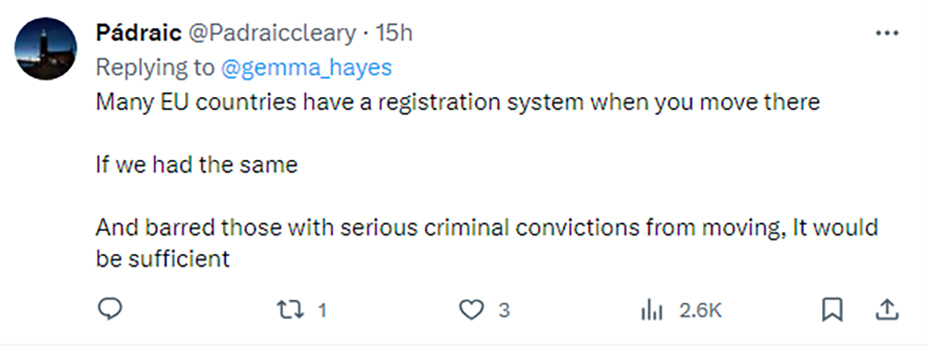
What the debate provoked by the Gemma Hayes tweet proves again – and it will be interesting to see whether it is simply ignored or piled on – is that there are a vast range of concerns that are simply not factored into the discourse on immigration here.
There have been signs that this has started to change, an indication perhaps that some politicians are beginning to listen to the people who elected them, and it is a debate that needs to take place.
There is no point in dismissing people’s worries about crime and other abuses by persons who, even where they are legitimately here as EU citizens, are obviously purely resident in order to take advantage of the social welfare system and other public provisions including housing. It is only in the context of such a debate that all of the issues can be properly looked at.
Photo Credit: rogerwoolman.com / Wiki / CC CCBY3.0
