Judge Martin Nolan is being criticised on social media again this week, as always because of a controversy around sentencing . But, as I explain below, an even bigger issue is at play here, primarily that ridiculous sentences continue to be handed down for the possession of child abuse materials because the issue is not a political priority.
On Tuesday, Judge Nolan handed down a suspended two-year sentence to Richard Hayes of Kilcock, Co Kildare, who was caught with horrendous child sexual abuse images and videos on two phones – including a toddler being raped, and a boy with a disability being forced to perform oral sex.
What kind of message is being sent by these ridiculously lenient sentences, which do not reflect that children, sometimes toddlers and babies, are being raped, beaten and tortured so that some sick monsters can get their kicks?
What are we telling deviants who are thinking of seeking out this material – which is only produced because there’s a market for it – when they are treated with what they might see as sympathy and understanding instead of being locked up for a very long time.
I’m not person who necessarily takes a default position of being tough on crime. I understand that sometimes people have the misfortune to be raised in very tough circumstances and live extremely disadvantaged lives, but we’re not talking here about robbing handbags or stealing cars, much as I don’t like it when my handbag is nicked.
The production of child sexual abuse images – the rape and torture of children for the sexual gratification of others – is a cancer in our society. Handing down suspended sentences to those who create the market for this vile, evil trade by downloading it, purchasing it or sharing it is sending the absolutely wrong message to those who might, as the court heard, be led “down the rabbit hole” of viewing child sexual abuse material.
MITIGATING CIRCUMSTANCES?
Hayes has no previous convictions, and the court heard he felt shame and remorse. So what? It is infuriating to see suspended sentences being handed down on these flimsy grounds – and because Nolan said he believed it was unlikely Hayes would re-offend. One child sex abuse survivor, Colin Power, previously criticised the excessive use of mitigating circumstances, saying:
“’He’s had a hard life, he’s not the brightest, he’s a hard worker, he has a good family supporting him’ — I don’t think any of that should matter. So what if he has a good family? That says something about them, not about him. He’s done wrong and this just makes excuses for why he shouldn’t have to pay for it. It allows others to excuse themselves for doing the same.”
That’s an important insight, in my view. “It allows others to excuse themselves for doing the same.” Colin Power is right: and if we send a message that watching children being raped doesn’t warrant a custodial sentence, then we are saying we – because these sentences reflect us as a society, whether we like that or not – don’t take child-rape that seriously.
It’s 6 years since Judge Melanie Greally, jailing Peter McDonagh for two and half years for possession of almost 1,000 sexual explicit images with some featuring children as young as two years old, said that the the production of these images “necessitates the abuse of children” and that “the need for deterrence could never be greater”.
Instead, we’re seeing case after case where those who download child sexual abuse or exploitation imagery are getting suspended or ridiculously lenient sentences. Fatima Gunning wrote on this platform just two weeks ago, that a woman who sexually exploited her own 8-year old daughter for perverts online walked free.
“What do you have to do to go to jail in this country?” she asked. You’d think that sexually exploiting a child would be a sure fire way, but it isn’t.”
The Sentencing Guidelines on child pornography (a terrible and misleading phrase) says that “Deterrence is also particularly important in sentencing for offences of this nature.” Why is that not reflected in sentencing?
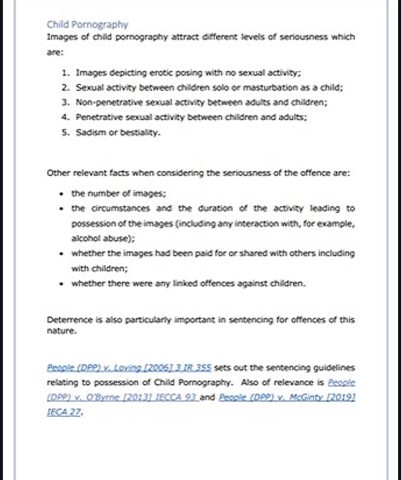
Well, as John McGuirk has pointed out, partly because of what comes next in that very same sentencing guideline – a reference to a series of court cases where superior courts either refused appeals by the DPP against the leniency of sentences or overturned longer sentences handed down by a lower court.
As John explained:
Carl Loving, an American immigrant and convicted conman, had been found with 783 images of child pornography. He had also conned several victims out of money; failed to appear in court; and generally behaved as a disreputable character. As the appeal verdict notes, “the trial judge expressed regret that the maximum sentence for the (child pornography) offence was five years imprisonment”, and imposed the maximum. In other words, the Judge had wished to impose a longer sentence than five years, but ran into a hard limit imposed in legislation. Nevertheless, Loving appealed.
The court of criminal appeal, in a decision by now-retired Judge Nial Fennelly, sided with Loving, and reduced his sentence to six months imprisonment. The court found that Judges have a duty to take mitigating circumstances into account, declared that the offences were on the lower level of seriousness, and reduced Loving’s sentence on the headline count to six months imprisonment, which he had by that time already served. Loving walked free from jail shortly thereafter.
DETERRANCE
It’s a source of much frustration to read all three of the rulings linked in the sentencing guidelines: because even though it is sometimes acknowledged that level 4 images (rape and sexual assault of children) are involved, and that deterrence is important, lenient sentences are upheld and custodial sentences are overturned.
In DPP versus McGinty, for example, where the DPP appealed a fully suspended sentence handed down in the Circuit Court to Steven McGinty for possession of child pornography, the judges say:
Cases of this nature are ones where the question of general deterrence must weigh heavily. The fact that the offence occurs in private and is relatively difficult to detect, as well as the fact that the victims are themselves deprived persons with no voice means that deterrence plays a particular part in sentencing, and places a premium on the need to deter those who might be tempted to engage in such conduct.
Further, they say that the DPP’s submission that “in child pornography offences, more than in many other serious offences, there is a greater need for general deterrence to discourage engagement with pornographic images involving children” is “well made that the offence is one which is capable of being committed in private and surreptitiously and there exists a potential that large numbers of offenders may go undetected.”
And they say: “We might add that it is of course vital to remember that real children, many of whom live deprived lives in impoverished parts of the world, are victims of vile sexual practices in which anyone viewing this type of pornography, is by, definition, complicit. It is an oversimplification to suggest that anyone engaged in such conduct is, in truth, at arms length from it.”
But the same judges then found that the judge in the lower court took mitigating circumstances into account and did not exceed the margin of appreciation in sentencing. The suspended sentence was not overturned.
The other ruling. in DPP vs O’Byrne, is in some aspects, even more frustrating. The court was asked to consider the appeal of a 3-year prison sentence handed down to Bryan O’Byrne for possession of 3,200 images of “unspeakable degradation”, and in which, the court acknowledged “the ages of the children in the images ranged from very young children to early teenagers.”
“Perhaps the best indicator however of what was involved can be obtained from a consideration of the succinct search term used by the appellant to seek and obtain these images: “Baby paedo kidnap rape and snuff””, the appeal court said.
3 years? People who search for images of baby rape and murder should never see the light of day again, in my opinion. But O’Byrne was appealing the severity of his sentence and, incredibly, the appeal court agreed that the “sentence of three years imprisonment is excessive, and did not give sufficient weight to the mitigating factors”.
There’s that phrase again: mitigating factors. Is it really uncharitable to say that while those who have a difficult life deserve sympathy, it cannot excuse being a consumer for an industry that kidnaps, tortures and rapes children for the sexual gratification of others?
Judges don’t like having their rulings overturned – and so the trend to hand out non-custodial sentences is exacerbated. It is appalling. The gardaí and legal experts working to prosecute those involved in this repellant, monstrous business must feel that every perpetrator who walks from the court without a day behind bars is laughing at them.
What has happened since Loving is that every pervert caught with child abuse material will argue that the images or videos they possess are at the “lower level of seriousness” and that they have had a sad, hard life. And since sentencing does also require consistency, the number of suspended or lenient sentences seems to be ever-increasing. The perps must be laughing at the system.
A 2019 analysis by journalist Caroline O’Doherty for the Irish Examiner found that:
Five years’ imprisonment is the most a judge can impose but in reality it is hard to find a case where that has actually happened.
Over the past year or so, judges around the country have pronounced the evidence presented to them to be reprehensible, vile and deeply concerning and one even declared there was a need for greater deterrence to stop the crime. Their sentiments were undoubtedly genuine — some were dealing with cases where the number of images and videos accessed by a defendant reached tens of thousands, or where the victims were babies, or where the level of depravity involved was sickening in the extreme.
And yet, in looking back over dozens of cases in the last two years, none cropped up where the maximum custodial sentence was imposed.
“The sentences are pitiful a lot of the time,” Colin Power told her. “If there’s lenient sentences or if there is totally suspended sentences, that’s not proving a deterrent to somebody who’s sitting at home accessing these horrific images. If they saw proper sentences, it might make them think twice about it.”
As John McGuirk wrote, change must be led by the legislature. There is little point in getting angry online with Judge Martin Nolan or other judges handing down lenient sentences, however understandable that reaction may be.
The people who do have options here are the politicians, who have the option to change the law in regard to the possession of child abuse imagery, including by imposing via legislative change a mandatory minimum sentence encompassing jail time. That this has not happened is a matter of political priority.
We need to make it a matter of political priority. The law must change – the maximum sentence of five years must be significantly increased to reflect the depravity of the crime, and this appalling trend in sentencing reversed.
Otherwise we continue to send a deeply disturbing message to those who pay to watch children being tortured and raped – that a suspended sentence indicates how much we really care.