LOOKBACK: This article was first published Easter 2023
_ _ _ _ _ _ _ _ _
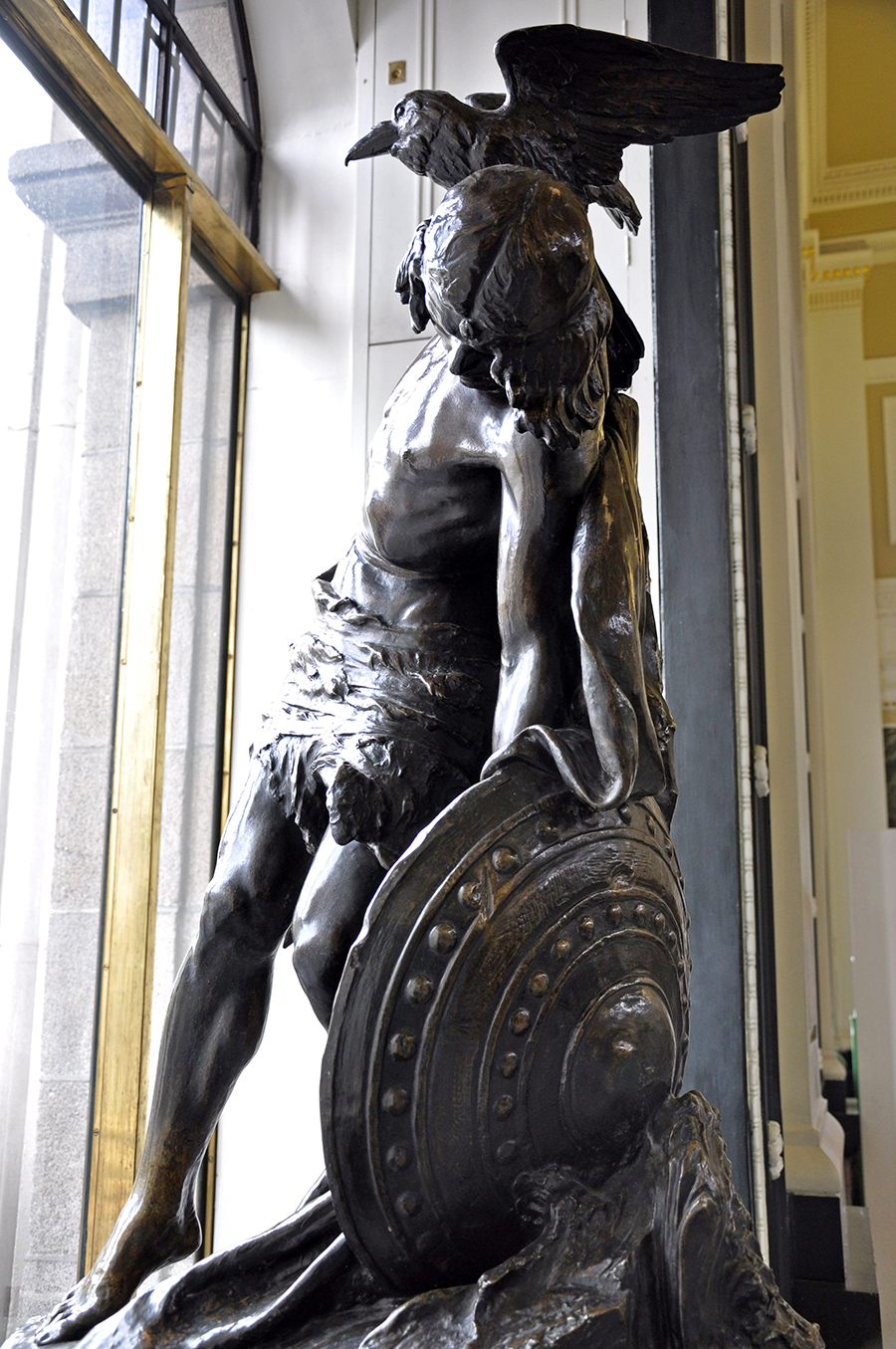
In 1935, sculptor Oliver Sheppard was commissioned to produce a statue to commemorate the 20th year anniversary of the Easter Rising. His statue of the death of CúChulainn was to take a prominent place in the symbolic and military HQ of the Rising, the GPO. It is there still for all to view.
Sheppard chose to represent the spiritual essence of the nation with a symbol of heroic constancy. Like Pearse, he excavated the mythic past for a symbol and a heroic example to inspire a bruised and pauperised nation.
This scene of CúChulainn strapped to the stone, defiant to the end, represented not just a heroic past, but a will to ensure the future of the nation through deeds and sacrifice. It was an appropriate symbol for the pecuniary times that were; and as a counter symbol to that engendered by the brutality and fratricide of the civil war.
It is still an appropriate symbol for today, as Ireland endures the two pronged decay of globalist neo-liberalism and the loss of sovereignty through pan-national federalisation.
In our present cultural milieu, where the concept of nation causes an aesthetic affront to the credentialed elite who run the political and cultural institutions of this country, such a notion is seen as an embarrassment. But what exactly has been offered instead, on what vision was it based? What do commemorative monuments represent? What do they serve?
All across Flanders are hulking memorials to the slain of the Great War. Gargantuan follies on the landscape, they bear the inscribed names of thousands upon thousands of slain men.
One poignant example, the Thiepval Memorial, built to remember the Somme, is a massive assemblage of arches; a folly in ziggurat form which reaches and strains towards the eternal sky.
The striking thing about it are its massive foundations. Its two huge pedestal feet that support that upper arch. No fine pageantry in its upper cornices, no decorated frieze signifying the lasting splendour of the culture that produced it. Its great nondescript hulk is a monument to the folly of inhuman ambition and industrial scale destruction.
For this is truly a critical metaphor of the arrogance and hubris and the calculations of two empires striving to reach to the skies and to equal God. It rests on two gargantuan feet, is as if to say that this ambition must necessarily rest on the bodies of all those millions buried in this soil. Its base holding up those arches; holding up those ambitions; is inscribed with the names of 72,000 soldiers who all now remain in the soils of Flanders. It implies that this metaphorical Tower of Babel could not have been attempted without the sacrifice of all these human lives.
This is an appropriate monument to those who died here, because the real critique of this war is a critique of its savagery and its pointlessness and the sallow vision and ambition of those who initiated and conducted it.
Its sheer size; its inelegance; its lack of beauty; are a metaphor for the folly of the Great War. The ziggurat structure, reminiscent of that Tower in Babel, is perhaps its greatest symbolic value. For it was this ambition: the ambition to create and to dominate, that initiated the industrial destruction of human life and the loss of innocence; and in a modern sense, the questioning of God.
If there was any doubt that both sides were equally gung-ho for this war, the account laid out by Barbara Tuchman in The Guns of August laid that to rest. Both the Anglo, French and the German side were enthusiastic to an inexplicable degree for the war. It was a jingoistic phenomenon that was very realistically portrayed in last year’s All Quiet on the Western Front.
The inscription of the names of all of those otherwise anonymous soldiers is appropriate because an exegesis of the ideas that brought us to that war can only produce a critique of its futility and waste of life. So perhaps to commemorate each one of those soldiers who died on a gigantic folly, is the only appropriate way to mark the First World War
When the Irish state was seeking for a way to commemorate the rising of 1916, the unimaginative political elite seemed to just look abroad to Europe for a model to copy.
In fairness this is what they do for everything so that wasn’t a surprise. The fact that Micheál Martin expresses a loathing for what he calls “backward nationalism” hardly leaves this lack of historical awareness, or national sensitivity a surprise.
A wall of names of the fallen was the standard, so it was, of course, suggested as an appropriate way of marking the occasion. As I have argued, this was an entirely appropriate and sensitive way of commemorating the fallen in the trenches of WWI. It was in my opinion, not so for a commemoration of The Rising.
When it comes to commemorating 1916, a Necrology Wall misses the point, and doesn’t have the proper focus of a monument to 1916.
The monument, which stood in Glasnevin, was vandalized (an act which I do not condone) and later taken down.
Read the writings of Pearse and you feel the recall of a sense of nation, and you can see the germ of a resurgent cultural pride. These are the things that make the assertion of nationhood possible.
Perhaps it’s no wonder the 1916 committee – who had to pass sanction of the anti-national political class – tried so hard to avoid making this the centre of the commemorative events.
If we look back at the accounts of the aftermath of the Rising, it was not the conflict or the destruction that had made an impression on the national consciousness, it was the intellectual force of the proclamation and the nationalist intellectual vision portrayed in the writings of its leaders.
In an analysis of the Easter Rising, the thing that we as Irish commemorated was the vision of the signatories of proclamation. It was that extraordinary document, The Proclamation of The Irish Republic.
Sheppard’s monument implicitly embodies this. He knew, that how we commemorate the past both reflects our present values, and shapes our vision for our future. As George Orwell commented “Who controls the past controls the future: who controls the present controls the past”.
One feels that the Irish government are nervous of this and, in this age where international integration and the surrender of sovereignty are their greatest priorities, they don’t want to go anywhere near celebration a vision of nation.
Certainly not the “backward nationalism” of this statement: “We declare the right of the people of Ireland to the ownership of Ireland and to the unfettered control of Irish destinies, to be sovereign and indefeasible” – just one of the sentences read from the steps of the GPO on Easter Monday 1916.
It was the vision expressed in these words, informed by our history as a people, that we celebrated, not the war itself, nor even the deaths of those who were executed. After all we should always look askance at the loss of life. We celebrated the vision that they hoped would be lasting, and an event that would inspire the people of Ireland to live up to a vision.
That is the thing that as a nation we should commemorate, and it was the thing that most Irish people, despite the zeitgeist of global citizenship, did commemorate. If there is a lasting monument to be built to the Rising and the people who took apart in it, it should have the celebration of this vision at its core