This week the Museum of Artifacts shared a remarkable image of a “fabric womb” made by a French midwife in 1759 which led to a royal commission to reduce infant mortality.
The photo has since gone viral with hundreds of thousands of people marvelling at a window to the womb from the 18th century, long before scans, 3-D or otherwise were invented.
According to the Museum of Artifacts this is " a fabric womb made by Angélique du Coudray, a French midwife who was commissioned by King Louis XV to reduce infant mortality.
From 1760 to 1783, she traveled all over France, visiting poor rural women and sharing her extensive… pic.twitter.com/IPW7sm0dlP
— Haley Kennington (@ladykennington) November 2, 2023
The Museum says that the fabric womb was made by Angélique du Coudray, “a French midwife who was commissioned by King Louis XV to reduce infant mortality”.
At the time infant mortality was shockingly high, and was believed to be leading to a population decline, with one source saying that “200,000 newborns died annually in rural France due to insufficient, obstetric expertise”.
“From 1760 to 1783, she traveled all over France, visiting poor rural women and sharing her extensive knowledge with them. It is estimated that she trained some 10,000 women” the Museum explains.
“Du Coudray also invented the first lifesize obstetrical mannequin, for practicing mock births, and published a well-received midwifery textbook.”
Aleteia has more on the training provided by this remarkable woman:
Part of this training involved the use of a mannequin, known as “the machine,” that was made of wood, leather, fabric, cotton, and even bone. Designed by du Coudray, it focuses on the pelvis and demonstrates what happens to a woman in labor. She also went as far as to design the newborn baby with an open mouth with a tongue, which the midwife could place their fingers inside in the case of a breech delivery.
The model was given a patent by the French king Louis XV in 1759. He also gave the midwife a payment for her to set about training other women throughout France in a bid to reduce infant mortality.
Du Coudray traveled the country training not only midwives, but around 500 male surgeons and 30,000 students. Thanks to her dedication, she also managed to have maternity homes built in some of France’s larger cities.
There is no doubt that du Coudray’s impressive skills and strict attention to detail allowed for the successful training of generations of midwives, saving the lives of countless newborns and their mothers.
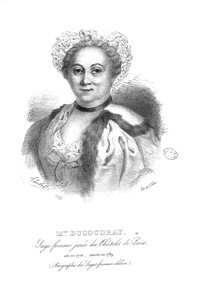
One paper recounting her extraordinary life says that “in a patriarchal society, Madame du Coudray knew how to stand out.”
“Since the 18th century, the midwife’s field of activity, which had been continuously changing and expanding, held some potential for conflict. While midwives were predominantly female until the 17th century and underwent an extensive education, from the 18th century on, they were increasingly confronted with academically privileged male physicians who scientifically shaped the field of obstetrics with additional and advanced skills.”
“To better distinguish the role of these supposedly better educated and trained male surgeons, the obstetricians, in childbirth from that of the midwifes, the term “man-midwife” was introduced.”
“This contrast is exaggeratedly reflected in the cartoon A Man-Mid-Wife by the Scottish painter and caricaturist Isaac Cruikshank and is still controversially discussed today. Madame du Coudray’s engagement certainly contributed to building bridges between these two disciplines of one and the same profession.”
The paper shows du Coudray’s mannequins and tells more about her exceptional life in progressing maternal healthcare. It’s well worth your time: https://journals.sagepub.com/doi/10.1177/23821205221090168

Uterus with the mannequin of a fetus, umbilical cord and placenta. Musée Flaubert et d’histoire de la médecine, Réunion des musées Métropole Rouen Normandie.
