It was reported yesterday that the Cabinet is to approve a decision to move thousands of Ukrainians out of direct accommodation over the Summer. This is being heralded as a move to free up hotel rooms which have been diverted from the hospitality sector and to return student accommodation to its former use before the new term begins at the end of August.
While the piece by John Drennan quotes a government source who claimed that the number of Ukrainian refugees has fallen from “114,000 to 80,000” that is out of line with the latest European Commission statistics on Beneficiaries of Temporary Protection (BOTP.)
According to Eurostat figures to the end of March, there were 111,770 Ukrainians living in the Irish state. That figure is very close to the total of new Personal Public Service numbers (PPSN) since Ukrainians began to arrive here in large numbers after the Russian invasion at the end of February 2022.
According to the Department of Social Protection 111,855 PPS numbers were issued to Ukrainians up to April this year. That would equate to the overall number of Ukrainian refugees who have been granted Temporary Protection but does not necessarily mean that all of those people are still here.
There have been various estimates of the numbers who have left the state, either to return home to Ukraine or to move to another EU state. One based on active PPS numbers – as measured by persons claiming social welfare or paying tax – put the figure at around 28,000.
Nonetheless the numbers of Ukrainians arriving here continues to grow, albeit at a slower rate. There were 1,885 new PPS numbers issued to Ukrainians between January and April which would suggest that the total for the year will be close to the 10,238 Ukrainians who arrived in the state and were issued with a PPS number in 2024.
The overall number of refugees arriving has fallen sharply from more than 66,000 in 2022. According to figures supplied by Minister Norma Foley to a Parliamentary Question on April 29 a total of 109,976 Ukrainians had been granted Temporary Protection up to the end of last year. Which is very close to the number of PPS issues.

The number of Ukrainians in state accommodation has fallen from over 48,000 to 29,301. The new Government decision will further reduce that by 4,000 it is claimed. There are also anecdotal, and so far unsubstantiated, claims that those numbers are inflated and that there may be a discrepancy between the number of BOTPs who are supposed to be in state accommodation and the numbers who actually are in direct state care.
Gript understands that this has been raised by a number of people and that Government members are not only aware of this, but that this is one of the reasons why the state is changing its policy on accommodation and taking a more hands on approach to the contracting of premises, particularly in the hospitality sector, for the accommodation of Ukrainian BOTPs.
That follows earlier decisions which reflected criticism including from within Fianna Fáil and Fine Gael regarding the perception that the Irish state was offering significantly more generous provisions to Ukrainians than other EU member state. Clearly this was acting as a pull factor and had contributed to the situation that the Irish state had, and still has one of the highest per capita numbers of Ukrainian BOTPs in Europe, matched and surpassed only by front line states with a land border with Ukraine.
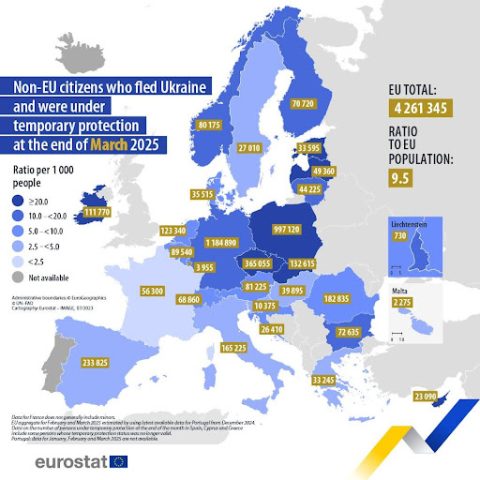
Not only that but as the map starkly illustrates, the Irish state has both a higher per capita level of Ukrainian refugees compared to much larger and indeed closer member states, such as France, but has twice as many actual Ukrainians under protection than France which had 56,300 at the end of March, although the French figure excludes minors.
In an effort to reduce the attraction of Ireland compared to other EU states, in January 2024 the Government slashed the payment for new arrivals from €232 a week to €38.80. That would appear to have had a significant impact on numbers although unlike most other states, the numbers arriving are still increasing.
In her reply to Fianna Fáil TD for Galway West, Minister Norma Foley also stated that last year 420 contracts for the accommodation of Ukrainian refugees had been ended. She claimed that this had freed up “around 15,000 beds, the majority of which returned to the tourism sector.”
We have yet to see proof of that, and the next release of payments from her Department may tell a tale. However, it is the case that many of the contractors who had been or are providing accommodation for Ukrainian refugees are changing over to International Protection applicants, and those numbers seeking accommodation continue to increase.
That fact, coupled with a whole new raft of applications for exemptions to change over to new IPAS centres, as illustrated here on almost a daily basis, will mean that the accommodation sector will continue to provide a headache for the state as it seeks to address community and business opposition.