The Polish general election, along with numerous referendums, will take place on Sunday, 15 October: the polls suggest outcomes are almost too close to call as many polarised issues will define the election, writes Sarah Hardiman.
Poles will decide on who to appoint to the two houses of Poland’s National Assembly, the Senate (upper house) and the Sejm (lower house). The socially-conservative nationalist Law and Justice party (PiS), who currently hold power, is formally headed by Mateusz Morawiecki, the Polish PM. However, it is Jaroslav Kaczynski, Poland’s Deputy Prime Minister, who is the de facto leader of the government which now seeks a third term.
Donald Tusk, former president of the European Council and also previous Prime Minister of Poland, is fighting to regain the premiership of Poland – a role he last held in 2014. He serves as head of the Civic Coalition (KO), a group of parties running together, comprising his own liberal pro-European Civic Platform party (PO). KO are the current opposition coalition.
Polish elections see dozens of parties enter the race; for this reason parties run jointly in coalition groups. Parties in Poland faction into very specific lines, resulting in numerous, niche party movements.
[Below is a screenshot of Politico’s summary of the coalition groups taken from the following: https://www.politico.eu/europe-poll-of-polls/poland/]
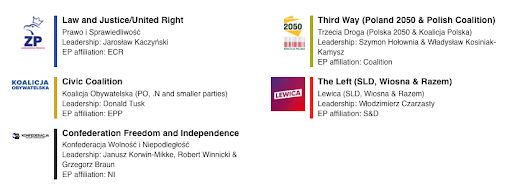
The ruling PiS coalition claims to stand for Polish sovereignty, identity and principles, with Deputy Prime Minister Kaczynski pointedly stating that Mr Tusk has put foreign interests above those of the Polish people, even accusing him at one point as acting as an agent for Berlin. “The Germans want to embed Tusk in Poland to sell off common property, his background shows it directly,” accused Kaczynski earlier this year. Kaczynski also referred to Tusk, publicly, as “pure evil.” Tusk has also levelled accusations of corruption at PiS.
Although the Deputy PM was absent from the main televised debate on Monday, after pulling out from participating shortly before the event, there were no swoons spared on the exchanges between the Prime Minister, who attended instead, and Tusk, who dominated the coverage which included all leadership candidates. The PM accused Tusk’s potential rule of being one which would see the forfeiting of national forests and other resources to foreign interests. Tusk recalled scandals embroiling PiS and accused the media operation of being “PiS functionaries“”. Some commentators acknowledged the debate moderators’ bias in their line of questioning, also.
Many comparisons were drawn between Tusk’s rule and Kaczynski’s in the debate. Kaczynski’s group has led many positive initiatives for Poland. They remain a popular party in rural areas, where they dominate the polls. They have improved much of the travel infrastructure of Poland and reopened many police stations closed under Tusk’s regime. From 2012-2021, the GDP for Poland has risen by 3.2%.
Referendums
In addition to the election, Sunday will also be an opportunity for Poles to vote on four referendums. The questions raised at the television debate certainly reflect the contentious suspicions held by the main parties of one another.
When Kaczynski announced the referenda in August, he made it clear that he was wary of Tusk’s intentions as a potential leader, and used this as an opportunity to poll the public of Poland on their opinions. “The voice of ordinary Poles is always decisive” said Kaczynski, who’s first vote to the people will be on the sale of state-owned enterprises. In a social media post on X, formerly Twitter, he claims “The Germans want to embed Tusk in Poland to sell off common property, his background shows it directly.”
Polls put Tusk’s KO at 30%, with PiS closer to 35%. It is unlikely either group will be able to form a government alone and will be forced to enter a coalition with another group. The Confederation group, which is right-wing, would possibly help PiS to retain their power, as they are currently polling at 10%. The Confederation’s message is one of strong anti-establishment sentiment, so they may be less keen to join forces. It is possible smaller parts of Confederation could join PiS to form a minority government.
PiS’s success may come down to its refusal to redraw electoral lines, leaving urban areas with fewer MPs, which will in turn weaken the chances of success for liberal-leaning KO. Warsaw should hold 34 seats, rather than the 20 it will have on Sunday, according to an electoral watchdog.
The other questions raised in the votes ask the Polish public for their position on the increase of the age of retirement, the removal of a barrier border with Belarus and the potential mirroring of the immigration policy of the EU.
Migration, cost of living and future Polish concerns
Two of the four questions asked in the referendums will ask for the public to voice their opinion on the matters relating to migration. Famous for skirting the EU policies on migration, Poland has a population of just under 38 million people, and has already accepted over 2 million Ukranians since the escalation in 2022 of the Russian conflict. It has taken a decidedly pro-Ukrainian position in the war.
It has made a point in the past of restricting migration from Islamic countries and has boasted a total of “zero” jihadist attacks in its nation as a result of these measures. The following video of PiS MEP Dominik Tarczyński, and several others by him, openly defend their position on migration to date and hail it as a success story:
Younger Poles do not appear to have as many ideological concerns as the front runner candidates appear to espouse. Much like Ireland, the cost of living and particularly home ownership is making their lives more strained than their older nationals. PiS has built a popular welfare initiative and provided for minimum wage increases in their time. They have significant control over the state institutions, and have aided in the cost of living crisis by keeping petrol costs very low, via publicly owned company Orlen which owns most of its petrol stations.
As the election draws near, it remains to be seen who will claim victory.