A play written by Pádraig Mac Piarais will be performed as Gaeilge in the open air in Gleann na Smól this weekend by Aisteoirí Thamhlachta, who say the play’s enduring themes raises question pertinent to modern times. Organiser Pól Ó Meadhra said that all were welcome to hear the play, and to hear music written for the first performance of ‘An Rí’ in the historical location.
On the King the ‘Eric’- Patrick Pearse’s short play, An Rí, packs quite a lot of questions
First Monk: “And are all guilty of the sins of the King? If the King is defeated it’s grief will be for all. Why must all suffer for the sins of the King? On the King the eric!”
Written in 1912, a year before Patrick Pearse was co-opted onto the inner council of the IRB, An Rí (The King) was first performed by the students of St. Enda’s, the school that Pearse ran in Rathfarnham, co. Dublin, that same year.
It is a short play but it comments on deep themes. Like all good art it doesn’t give a clear answer to the questions it raises. In fact, within the dialogues and themes and characters of An Rí we may be left with a more ambiguous understanding of human nature and our conception of morality.
The quoted line above reveals Hume’s dilemma of the “is” and the “aught” and expands on it as a sociological context. The “eric” Pearse’s first Monk speaks of is an Irish word which we could translate as the wages of sin. But it’s more than the very modern understanding of a personal debt for the sins of the individual, it is a combination of sin and fate. It is the cost of dysfunction; and all who dysfunction touches pay the price even though they may be innocent.
That is one of the themes that Pearse prods at in this enthralling morality play.

The Abbot, a complex character who has a wisdom of years of leadership and meditation but also an unempathetic hardness that allows him to sacrifice the most innocent amongst his community, answers his companion: “The nation is guilty of the sins of its princes. I say to you that this nation shall not be freed until it chooses for itself a righteous King.”
And that is one of the central themes of the play: can a society ruled by dysfunction produce good? Can a people led by a corrupt government thrive?
If the king in An Rí is the archetype of corrupt leadership, Giolla na Naomh is the opposing archetype. He is the only one for whom wealth and power has no attraction. The antithesis of the corrupt and violent king, he would rather worship God than go to war. Being the most un-tempted by power he is deemed the only one who can assume the mantle of a just king.
Ironically, the most unwilling becomes the only right choice for the role of king, but more revealing of socio-memetic dynamics, Giolla na Naomh becomes the Girardian scapegoat, who through his death heals the dysfunction that has festered within his society. It is hard not to see the comparisons to Girard’s scapegoat which gains its most revealing realisation in the death of Christ, an innocent victim who goes willingly to his death to atone for the sins of others.
The conclusion is that the wages of the sins of the leaders are born by the people. The dysfunction of society is visited on the innocent and it is not the tyrant who suffers from the corruption that festers within the society he rules. Looking back from a distance of over 110 years we know that in the years following Pearse’s death hundreds of millions of innocent people suffered and died under such rulers.
The play has three character components: a monastic community; the king and his soldiers; and a community of children or young men who seem to be acolytes of the monks. The Abbot is the most complex character of the play. He understands the flawed character of human nature and the conflict within the heart of man. His main protagonist is not a man but a spirit, which he is wary of; the animating spirit of war. This invades the hearts and possesses the minds of young men, and against this he knows his words and reason is weak protection.
“The old wait for death, but the young go to meet it,” he says.
“If into this quiet place, where monks chant and children play, there were to come from yonder battlefield a bloodstained man, calling upon all to follow him into the battle-press, there is none here that would not rise and follow him… That music of the fighters makes drunk the hearts of young men.”
But Pearse’s most insightful line is what sets off the desire for slaughter in the minds of the young men of the monastery.
One of the monks relates: “It is not the King’s case I pity, but the case of the people. I heard women mourning last night. Shall women be mourning in this land till doom.”
Strange to say, it is this moment of human vulnerability, which should move the heart to pity, which actually incites the spirit of death in the minds of some of the monks. It is a pattern we see in epic sagas throughout history. For instance, the siege of Troy starts with a description of the Acadians slaughtering the innocents of the plains around Troy. The sound of lamentation only spurs on a sadistic spirit which drives the warriors to greater cruelty. This is the spirit of slaughter which possesses rampaging armies and school bullies alike.
The Canadian physician and trauma expert, Gabor Mate, whose Dublin visit we covered here few weeks ago, describes the bully’s response to vulnerability: “in the eyes of the bully such unabashed vulnerability is like a red flag to a bull, inflaming the urge to attack.”
Pearse captures this demonic possession of the mind expertly with the contrast in this empathic portrayal of the feeling of grief, and the immediate excitement of the monks with the prospect of war. If we are to think of the spirit of war as the demonic force that celebrates the suffering of human beings, it doesn’t matter what the cause of the conflict is; the demons are winning once human beings are being slaughtered.
Another monk says: “battle is glorious! While we were singing our None but now, Father, I heard, through the psalmody of the brethren, the voice of a trumpet. My heart leaped, and I would fain have risen from the place where I was and gone after that gallant music. I should not have cared though it were to my death I went.”
The abbot understands at an intuitive level that the pull of the spirit is stronger than the reason of the mind.
This leaves him with a frightening realization: that the fervor that devotes a man to God can just as easily turn him to corruption. The Abbot opines that only experience can teach wisdom and so allows his charges to follow their own fate.
“There is a heady ale which all young men should drink, for he who has not been made drunk with it has not lived. It is with that ale that God makes drunk the hearts of the saints. I would not forbid you your intoxication, O young men!” he says.
When requested to, Giollas na Naomh accepts the duty of the king in the battle. The theme of duty and sacrifice are strong here. He goes to the battle and wins the field but dies in the process. He is brought back from the battle on a stretcher and laid out in sanctified state. Kingship is passed back to the old corrupt king.
This finale invokes what the French Philosopher, René Girard, describes as the scapegoat mechanism. The innocent are sacrificed bringing a sense of unity and peace for a while, and everything stays the same. The death of Giolla na Naomh brings about a cathartic unity of the people as they unite around a civilisational mission.
In the scapegoat mechanism, his death purges the disharmony and dysfunction of the society that has festered and grown. But society returns to how it was under the old rulers for all its dysfunction and resentment to build up again.
These are the thoughts that remain swirling in your head as we witness the sanctifying of Giolla na Naomh in the final scene of An Rí. The king, who had failed his people, resumes his position as king. Giolla na Naomh, who had no wish to fight, makes the ultimate sacrifice, and all those who spoke of the glory of war, took no part in it.
Pearse presents these themes with an aesthetic that mixes Christian symbolism with Old Gaelic visual language.
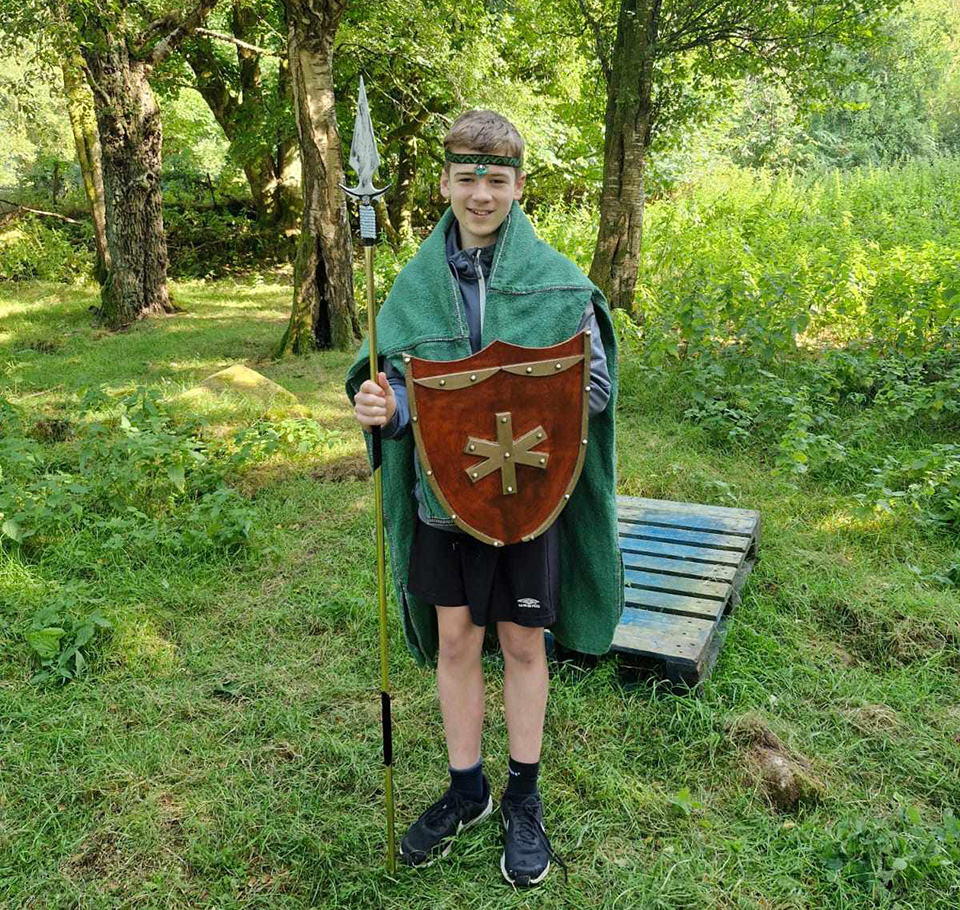
Giolla na Naomh is transformed into a king in a ceremonial rite reminiscent of ordination. The description of the king has a dense alliterative quality reminiscent of the roscanna of the Ulster epic, An Táin.
“Tá claomh colg-ghéar cinn-óir agus craoiseach chrann ramharcheann ghorm agus sciath dhearg dheargscnaithe dhealrach. Do chonacas lá I tdig m’athar é”
“He has a keen-edged, gold-hilted sword and a mighty-shafted, blue-headed spear and a glorious red-emblazoned shield. I saw him once in my father’s house.”
It is a luxurious mix of symbolism, deep themes and, and rich Irish language.
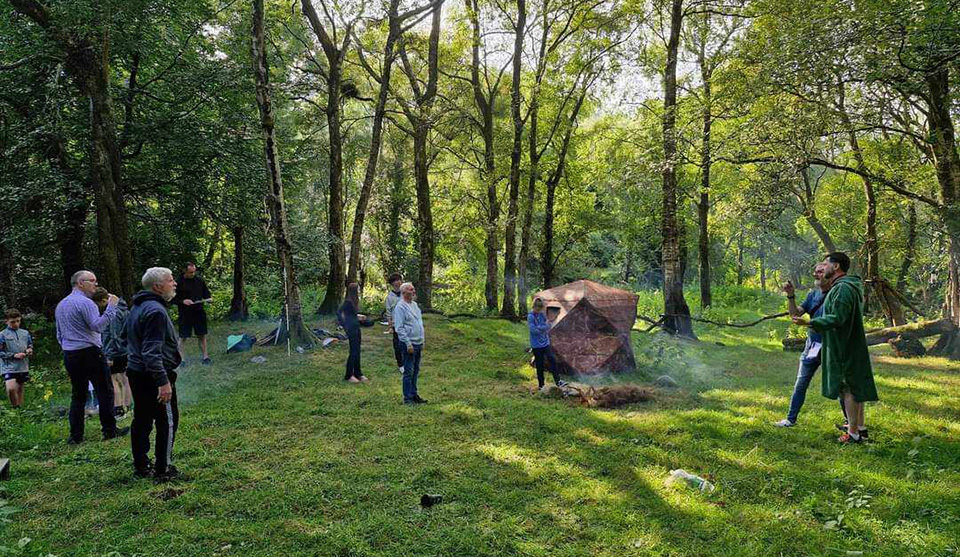
‘An Rí’, a play as Gaeilge, written by Pádraig Mac Piarais, will be performed by Aisteoirí Thamhlachta next Saturday and Sunday in Gleann na Smól Co. Dublin (besides Tallaght) at 4:30pm. Like Pearse’s original performance in 1912, it will be performed in the open air. For directions to the location of the performance and to book tickets book here. ‘An Rí’ le Pádraig MacPiarais Tickets, Sat, Sep 14, 2024 at 4:30 PM | Eventbrite.