The war is the first thing that strikes you about Ukraine.
In our case, it was unavoidable from the moment we arrived at the border crossing in Eastern Poland on Friday afternoon, and encountered nothing less than a full battalion of Ukrainian troops making their way back into their country after what, presumably, was some time spent training in the west. There were men almost as far as the eye could see, all in the prime of their lives, all destined, ultimately, for the front lines still hundreds of miles away from them. One of my travelling companions, awed by the sight, took a photograph of this scene and was lucky not to lose his phone after being swiftly and unceremoniously told to delete the picture. The Ukrainians do not permit photos of their troops, for fear that the families of said troops would be targeted by the enemy.
For the rest of us, border control itself is a lengthy and unsurprisingly thorough process – we crossed on foot, making our way through three layers of security. Only Israel, in my experience the of places I’ve been, has been more thorough in the vetting of those trying to enter its territory – though the Ukrainians are generally more good humoured about it than the Israelis, whose reputation for cheerfulness does not, in this writer’s experience, extend to their border guards. What’s more, there are no civilian border guards on show: The military has control of Ukraine’s borders, at least going by the uniforms.
Once you pass the border, the war recedes a little bit into the background. A long drive through the countryside of the Lviv Oblast is a reminder both of how huge this country is – that which looks a short distance on a map is not anything of the sort – and of why so many tyrants have fought for centuries over this place.
Endless rolling fields of corn and maize, circling White Storks – utterly magnificently huge birds – returning to their enormous (and ever-present) nests; and little villages which have an uncanny resemblance to places like Granard and Castleisland – long, wide streets, religious shrines, and provincial old ladies going about the daily business of provincial old ladies everywhere, shopping and nattering to each other outside the shops. Only when we met a tank, precariously perched on the back of a lorry, were you reminded during a long drive eastwards that this country is at war. For the rest of the time, you look out the windows thinking that farmers in Ireland would kill for land like this.
The first thing that strikes you about the people, driving through Ukraine, is the obvious wealth disparities that are perhaps most visible on the roads, where cars last seen in Ireland in about 1992 share the highways with the latest high-powered german imports, or American-spec Hondas shipped across the Atlantic. On a drive from one of the surrounding towns to Lviv, we were transported in an old Opel estate, dating to, I’d guess, about 1993, whose precise model marque had long since fallen off the back, along with much else. The boot no longer opens, and your luggage is loaded by flattening the rear seats. I would not be optimistic about the car’s chances at the NCT.
The driver, a fellow called Yuri, was one of the most patriotic Ukrainians we have encountered so far, as a quick look at the inside of his car (Photos taken with the drivers permission) demonstrates.
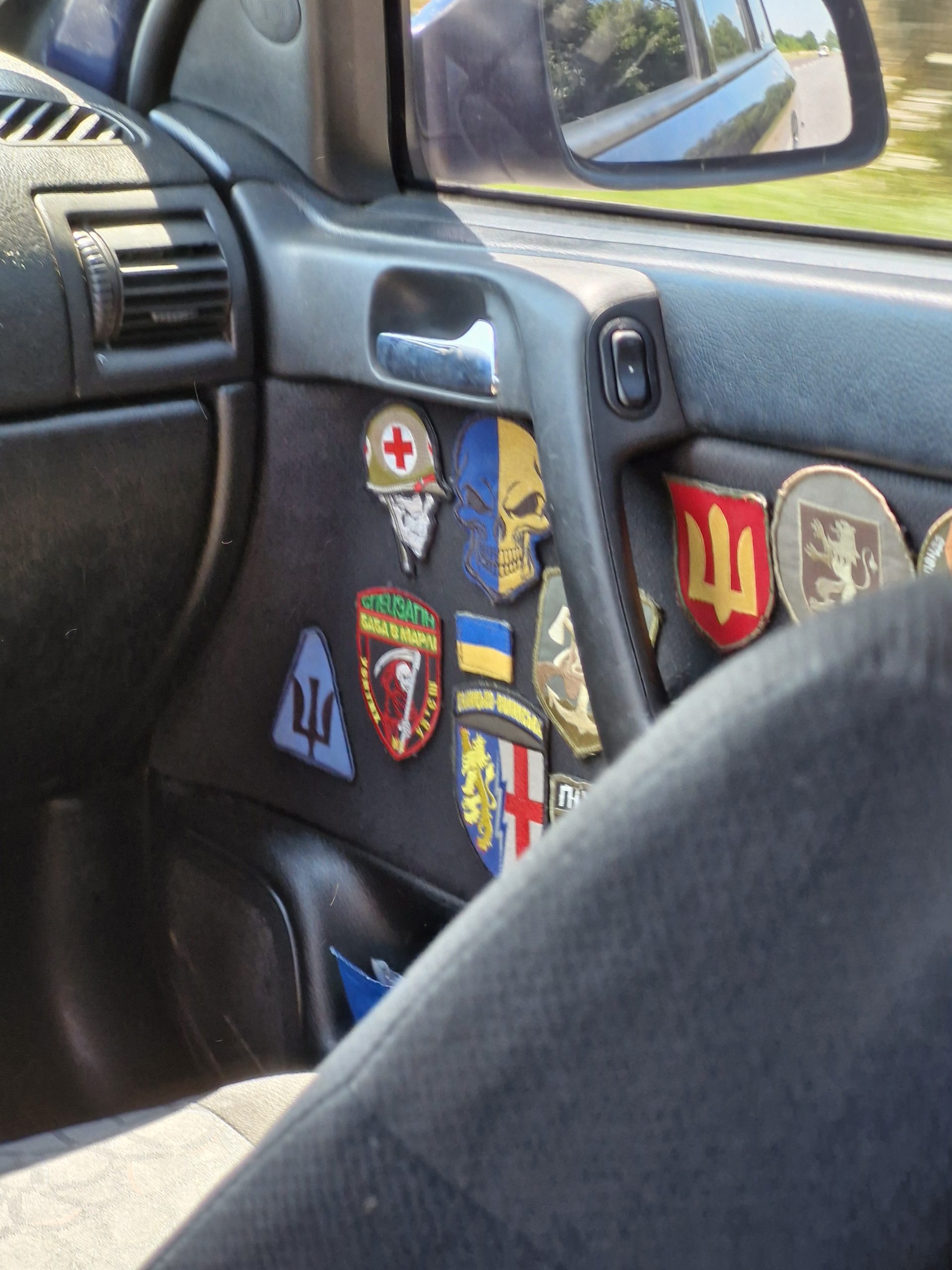
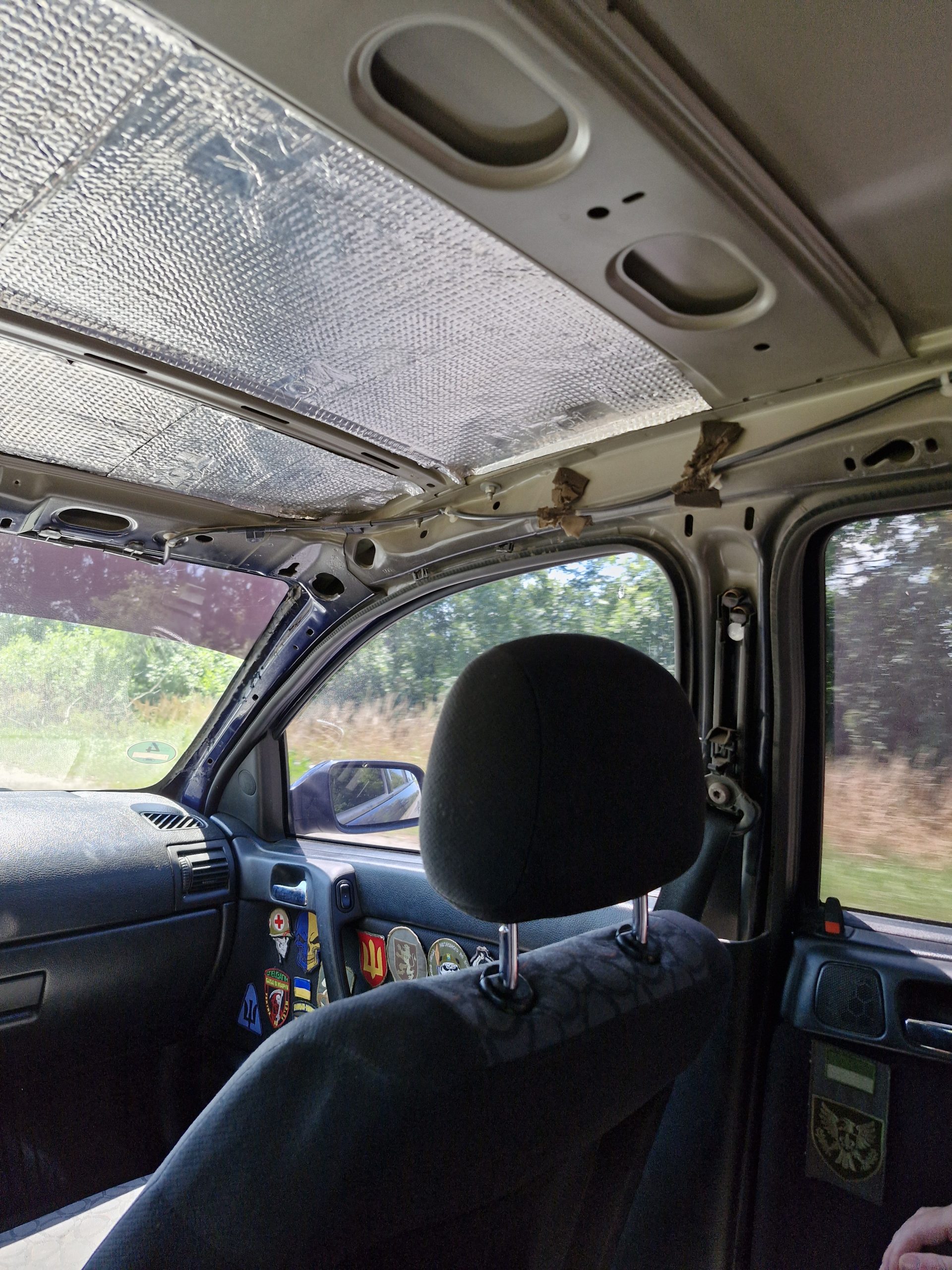
Two of Yuri’s brothers are fighting the Russians. One cousin has not come back.
Yuri, like many people in this part of Ukraine, hates the Russians. He likes the west. “We want to live like Americans, and British, not like Russians”, he said.
In his car, the only non-Ukrainian emblem is a badge for Liverpool Football Club. He was massively excited for a few moments when he thought that my wife and I might be English. They like the English here. In an almost comical way, he loves Boris Johnson. Many Ukrainians do.
By contrast, Yuri wasn’t 100% sure where Ireland was, was my impression when we corrected him about our origin. Still, my wife’s Liverpool sympathies gave them an instant connection, as did the news that she teaches Ukrainian students.
On that topic, there is a bitterness here, too. At the wedding we attended, one of the waitresses was eager to chat in order to practice her English. She is 17, incredibly bright and friendly, and doing the Ukrainian equivalent of the leaving cert. Two boys from her school – I assume a year or two older but I may well be wrong since conscription kicks in at 16 – went to fight the Russians and will not be coming back. Others are still at the front. They went, she says, but others didn’t.
They call them “the golden class” here – the people who somehow don’t get sent to the front. I suppose it is the same in every society that fights a war. It is the patriotic poor who most reliably bleed, while the wealthier find their way out legally or through other means.
A cynical thought flashed through my brain – for all the Ukrainian cars one sees on the roads in western Europe and in Ireland, you don’t see too many like Yuri’s, with bits hanging off, and patriotic badges stuck on. The drivers of those cars are, I suspect, mostly still here in Ukraine.
Of course, the vast majority of Ukrainians in Ireland are, indeed, women and children. Many, it should be said from regions far to the east of Lviv. But it was hard to listen to Yuri’s story, and that of our young waitress, and not think of the several thousand Ukrainian men of fighting age who are living in Ireland. Are they part of the “golden class”? Some of them, I think, certainly must be.
As for “normal life” in Ukraine? It goes on.
We’re here, as alluded to above, to attend the wedding of a very dear friend of mine to his Ukrainian bride. The wedding was at a beautiful old Orthodox monastery, and the ceremony, though incomprehensible, was unmistakably the way Ukrainians have been getting married for centuries. It struck me once again that the Catholics, in their folly, did away with the best advert for their religion when they abolished the old Latin Mass.
The reception was curfewed, as everything is in the small towns, at 11pm. In Lviv, from where I write this, that curfew is extended to midnight.
Walk the quieter streets of Ukraine after dark, and you’ll hear music coming from the lampposts. This confused me until I asked a local: It turns out the music is coming from the air-raid sirens, which play unobtrusive tunes when they’re not wailing. And wail they do: When Russian missiles or long-range bombers enter Ukrainian territory, the sirens go off across the whole country, because nobody can be sure at that stage where they might land. Our hotel here in Lviv has both a rooftop jacuzzi, and a basement bomb shelter. The duality of a country at war, trying to live a normal life anyway. It’s also, it should be noted, remarkably cheap: We’re paying just over €120 for two nights in a hotel that is every bit a match for the Shelbourne or the Merrion. A lunch that would cost 50 or 60 euros in Dublin can be obtained for 15 here, even in central Lviv.
What do I think, after three days here? It’s hard to say. People like Yuri, I have no doubt, will fight the Russians to the last man. There are a great number of people like him – flags fly everywhere. There is immense pride here in the defence of Ukraine: On the road we passed a cemetery where the section for the war dead was small, but instantly recognisable because of the flags flying high and proudly from each recent grave. In February, President Zelensky put the Ukrainian dead at 31,000 – the Russians say it is perhaps double that. I do not know who is telling the truth. In the villages we were in, there are war memorials going up in the manner of those you find in every English town, or in Unionist villages north of the Irish border: Lists of the local fallen. They are growing, but for many, as on our own islands, they appear a source of pride as well as pain.
What I know, having spent a few days here in this admittedly far-removed from the front part of Ukraine is that this is a resilient country and the majority of people who have not fled – not all, but a huge majority – seem determined to fight for as long as it takes.
Yet there is also deep inequality, and hints of corruption beneath the surface. There is wealth and privilege and, I suspect, a bit of draft-dodging in Lviv, without a shadow of a doubt. The question is whether discomfort with that should take away from supporting people like Yuri and his brothers, two of whom are fighting to save a country they love. I have concluded that it should not.
Ironically, the most powerful moment of our trip, I thought, did not relate to the war at all. At least, not the present one.
In the centre of Zhovka, a town we passed through with a population of 13,000 people, stands this ruined hulk of the once-great Synagogue that serviced the 4,500 Jews of Zhovka. In 1942, the Germans blew it up, and deported 3,500 Jews to Belzec, where they were gassed. Of the remaining 1,000, fewer than 100 survived the war.
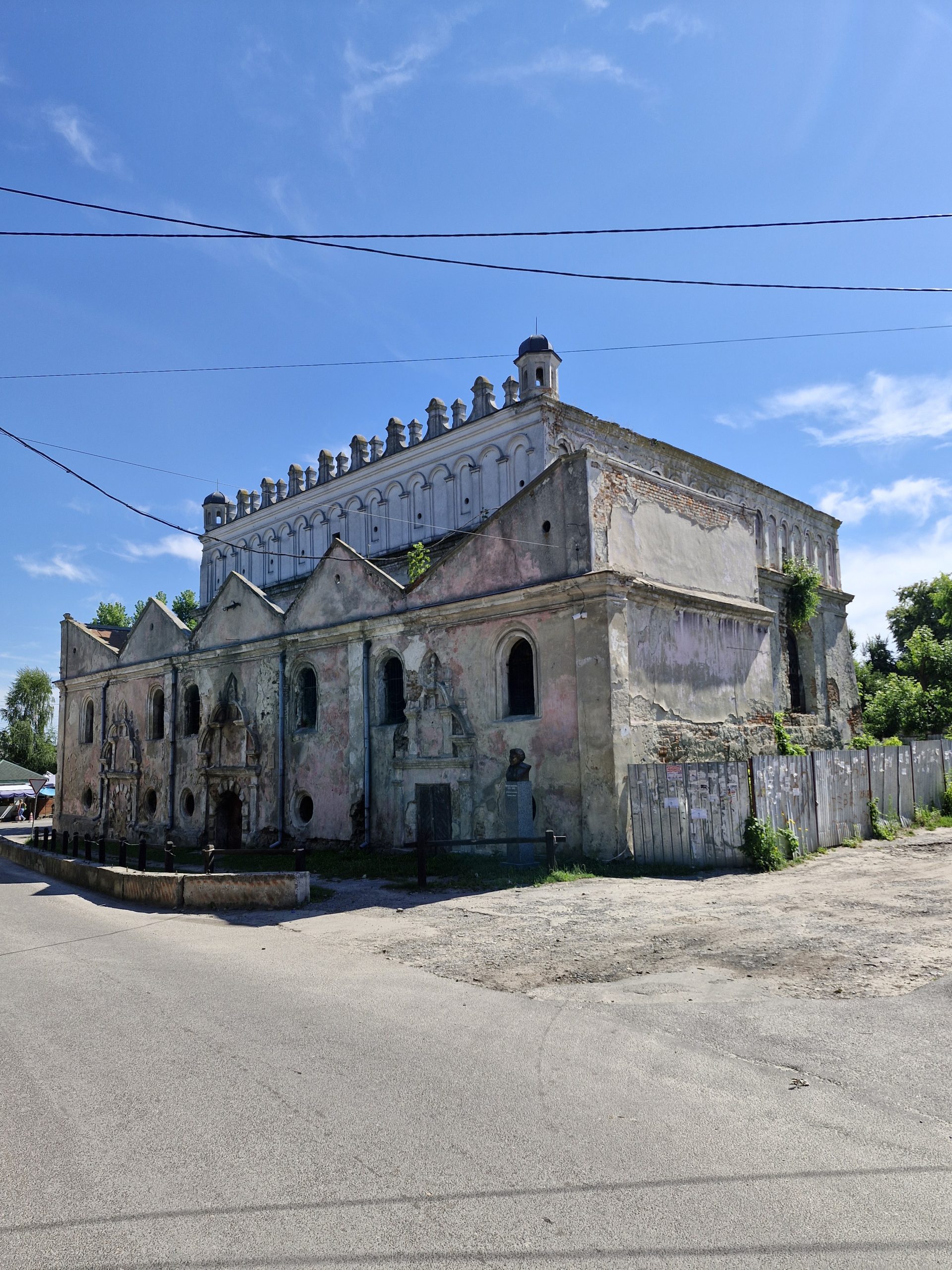
This is a country that has known horrors before. I often read critics of Ukraine citing the fact that life goes on here – that people still eat out, or go to nightclubs, or party at night time. I put this question to Yuri, asking him what he would say back to westerners who criticise this aspect of life in the war.
“What can you do?” he responded. “In war, you still need to live your life”.
That’s how it is here, it seems to me. The war is everywhere, but ignoring it to get on with the everyday business of life is the way local people are fighting it. More power to them.