The latest statistics from the European Commission, published yesterday evening, on the numbers of persons seeking asylum show that the Irish state has bucked the overall trend within the EU as whole.
While the number of applications fell across the bloc in the month of March this year by 12% compared to last year,, numbers continued to rise in Ireland – doubling since March 2023
These were all applicants for International Protection. Ukrainians who are granted Temporary Protection are not counted for this purpose.
The total number of applications, both first time and subsequent, in the 27 member states in March was 73,445. That compares to a total of 83,915 in March 2024. As the chart shows, that represents another fall from the high of more than 122,000 that was reached in October 2023. European states have clearly acted in most cases to halt what was a dangerously and rapidly increasing influx of people.
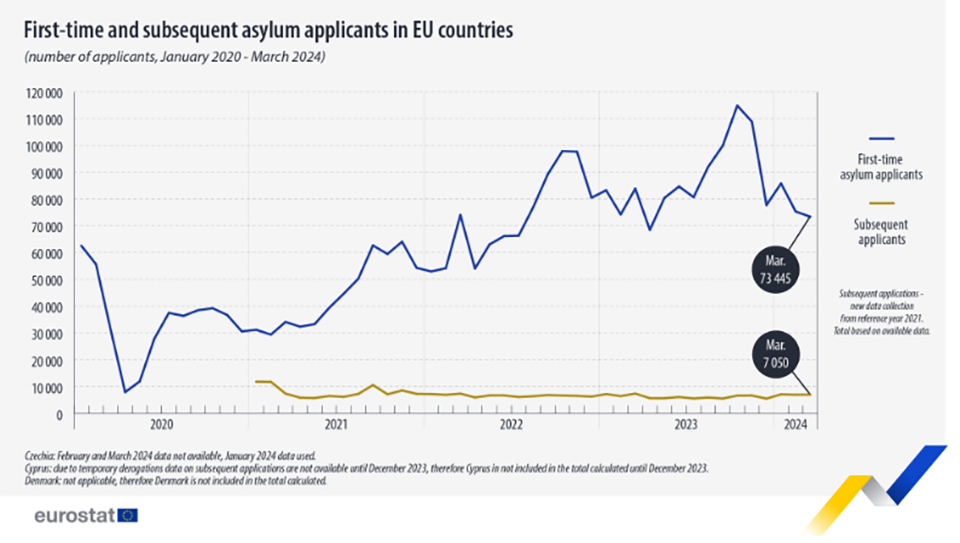
The Irish state continues to buck the trend both in terms of numbers and in the countries of origins of where people claiming asylum originate. With regard to the numbers, a year-on-year comparison shows that while the number of asylum applications within the EU as a whole fell by 12% between March 2023 and March 2024 that there was a 113% increase here; with the number of applicants more than doubling from 855 in March 2023 to 1820 in March this year.
The Irish state is just one of nine of the member states to have seen a year-on-year increase between March 2023 and March 2024. The others being Belgium whose numbers increased by 4%; Greece by 40%; Italy by 32%; Latvia from just 30 to 85 people; Malta from 60 to 70 people; Portugal from 180 to 225 people; the Netherlands by 20%, and Poland by 40.5%.
So the rate of increase in Ireland has either been the opposite to or significantly outpaced that of other EU states. That was indicated by the sharp rise last year, and as is reflected in the trend so far in 2024.
It is also notable that the Irish intake is twice the per capita EU intake – the March intake equates to 16.4 per every 100,000 of the EU population compared to 35 of every 100,000 of the population of the Irish state.
While the Republic of Ireland is ranked 19th in population size of the 27 member states, it had the 8th largest intake of applicants for International Protection in March. An interesting comparison is between the Irish state and Denmark. Denmark has a population of just under 6 million, but in March only accepted 160 applications for asylum and that was down from 195 in the same month of 2023.
In the whole of 2023, Denmark only accepted 2,455 applications for International Protection. Denmark has also set about deporting persons whose applications have been rejected. In regard to Temporary Protection, at the end of March this year, the number of Ukrainian refugees in Denmark was 39,680 compared to 104,315 in Ireland.
The Danish hardline stance on migration is shared by the current Swedish and Finnish governments, both of which countries also witnessed falls in the number of applications. Sweden similarly, despite its population size and relative proximity to Ukraine only has 42,000 in Temporary Protection.
Beai in mind that Denmark is governed by a left of centre coalition the main component of which is the Social Democratic Party. Any resemblance to any left of centre party in this state, not least the one led by Holly Cairns, being purely coincidental on the issue of migration.
The Irish intake of applicants for International Protection also contrasts with that of the EU states as a whole. The main countries of origin across the 27 member states were Syria, Afghanistan and Venezuela.
According to the IPAS statistics for March, Afghans accounted for just 4% of arrivals here in that month, and Syrians for just 2%.
In contrast, while the EU figures for January 2024 show that applicants from Nigeria accounted for just 1,705 or 1.8% of arrivals across the EU, they accounted for 343 or 23% into the Irish state. Which means that one in five applications for asylum within the EU in January were made here. While that might appear odd, the fact that so many persons who apply for International Protection here arrive from the United Kingdom across the border between the 26 and 6 counties provides much of the explanation.
What these latest statistics illustrate that while the Irish government appears to have moved in the direction of tackling abuses of the International Protection system here, that it has still not reversed the tide – partly caused by stricter regimes in other EU states and in the UK – not acted decisively as of yet to ensure that bogus applicants are quickly processed and sent on their way.