Researchers in the UK have developed a drug which extends the lifespan of mice by over 20%, in what they are calling a “tantalising” potential future treatment for humans.
Scientists at the Medical Research Council Laboratory of Medical Science and Imperial College London have discovered that ‘switching off’ a protein called IL-11 can “significantly increase the healthy lifespan of mice by almost 25%.”
The researchers also treated 75-week-old mice – equivalent to the age of about 55 years in humans – with an injection of an anti-IL-11 antibody, a drug which stops the effects of the IL-11 in the body.
Notably, the study found that female mice lived even longer, and it also “largely reduced deaths from cancer in the animals, as well as reducing the many diseases caused by fibrosis, chronic inflammation and poor metabolism, which are hallmarks of ageing.”
There were also “very few side effects observed.”
“The results, published in Nature, were dramatic, with mice given the anti-I-11 drug from 75 weeks of age until death having their median lifespan extended by 22.4% in males and 25% in females,” the study’s authors said in a statement.
“The mice lived for an average of 155 weeks, compared with 120 weeks in untreated mice.”
Professor Stuart Cook who led the study said: “While these findings are only in mice, it raises the tantalising possibility that the drugs could have a similar effect in elderly humans.”
The average life expectancy in Ireland is currently 81 for men, and 84 for women. If, hypothetically, a drug could extend human lifespans by a similar amount to this drug, we would see men living to 97 on average, and women living to 100 on average.
“These findings are very exciting,” Professor Cook continued.
“The treated mice had lesser cancers, and were free from the usual signs of ageing and frailty, but we also saw reduced muscle wasting and improvement in muscle strength. In other words, the old mice receiving anti-IL11 were healthier.
“Previously proposed life-extending drugs and treatments have either had poor side-effect profiles, or don’t work in both sexes, or could extend life, but not healthy life, however this does not appear to be the case for IL-11.”
Anti-IL-11 treatments are currently in human clinical trials for other conditions, potentially providing “exciting opportunities” to study its effects in ageing humans in the future.
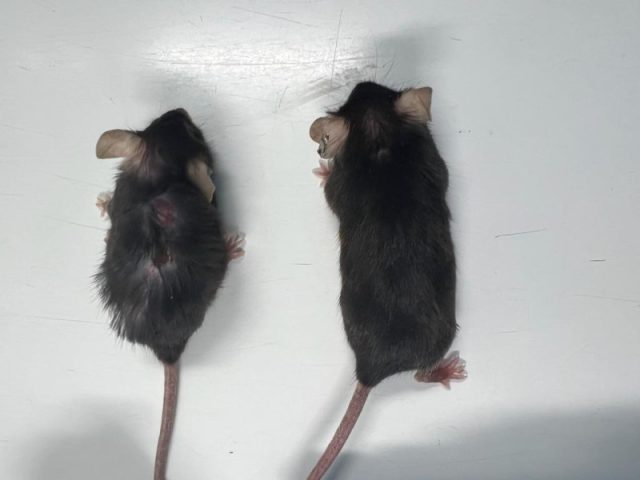
Below is pictured a picture of identical twin mice of the same age. The mouse on the left has aged normally without intervention. The mouse on the right received anti-IL-11 antibody treatment from 55 weeks, the equivalent of middle aged in a mouse.