How does one measure a society’s compassion? In recent years in Ireland, at least, the dominant voices in Ireland have had a unified answer to that question: By doing the things we ask you to do. We become more compassionate by voting for compassionate things – shorter divorce times, legal abortion, expanding marriage, and so on. Then the politicians applaud us for said compassion, as if the voters have bettered themselves in the process. Meanwhile, little enough is expected of those actually in charge.
This is the Gaelic Paradox: Compassion in Ireland is almost always expected from society – the people as a collective – but it is rarely demanded from the state as a singular entity. The same state that has, for example, a long record of drawing out legal actions for as long as possible to avoid paying compensation to those it has greviously wronged will at the same time tell the rest of us that we can be more compassionate and less callous if we vote for particular policies.
The state is genuinely capable of compassion, of course: Just look to the almost limitless second and third and one hundred and seventeenth chances it routinely gives “good family men” convicted of crimes in the courts, who are sent home with a stern warning and a suspended sentence as proof of the state’s basic decency. Yet similar decency can be hard to extract for those who are victims of state incompetence or malice, as Garda Maurice McCabe could tell you after his years-long legal ordeal, or as the women who found themselves infected by poisoned blood could tell you in their years-long fight with Michael Noonan.
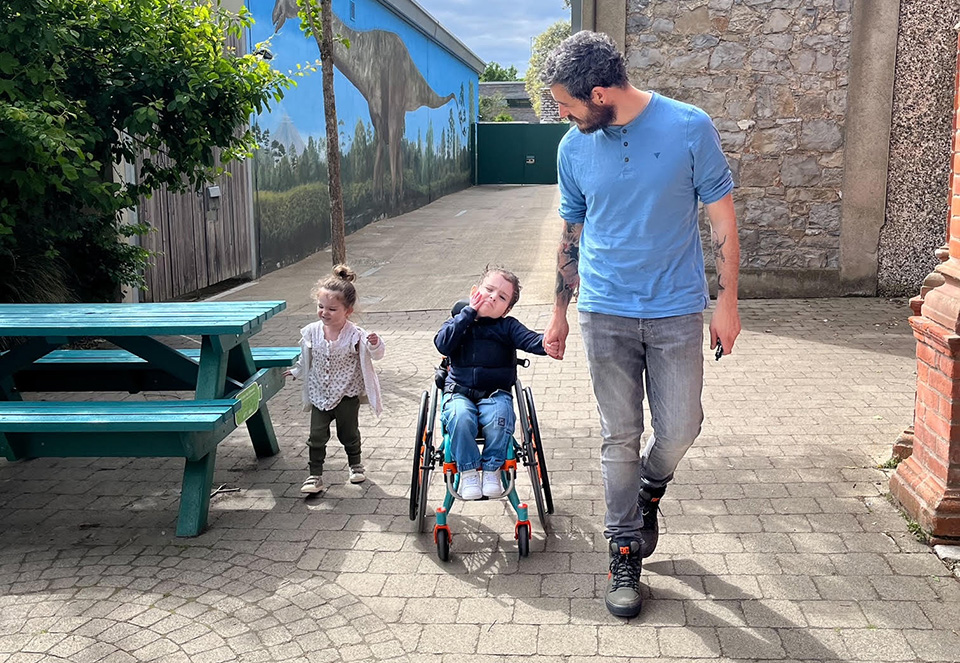
The case of Harvey Sherratt is almost spellbinding in its callousness: On Sunday, it was reported that the department of health had finally been in contact with Harvey’s parents Gillian and Stephen after an online campaign prompted by reporting in this news outlet and elsewhere called on the Government to save their son.
Harvey is seven years old, and, in the estimation of his parents, will die if he does not receive an operation for which he has been waiting for almost the entirety of his life. Videos posted by the Sherratts make cruelly obvious the degree of suffering that their son is enduring. The video below shows him wearing Christmas pyjamas, because instead of opening his presents, Harvey spent Christmas Day in hospital struggling for breath. The curvature of his spine -now beyond 80% – means that his own body is collapsing his lungs:
December 2023, yet another Christmas Harvey had to miss due to breathing difficulties. #scoliosis @SBH_PAG @DonnellyStephen @LeoVaradkar @TomClonan @scolionetwork pic.twitter.com/jSSejarpba
— Gillian Sherratt (@GillSherratt23) February 3, 2024
The Irish state should not, necessarily, be condemned for its inability to provide swift treatment for scoliosis. It is a blessedly rare condition, and in fairness to the mandarins and civil servants who decide these things, Scoliosis surgery is expensive, complicated, and specialised. It typically involves cutting edge techniques like inserting an expanding rod into the spine, or fusing two bones together. Finding surgeons in Ireland qualified to carry it out, and providing the facilities to clear the backlog, is certain to be expensive and difficult, especially when the one surgeon who was looking after Harvey has been placed on administrative leave. Even without getting into the details of that case, it’s fair to say that not being able to perform the operations Harvey needs here in Ireland is nothing to necessarily be ashamed of.
What is shameful, however, is that – and an effective shrug of the national shoulders – being the end of the matter. A truly compassionate state would not simply leave one of our own children – an Irish citizen – to suffer from a curable and treatable illness on the grounds that we don’t have the facilities or the expertise here. A compassionate state would have had Harvey and his family on a flight to a US facility years ago when his condition was less advanced, and covered the costs and the expenses. Yes – the costs might well be more than the Sherratts or Harvey could ever hope to pay back in a lifetime of tax. But isn’t that why the rest of us pay tax?
At the end of the day, any one of us, but for the grace of god, could be in the position that the Sherratts find themselves in: With a beloved child suffering terrible pain and in need of expensive life-saving care.
Of course, as the Sherratts point out, it’s probably too late for that now:
This cannot be solved by sending kids out of the country, it cannot be done, it won’t be done. They are far too complex, and the amount of care that they need afterwards is shocking,” said Mr Morrison (Harvey’s father -ed). He agrees with Senator Clonan that “complications” have arisen in the patients “because it was left to go so bad”.
“No one anywhere in the world is doing surgeries that have 80-degree spinal curvatures, it’s not heard of anywhere else, it’s only in Ireland that we are doing all these really complex surgeries.”
“Why?”, he goes on: “In other countries there are doing surgeries a lot earlier, they are not letting it get to 81 degrees, so therefore it’s a lot easier for positive outcomes.”
And so, we have this awful situation where children are allowed to reach a stage where their suffering is so extreme that the cure would be almost as bad as the disease, when in other countries the intervention would have happened years earlier. All while we wait for an alleged magic bullet: The overdue and over-budget children’s hospital.
Harvey’s parents are now considering, they say, leaving Ireland entirely with their son. Who could blame them? They have objectively and obviously been failed by this society. But they are not alone.
All of us who work and faithfully pay our taxes have been greviously failed in this case, and in the other cases of children with scoliosis. Paying taxes is, in fact, evidence of societal compassion: We fork over large amounts of our money to help others in need.
When that help is not delivered, it is not the voters or the public who are to blame. It is not Irish society which lacks compassion. It is the state, and those who run it on our behalf. That this little boy has been left in this condition is one of the many reasons why any politician who talks about compassion in the context of this state should be met with scorn and derision. Clean up your own house, because the rest of us are doing our part.