In an ideal world, would we have no covid at all? Sure. But if we must have Covid – and, whatever the zero covid people might say, we don’t have a choice in the matter – then this is what you would want to see:
Whoa. Serious surge in Covid-19 cases among adults 19-24 – more than doubled in a week.
Infections among primary-age pupils are now 2.5x higher than at the point when the contact tracing procedure in primary schools was changed.https://t.co/MJvL9d8CwU pic.twitter.com/C81bD6SeTL
— Gavan Reilly (@gavreilly) November 11, 2021
One of the great problems during the pandemic has been a relentless – and politically driven – attempt to eradicate covid altogether, which was always doomed. In truth, once the virus escaped Wuhan, China, and dispersed to the four corners of the globe, there was never any likelihood that it could be stopped. But in pursuit of the idea that we might be able to stop it, Western Governments followed a containment protocol that involved shutting down whole sections of the economy, and society, on the pretext of “protecting the vulnerable”.
The unspoken part of “protect the vulnerable” is, and ever has been, that there is a big chunk of society which is not vulnerable. Those people: Young and healthy, mostly, can get Covid 19 and either have mild symptoms, or none at all. Most people in Ireland, after all, now know at least one young person who has had covid, and suffered nothing more than a mild cough for a few days.
The vaccines, effective though they have been at reducing deaths and serious illness, are very ineffective when it comes to stopping transmission of the virus. The most effective way, then, to build up population level immunity in the short to medium term is, in the crudest terms, to let the virus rip through the young and the healthy, and add natural immunity to their vaccine provided immunity. This is, in short, the infamous herd immunity strategy first proposed by Boris Johnson and his scientific advisors at the very beginning of the pandemic, and roundly slated. It is amusing, then, that Ireland, like the UK, has now quietly adopted it, after all else failed.
Will this approach work? Chances are that it will, actually. If you look at the UK data, you will see that they had a sustained surge in cases starting in June, shortly before they abolished all restrictions. That surge relented slightly after the UK opened up, before slowly climbing again. All in all, since June, the UK has had its longest, most sustained, surge in Covid cases. And those cases are now… falling:
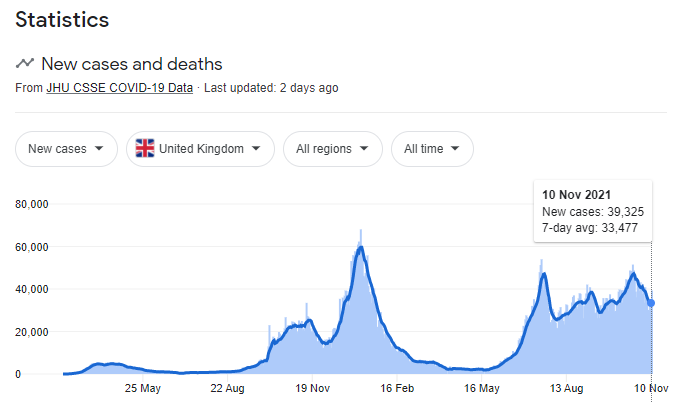
What’s interesting though is this: Compare the UK case map above to the UK death map, below. You will see that up until this June, deaths and cases tracked each other very closely. And then, the link was broken:
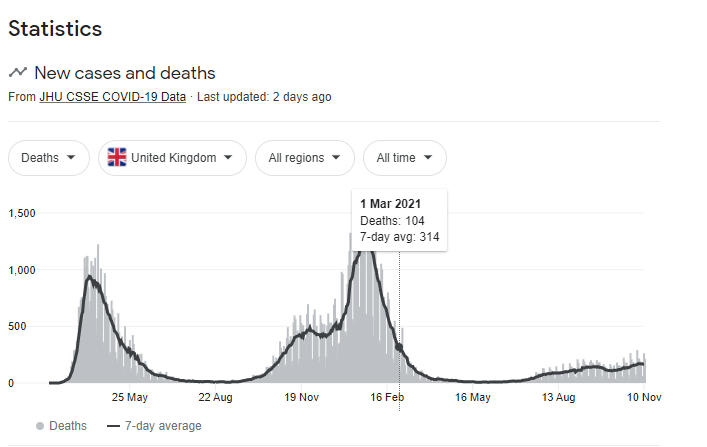
What you’re seeing there, in all likelihood, is the impact of vaccines on reducing deaths and hospitalisations. In other words: The vulnerable have been protected. Now, with the death curve flattened, the UK is able to cope with a greatly elevated number of cases, over a long period of time. That’s exactly what the mission was at the beginning of the pandemic: Flatten the curve until the vulnerable could be protected.
The truth of the matter is that Boris Johnson’s Government recognised in the summer that their mission on Covid was largely accomplished: Protect the vulnerable, and the health service. A large surge in cases amongst children, and the young, threatens neither the vulnerable, nor the health service.
We should not consider this wave of cases, here in Ireland, as a fourth wave. It is, in fact, a distinctive phase of the pandemic: A normalisation wave, where population level natural immunity does its job.
Of course, the problem in Ireland is that very few people will see it that way. In the public mind, every case is the same as the next, and just as much of a risk. That perception is a result, unfortunately, of widespread misinformation. Misinformation which, largely, has been spread by the news media.
We’ll leave you with this. Remember, if you will, what the Irish Times said about the UK’s covid policy, when they re-opened:
— Ed Fidgeon-Kavanagh ░P░P░T░ ░I░N░ ░B░I░O░ (@Clearpreso) November 11, 2021
https://twitter.com/daveirl/status/1458800480050573314
