Social media may have made it easier to spread but unethical actions and unfair attacks have been the bane of elections and of candidates since voting began.
Last-minute negative leaflet drops, poster removal, and planting false rumours, can now be joined by more hi-tech versions of foul play, including sophisticated possibilities with ‘deep fakes’ – though that doesn’t seem to have been a factor in the Irish electioneering so far.
According to observers, the more old-school aspects of unfair campaigning are still prevalent: and smaller parties and newcomers who haven’t the same access to the airwaves or the deep pockets to deal with attacks on their efforts to gain public attention say the impact on their campaigns are disproportionate.
POSTER REMOVAL
The larger political parties have long accused each other – on the ground at least – of tampering or removing candidate posters, which are one of the most visible aspects of political campaigns. Smaller parties and Independent candidates, lacking the deep pockets of the more well-established groupings, are likely to feel the vanishing of hard-paid-for posters erected by volunteers more keenly.
Independent candidate Helen O’Sullivan, who is standing in the Bantry area in Cork, said her posters were removed just outside Schull. “It really is disheartening when you are out working day and night and then someone does this,” she said.
In Laois, Independent Dom Dunne, also reported posters gone missing. “I paid good money out of my own pocket but I’m putting up no more now. It’s costing me a fortune,” he said.
Anthony Cahill is founder of Irish People, a newly registered political party grouping which says it stands on principles and on “inviting ordinary people” to stand to represent what they say are the “actual majority views” on issues such as immigration and climate change.
The party is running 54 candidates in the local election across the country from Cork to Donegal, and Cahill says the list includes candidates such as Kim McMenamin in Buncrana as examples of people who are well known in their areas.
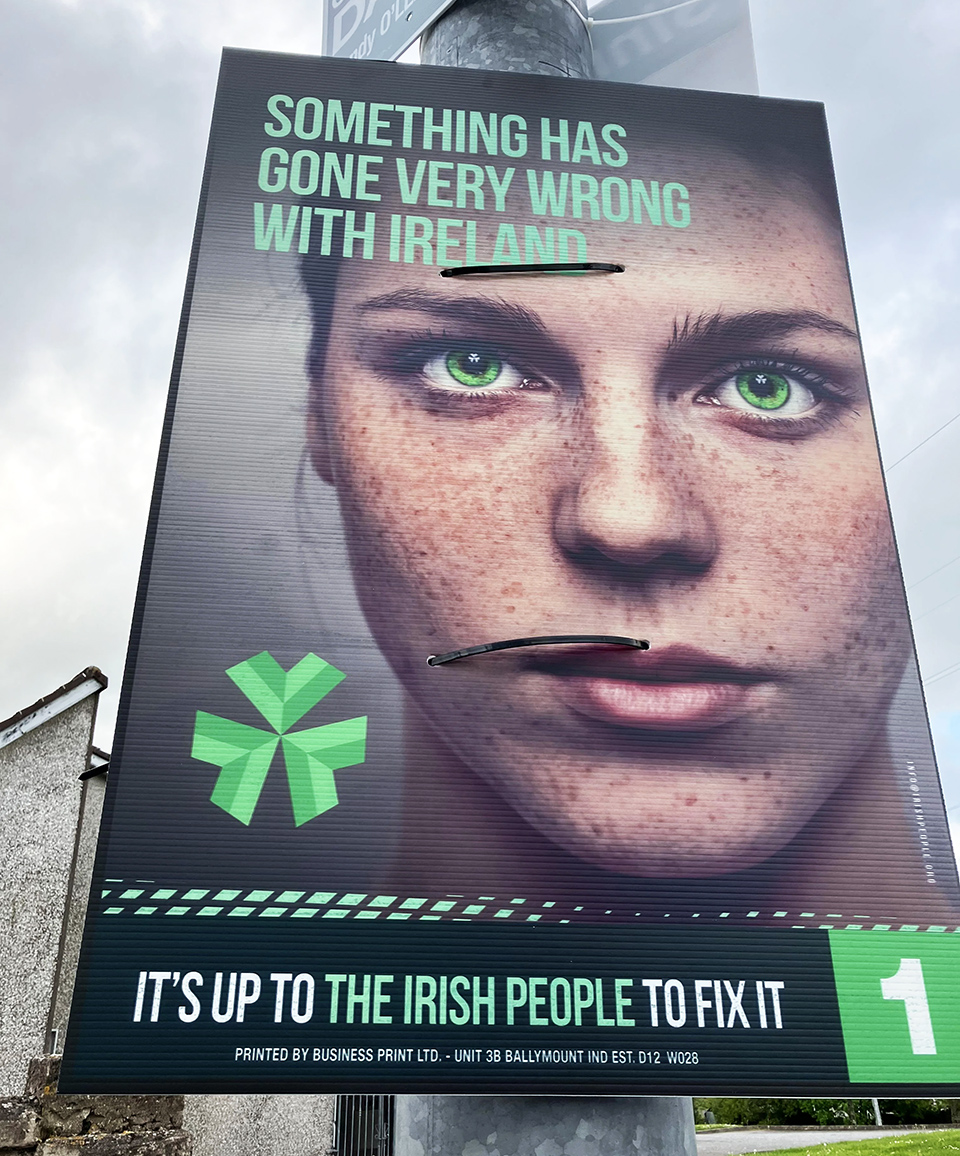
Cahill says that in a number of constituencies every single poster for candidates were removed – such as in Donegal where all posters for candidate Dr Anne McCloskey were taken down. Gardaí are investigating that case, he says.
Another candidate, Conor Rafferty in Rathfarnham, also saw every poster removed.
The party’s candidate in Sligo, Michael Kelly, who is running in Sligo Municipal District, says his posters were taken down both in Cranmore and in the Garavogue Villas. Speaking to Ocean FM News, Mr Kelly said it is “a frustrating thing to happen, given the cost and effort that goes into producing election posters”.
“All we can do is report it and get on with the canvass,” Cahill says, acknowledging that the party’s principles may attract the attention of left-wing activists. He rejects the label of ‘far-right’, and says the phrase is used to silence people, though the party has been criticised for using phrases such as “woke indoctrination” and “ethnocide”.
He said that “dozens and dozens of complaints” were also made to Dublin City Council about the party’s posters relating to NGOs and immigration, but that the Council found the messages did not contravene the law.
“A lot of these people are so unaccustomed to uniformity in attitudes, they can’t handle a different point of view,” he said. “So, for some people, if they can’t get a poster removed, they’ll just steal it – they were removed illegally.”
FAKE NEWS
Most reports on fake news in electioneering starts with the tale of the “Pope Francis Shocks World, Endorses Donald Trump for President” fake headline, which, while untrue, was a piece of deceit that might have convinced some voters in the 2016 US Presidential election, though very likely not as many as suggested.
On a local level, the claims are not so grandiose – and the opponent bashing might not be so obvious – but previous elections have shown how social media can be used to spread fake news, often at a speed that makes it difficult to respond to.
In 2014, Paul Murphy of the Socialist Party demanded that Sinn Féin ‘investigate whether one of its members made up a Facebook profile, purporting to be his and falsely attributing comments to him’.
The row erupted after Sinn Féin member Jason Roe posted an online picture of a conversation he had with a profile which carried Mr Murphy’s name and picture, the Irish Examiner reported.
It read: “Why am I scared of Sinn Féin? It’s politics Jason. I know Sinn Féin may block water charges if they get elected but I’m not a member of Sinn Féin so politics kicks in and I say what I have to in order to gain support!
Mr Murphy said the account had nothing to do with him and said he “believes strongly” that the Sinn Féin member set it up.
Questions have even been raised in the Dáil about fake profiles being used by members of political parties – but for candidates standing in the local election, messages flying around What’s App groups can be hard to track and even harder to counter.
Margaret McGovern, a nurse who is standing for Aontú in Howth-Malahide, said that she became aware this week of a document that was being circulated just days ahead of the vote that she felt misrepresented her views.
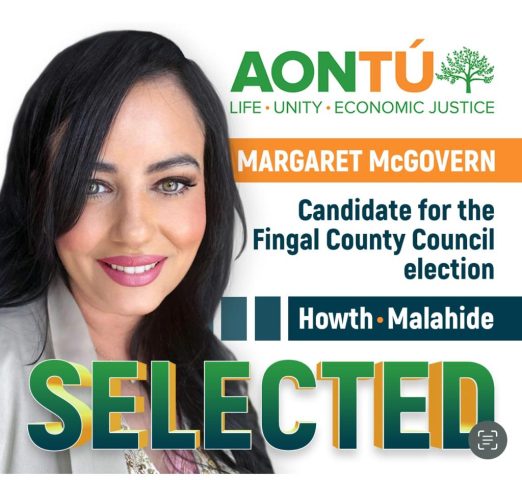
She points to a pdf “circulating among multiple WhatsApp groups including residents’ associations, running groups and others” which has the appearance of a ballot paper of sorts and which she says “strongly misrepresents me”.
The paper lists the candidates under the title ‘Fingal County Council Local Elections” and attributes motivations and policies to all fifteen. McGovern feels it would be believed by some voters to be an form of communication from the local authority.
“It says I’m for a Brexit for Ireland – which is completely untrue,” she says. “It says I voted for sanctions against Israel – also complete nonsense, where am I meant to have cast this vote?”
“It also characterises me as being ‘anti-immigration’, when our policy is that we are opposed to the chaos created by the government’s mishandling of the situation,” she said. “Most people share that opinion, according to the polls: it’s not fair to describe me in such terms.”
“The problem is that its almost impossible to counter the false claims, because social media is so hard to track,” she said. “You have to hope you’ve knocked on enough doors to make a difference – and that my own messages clarifying my stance on these issues is seen by at least some of the people who’ve also seen the fake news.”
ONLINE VIDEOS
Sharing video clips online which have been taken out of context or edited to make a different impression than might have originally been conveyed can now be done by almost anyone with a smart phone. Some of these clips are clearly intended more as jokes than as deliberate acts of political influence, but the line can blur, even if unintentionally, when the people sharing the material have widespread audiences.
Mark Malone, a left wing activist who now works with the taxpayer-funded Hope and Courage Collective which says it provides a “community-based response to tackling hate and extremism”, shared a clip of a heavily edited version of a video originally made by the Irish Times.
The Irish Times had accompanied Independent candidate, Niall Boylan, one of the front-runners in the European Elections in Dublin on a canvass in Tallaght. In the video, Boylan seeks to give a woman a leaflet and then hams it up for the camera when she and another woman don’t take one or stop to chat – a sequence of events that happens dozens of times a day to any candidate. Boylan’s interaction with the woman is over in seconds and the candidate then moves on.
Malone cuts the clip out, slows it down, and then edits it to add music, describing the video as showing Boylan “chasing after a woman” in “one of the weirdest things of this whole campaign.” For an activist who makes a living from talking about issues like ‘misinformation,’ and who has been invited into the Oireachtas to discuss the matter, it seems more than a little unwise to make use of an edited video when making such a statement about a election candidate, who he clearly opposes, immediately before an election.
It’s particularly rich given that Malone has previously accused Niall Boylan of using “disinformation to attack and demonise political opponents.”
Malone, a media darling who is regularly interviewed on the all-pervasive threat of ‘far-right disinformation’, has lamented that digital platforms enable bad actors to “freely orchestrate their campaign of disruption by providing them with a giant megaphone to spread their hate and lies”. Indeed.
Malone turned off comments on his video shortly after uploading it, but his feed on X shows repeated posts bad-mouthing Boylan. Seems a bit at odds with the kind of respectful debate you’d expect from a ‘Hope and Courage collective’.
I want to personally thank each and every person that told over the last two months that they will vote for me. It’s been an amazing experience and I promise I won’t let you down. #VoteNiallBoylanNo1 and let’s put the establishment in their place. pic.twitter.com/PGHrIsk5BU
— Niall Boylan (@Niall_Boylan) June 6, 2024
But taking things out of context can happen often in regard to online videos – as Umar Al-Qadri, who is also running for the European Elections in Dublin now knows.
He said that edited clips of his description of Jizya, a historical tax paid by non-Muslims to Muslim rulers, were taken out of context and shared to claim he supported the practice.
He told the Journal that the clip was taken from an academic talk and was not an expression of his political views. “I nowhere condoned — I nowhere propagated for Jizya. In fact, I am a strong opponent of Jizya tax,” Al-Qadri said.
On misinformation, Martin McMahon of the Tortoise Shack podcast tweeted this week to tell people intending on voting for Niall Boylan to sign their name on the ballot paper – an action which would spoil their vote. McMahon may claim it as a joke, but as someone with a media platform through his podcast, it’s not unlikely that people might take what he’s saying seriously.
Its polling day tomorrow, and the results will start to trickle in from Saturday morning, when it will become more evident whether an anti-establishment vote and support for smaller parties and Independents has materialised. Between then and the next election, however, the attempts to nobble your opponent – or a candidate you don’t like – won’t be going anywhere.