Some years ago I was spending the night in a house in a rather remote part of the country. The woman of the house prepared my sleeping place in the living room: a mat woven from fibres to lie on and, at one end of it, a pillow and blanket. She had so arranged things that my head would be near the door, so I simply reversed the set-up, with my feet near the door (in case anyone would pass that way during the night). Next morning she told me that she had slept fitfully, upset and worried about my sleeping position: with my feet facing the door I had unwittingly adopted the position of a corpse: waked, and finally removed from the house feet-first! She had tossed and turned in insomniac unease, wondering if I’d ever again see the light of day.
Filipinos have some unusual beliefs and practices regarding death and burial. With very few exceptions, every corpse in the Philippines is embalmed, vital because of the warm, humid climate; without embalming, the body would quickly putrefy. The wake can last up to two weeks, especially if there are family members travelling from abroad – but even for the poorer, the wake is at least 3-4 days. In rural areas the wake is always in the house, in urban areas it is either at the house or at a funeral parlour. But wherever it occurs, the corpse is never alone; 24/7 somebody is present. The days and nights pass with different activities: neighbours visit, Mass may be celebrated, other prayers and devotions will be offered by various groups, and so forth. Everyone who visits is fed: the wealthy employ teams of caterers, the more down-market offer to each visitor a sandwich and some juice. Everyone approaches the coffin and looks at the deceased, who lies, embalmed and with make-up worthy of a Hollywood star, under a pane of glass.
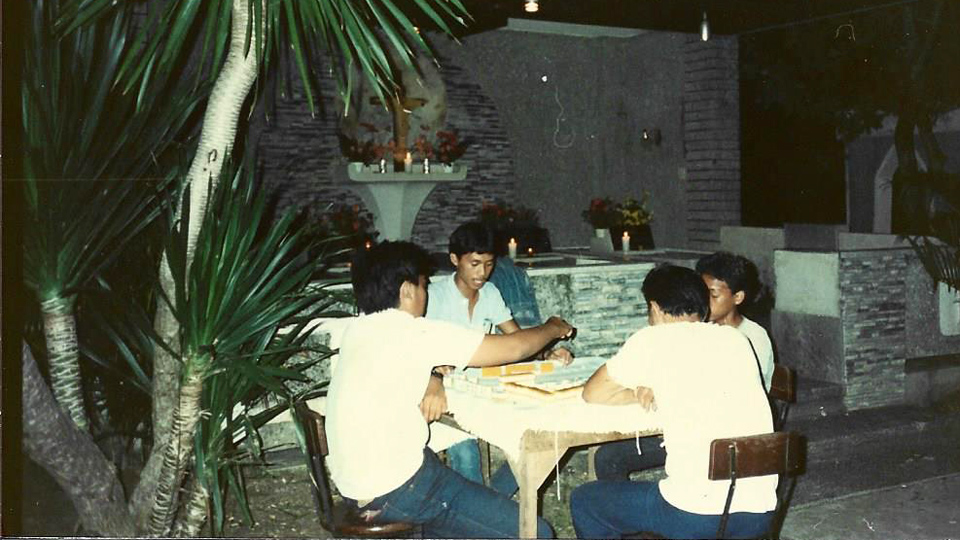
The wake continues day and night, without pause. It’s a time to salute the deceased and to ease, however slightly, the burden on the bereaved. As night approaches, and the other activities have ceased, the vigil begins. For these sleepy hours till dawn, a certain resilience and creativity are required. The solution? Playing cards and/or mah-jong (a Chinese game played with small ivory or plastic tiles). And occasionally a drink or two are had, to help to pass the long hours till sunrise. (The games and the drinking are too much for some of the more puritanical clergy, who mandate that if they continue, there will be no funeral Mass).
The funeral itself follows the usual format, although be prepared for long and often emotional eulogies. The hearse heads for the cemetery, playing on external speakers, some suitable hymn or one of the deceased’s favourites (e.g., Sinatra’s “I did it my way”). The coffin is lowered into the grave (rural setting) or, in an urban setting, placed into a niche in an 8-ft column, with 3 or 4 other niches in each column. After 7 years, the bones/dust are then solemnly removed to provide space for the next coffin; this is simply a municipal requirement, due to the large population of the country. In the rural cemeteries a small fire of twigs is lit and the people step over the fire, through the smoke (this is called “palina”). Supposedly this is a way of leaving behind in the cemetery any impurities which may have accrued due to having been among the dead; more simply, it’s a rudimentary form of disinfecting.
Some other unusual customs persist in the rural areas. After the wake, as the coffin is being taken out of the house, all present walk/stoop under it, and must not look back or return to the house. Walking under the coffin will somehow offset any feelings of undue loneliness for the deceased; not looking back prevents the spectre of the dead from returning. For the duration of the wake, no sweeping is done in the house, as this could cause other family members somehow being “swept up” in the dragnet of death. An overarching theme of these restrictions is that, by following them, some illness or misfortune will be duly prevented, though it has to be said that the chain of reasoning is far from clear! For instance, when leaving the cemetery, apart from passing through the smoke of purification, there is also the custom of putting ashes on the mourners and, further, of rubbing the juice of the lemonsito tree on the mourners’ hands – all to ward off any prospective return of the all-too recently buried. A somewhat macabre tradition, also supposed to minimise post-mortem loneliness, involves the mourning spouse wearing the underwear of the deceased – although how differences in waist size are negotiated is anyone’s guess.
One interesting detail of comparison between our Irish practice and that of the Filipinos is that during mourning we wear black, the quintessential expression of sadness (the darkness of death), whereas in the Philippines at the funeral Mass the mourners wear white (shirt or blouse), with a simple black tag on the breast to express sadness. I wonder if, even amidst their various beliefs and practices surrounding death, they may not have held onto a nugget of vital wisdom: their white clothing expresses the expected joy promised by the Lord. Their white somehow mirrors those common-sense defying words of the Preface of the funeral Mass: “Lord, for your faithful people, life is changed, not ended”. What do you mean? The once-alive person is lying cold in the coffin, not a heartbeat, not a breath in the lungs, nothing. How can we say “life is changed, not ended”?
I think because “life” is greater than anything our human intelligence or science or wisdom can cope with or measure or define. A table, a tree, a universe – all these describe specific things, finite realities. But “life”, “existence”? The best we can do to “measure” life is in terms of heartbeat & other “vital signs” and once these have gone, we say that the person is literally “life-less”. That, however, sounds like hubris to me, a kind of presumptuous declaration that we have grasped life, its contours and limits. But what our faith is teaching us is that life is greater, vaster than anything we can encapsulate. And that’s why our faith says that life has changed, not ended. That thoroughly mysterious, profound, God-given and God-destined gift called “life” has changed gear, entered some other level of existence or expression. This, for me, is the most euphoric, most stupendously audacious teaching of the Church, and it’s not just speculation: it’s based entirely on the belief of St. Paul & and the early Christians: our life on this earth, while grand & miraculous, is not the whole story, and that there is some state even more glorious awaiting us. Paul used the image of the “spiritual” body, Jesus used the image of the eternal banquet, but it’s all really a mystery. Can we understand this? No. Is there any proof? Again, no. But we don’t require proof, only faith and trust.