Sample exam papers for the new Leaving Certificate subject ‘Climate Action and Sustainable Development’ reveal a radical course that will see students addressing questions of “environmental racism,” climate mis- and dis-information and the role colonialism has played in perpetuating “climate injustice”.
One question on an ordinary level sample paper presents a passage taking aim at the Irish agricultural sector as a primary reason for Ireland missing its emissions reduction targets, and states that an “intensive farming lobby appears to be in the driving seat”.
Another question, on a higher level sample paper, states that the “values and worldview of producers of media have a large influence on public attitudes to issues related to climate change and climate justice” and describes this as “a problem”.
In their discussion of that statement, students are encouraged to give consideration to “the effectiveness of the controls on media to ensure accurate reporting of climate justice issues”.
The State Examinations Commission published this week a number of sample examination papers for new and revised Leaving Certificate subjects, due to be introduced in schools next September.
The two new subjects – ‘Drama, Film, and Theatre Studies’, and ‘Climate Action and Sustainable Development’ – will be available in a selection of schools from 2025/26, according to the Department.
Four sample examination papers were published for the Climate Action and Sustainable Development subject, two representing higher level papers and two representing ordinary level papers.
Questions contained in the papers reveal that the course will be a mix of ecological and climate science-related questions, and civil, social and economic questions related to the climate movement and matters of “climate justice”.
We looked through the four sample papers to see what sort of material students will be expected to deal with if they sign up to the Climate Action and Sustainable Development subject.
Here is what we found:
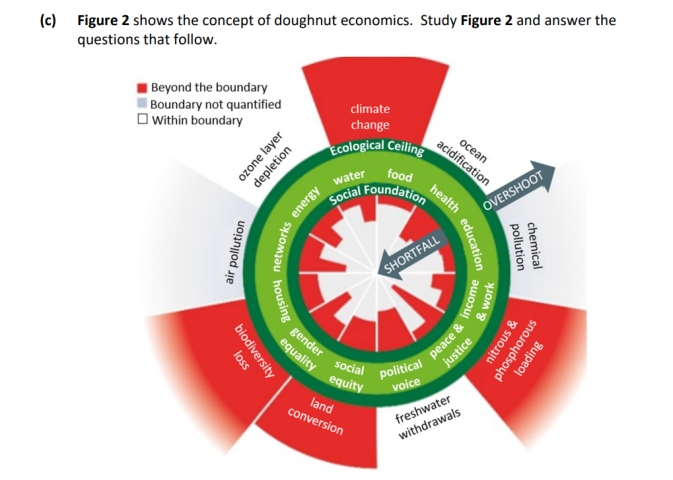
The concept of ‘Doughnut Economics’, created by economist Kate Raworth, arises across the papers, which looks to reimagine economic theory by balancing human needs and planetary boundaries. The doughnut is intended to be a metaphor for equilibrium, straddling human/social needs and planetary or ecological boundaries.
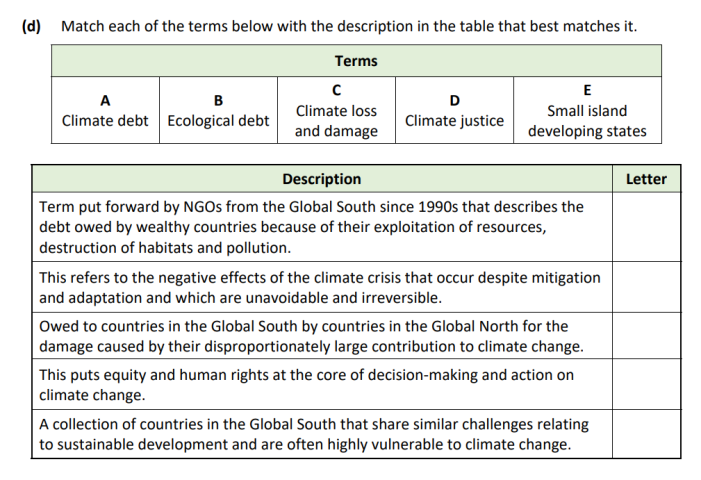
Students are also asked across every paper to match terms with their descriptions, with the higher level sample paper 1 asking students to successfully match the terms Boycott, Lobbying, Civil disobedience and Trade union organising to their descriptions.
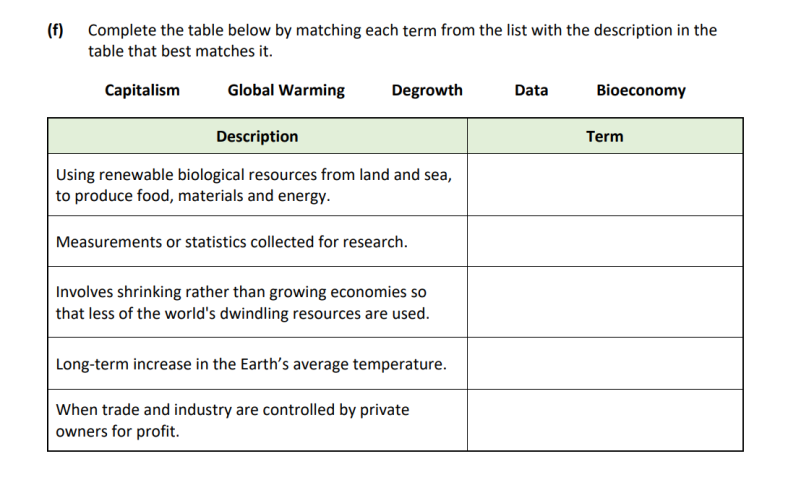
In the other sample papers, terms students are asked to match to their descriptions include: Community organising; Creating alternatives; Climate debt; Ecological debt; Climate loss and damage; Climate justice; Small island developing states; Capitalism; Global Warming; Degrowth; Data and Bioeconomy.
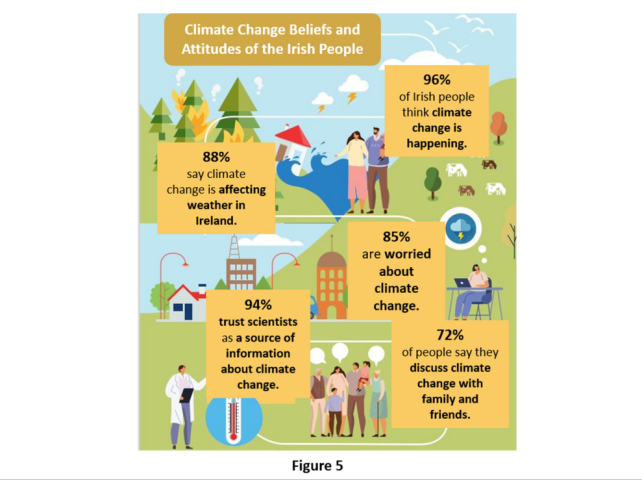
The topic of ‘mis-’ and ‘dis-information’ is also addressed in two of the papers, with higher level students asked to correctly identify examples of each, and to weigh in on whether statistics provided suggest the Irish public’s beliefs in climate change have been affected by misinformation and disinformation related to the topic.
In the higher level sample paper 1, students are asked to “Describe one example of environmental racism that you have studied,” implying that the concept of ‘environmental racism’ is a component of the curriculum.
On the same page, and on one of the sample ordinary level papers, students are asked to consider the matter of ‘rights of nature’, which sees nature given ‘legal rights’ in an effort to change views of the natural world, such as has been done in Ecuador and Bolivia, according to the sample ordinary level paper.
The exams centre climate campaigning and advocacy, with one question in the higher level sample paper 1 asking students to “Briefly describe one way you ensured there were no barriers to participation in a dialogue that you facilitated related to climate action and sustainable development”.
In the same question, students are asked to imagine that they’re designing a public information campaign to raise awareness about the “urgency of climate action”. They are instructed to choose “two reasons why urgent climate action is needed” and to “justify why they should be communicated as part of the campaign”.
Public attitudes to climate change come up, in the form of an infographic that provides statistics and asks students in response to those figures “why scientists are considered a trustworthy source” and whether the statistics suggest misinformation and disinformation have influenced the Irish public’s beliefs about climate change.
‘Climate justice’ and ‘climate injustice’ are topics that are repeatedly addressed across the sample papers, including the movements that have started in response to this concept and their efficacy. In this paper, students are asked to discuss the statement: “Climate action should promote climate justice for humanity and nature.” They’re encouraged to include in their discussion their understanding of climate justice, “how healthy ecosystems and the realisation of human rights are interdependent” and examples of actions that can be taken to address “root causes of climate injustice”.
An initial question in the second higher level sample paper asks students to select out of five options the three demands “best aligned with a global campaign for climate justice”:
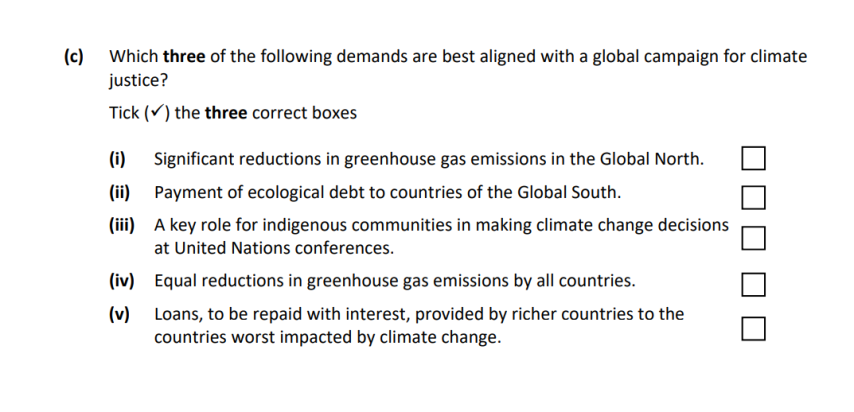
The topic of ‘colonialism’ and the role it has to play in climate justice and injustice is also present in this paper, although the initial question simply asks students to “Define colonialism” without any additional context.
Later on in the paper, colonialism is linked to climate injustice by way of a 2022 IPCC report, which stated that ‘historical and ongoing patterns of inequity such as colonialism’ contribute to climate injustice, before asking students to explain an example of this process in action.
Students are additionally asked in the sample paper to explain why it is the case that when “economic inequality intersects with inequality based on ethnicity, people’s capacity to respond to climate change can be reduced”.
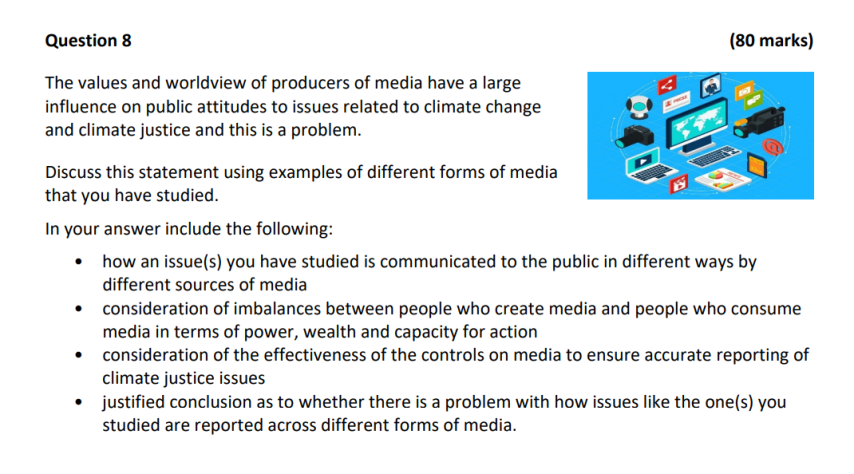
One of the last questions in the second higher level sample paper considers the role of the values and worldview of producers in the media, and how they relate to the way in which they influence public attitudes to issues of climate change and climate justice. As highlighted above, this is described in the question as “a problem” and students are encouraged to consider “the effectiveness of the controls on media to ensure accurate reporting of climate justice issues”.
This paper features an excerpt taken from an article on climate media site, DeSmog, which outlines the role Ireland’s agricultural industry plays in contributing to the country’s emissions. Describing Ireland’s dairy production as “unchecked,” it says that the “intensive farming lobby appears to be in the driving seat”.
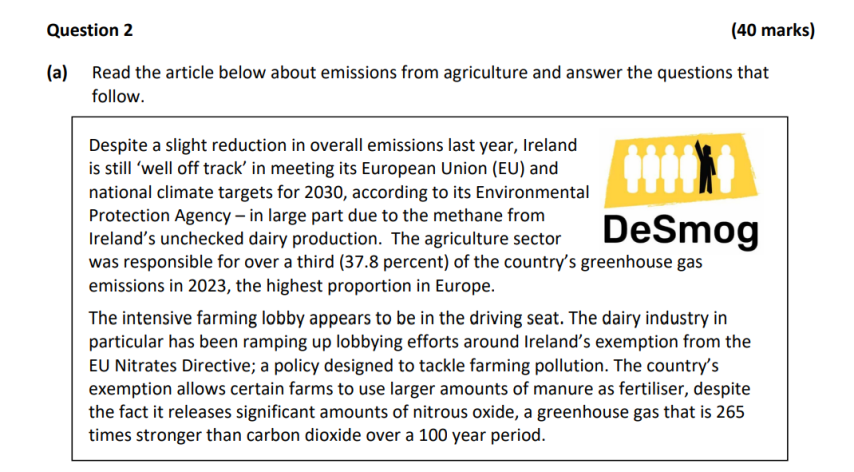
Some of the questions following this passage ask students to “explain briefly how lobbying can influence decision making” and to “examine one way the Irish government has taken action to reduce negative environmental impacts”.
On the climate advocacy front, a later question in the same paper examines students’ understanding of “facilitation skills” by choosing one such skill and explaining the importance of using that skill “when communicating with people about climate action and sustainable development”.
The skills they have to choose from include: Active listening; Questioning; Awareness of other people’s behaviours; Self-awareness; and Managing conflict.
Media framing of climate issues is also examined in this ordinary level sample paper, by presenting two different ways that a COP29 deal was covered by different articles:
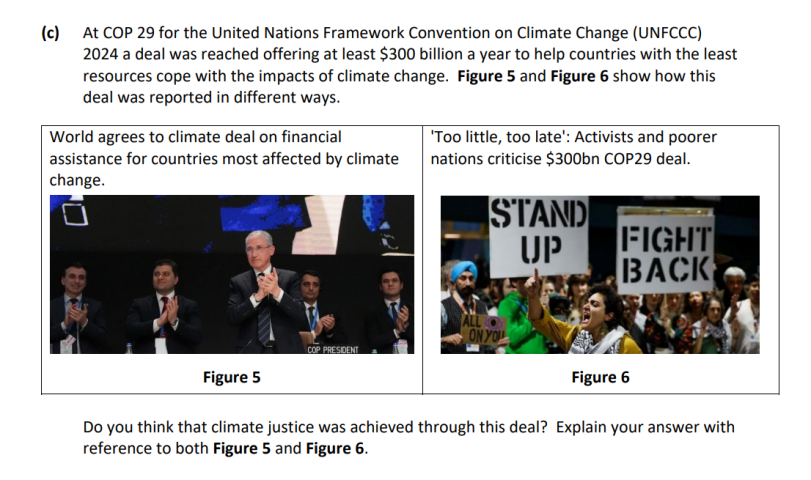
In light of that framing, students are to consider whether “climate justice” was achieved through the deal in question, referencing both images – one of which is objective, the other taking a critical stance towards the development.
One of the final questions on this paper asks students to discuss how age, ethnicity and gender can influence how people experience the impact of climate change.
The topic of individual and collective action comes up twice in this fourth paper. It comes up first when students are asked to indicate whether the statement “Individual action is more effective than collective action at achieving systemic change” is true or false, and again later on when they’re asked to discuss the roles of individual and collective action in “resolving the root causes of climate injustice”.
A lifestyle choices question features in this sample paper, which asks students to consider a chart showing “which lifestyle choices reduce carbon emissions the most”:
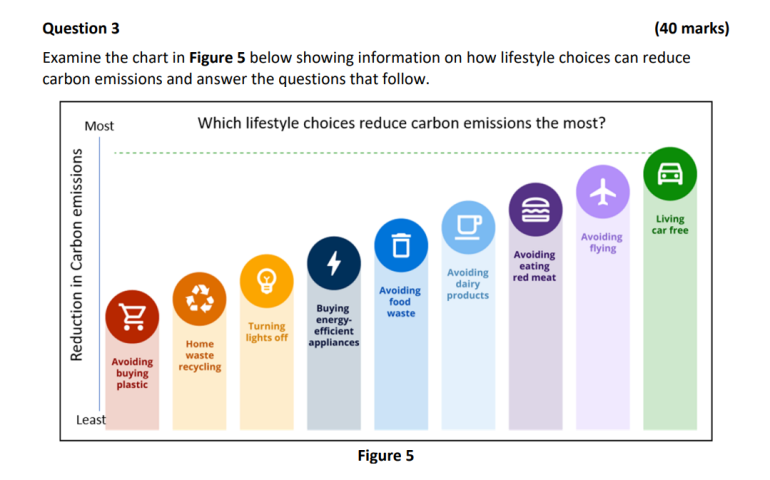
They are asked to identify which lifestyle choice reduces carbon emissions the most and then to choose one of the lifestyle choices and explain how it reduces carbon emissions.
The Re-turn exchange scheme also features in this paper, with a brief article excerpt explaining its role in “record-breaking recycling achievements”:
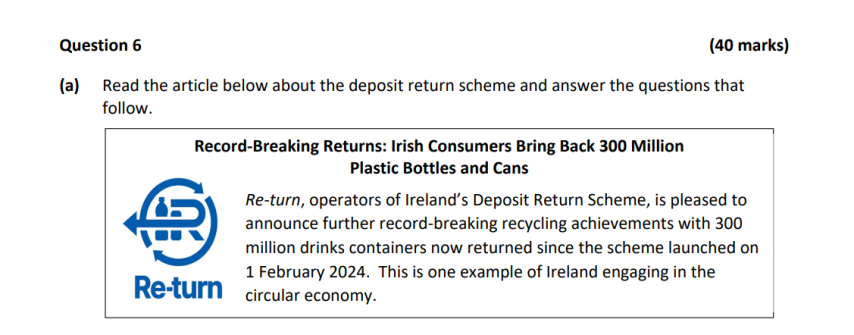
One of the questions following this passage asks students to explain how the Re-turn logo “helps to communicate the aim of the scheme”.