For decades, the gender pay gap has been presented as one of the defining economic inequalities of modern society. Politicians promise to reduce it, employers are required to report it, and campaigners often cite it as evidence that women continue to face systemic disadvantage in the workplace.
Yet one important distinction is frequently overlooked: equal pay and the gender pay gap are not the same thing.
In Ireland, the Anti-Discrimination (Pay) Act 1974 made it unlawful to pay men and women different rates for the same work—or work of equal value. That principle has since been reinforced through the Employment Equality Act 1998 and subsequent equality legislation.
Employers have therefore been legally prohibited from paying women less than men for performing the same or equivalent work for more than fifty years.
The gender pay gap measures something different. It compares the average earnings of all working men with those of all working women, regardless of occupation, hours worked, seniority, career interruptions or family circumstances.
A gender pay gap can therefore exist even where employers fully comply with equal pay legislation.
If unequal pay for equal work has been illegal for half a century, what explains the gender pay gap today?
This article examines two recent Irish studies that address that question:
- Doris, O’Neill and Sweetman (2022) – Why Do the Earnings of Male and Female Graduates Diverge? The Role of Motherhood and Job Dynamics. The study follows more than 118,000 Irish university graduates over a ten-year period to examine how men’s and women’s earnings diverge after entering the labour market.
- L. Bari (2024) – Gendered Divergence in the Impact of Parenthood on Wages: The Role of Family Size, Human Capital and Working Time. The study examines earnings across the wider Irish workforce, focusing on how parenthood and family size affect men’s and women’s wages.
Despite using different datasets and methodologies, both studies reach the same broad conclusion: men and women begin their careers on broadly similar earnings, but substantial differences emerge after parenthood, particularly among mothers.
What Does the Gender Pay Gap Actually Measure?
Public debate often assumes that the gender pay gap is evidence that women are paid less simply because they are women. Others argue that it reflects differences in occupations, working hours or career preferences. These explanations are often presented as competing theories.
The two Irish studies reviewed here suggest a different perspective for Ireland.
They indicate that the largest earnings divergence occurs not when men and women first enter the labour market, but after they become parents. Identifying when the gap emerges is important because it points towards very different explanations—and potentially different policy responses.
Study One: The Gap Appears After Parenthood, Not After Graduation
The first study, conducted by Doris, O’Neill and Sweetman, tracked more than 118,000 Irish university graduates for up to ten years after graduation. If labour market discrimination at the point of entry were the principal cause of the gender pay gap, one would expect to see substantial earnings differences immediately after graduation.
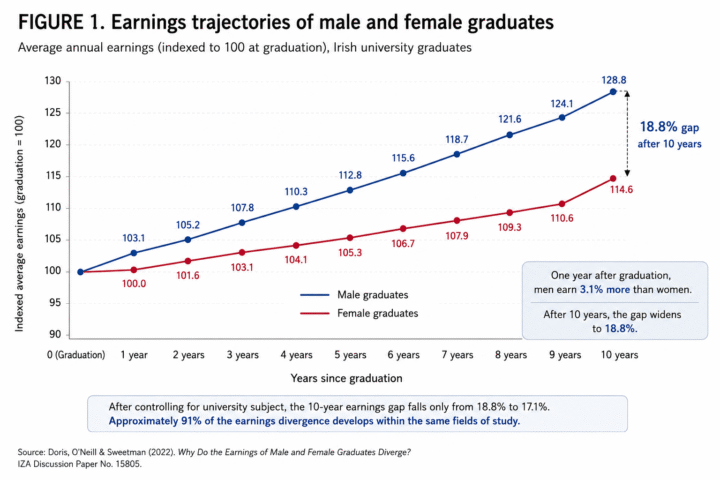
Instead, the researchers found that one year after graduation, male graduates earned only 3.1% more than female graduates. They do not attribute this relatively small difference to any single cause. It may reflect graduates entering different employers, industries or specialisations that offer different starting salaries.
What is more striking is what happens over time. During the following decade, the earnings gap widened to 18.8%. Educational choices explained surprisingly little of that divergence. After controlling for degree subjects, the ten-year gap fell only slightly—from 18.8% to 17.1%—leading the researchers to estimate that approximately 91% of the earnings gap develops within the same fields of study rather than between different disciplines, which rules out the option that it is because men and women choose different professions.
The study identifies childbirth as the principal turning point. Mothers experienced an immediate 27% reduction in earnings following the birth of their first child, while fathers experienced no comparable decline.
Six years later, mothers still earned around 35% less than before childbirth. Similar patterns appeared across graduates from Business, Law, Engineering, STEM and the Humanities, suggesting that motherhood—not educational choice—is the principal driver of long-term earnings divergence.
The researchers also considered other explanations. Job mobility accounted for little of the widening gap, while reduced working hours explained only about half of the motherhood penalty. The remaining difference reflected slower career progression, interrupted employment and workplace structures that continue to reward uninterrupted careers.
Study Two: Family Size Matters
While the first study focuses on university graduates, Lauren Bari’s (2024) research examines the wider Irish workforce and asks an additional question: does family size influence earnings? Her findings suggest that it does.
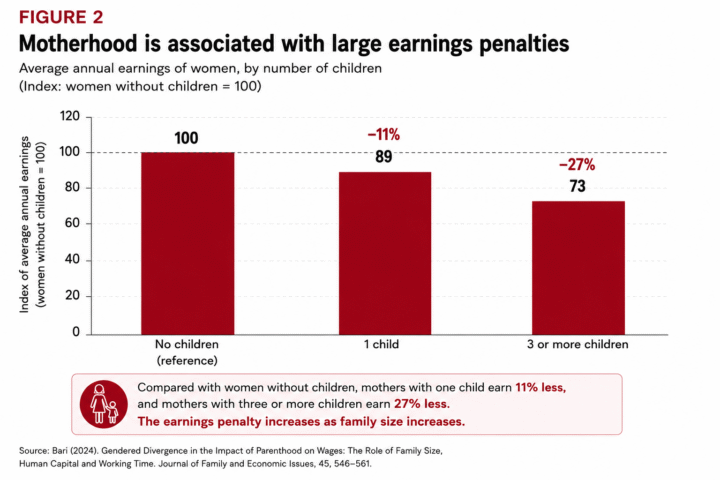
Compared with women without children, mothers with one child earned approximately 11% less, while mothers with three or more children earned around 27% less. The earnings penalty associated with motherhood therefore increases as family size grows.
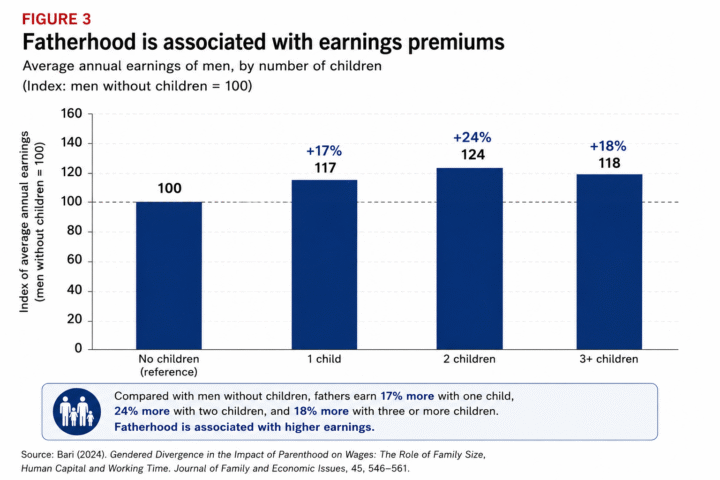
The pattern among men was almost the reverse. Compared with childless men, fathers with one child earned approximately 17% more, fathers with two children enjoyed the largest premium of around 24%, and fathers with three or more children still earned about 19% more than comparable childless men.
Rather than the greatest earnings divide existing simply between men and women, Bari’s findings suggest that the largest gap exists between mothers and fathers, particularly in larger families.
Why Does Parenthood Affect Men and Women Differently?
Taken together, the two studies show that parenthood affects men’s and women’s earnings in markedly different ways.
Mothers experience a substantial earnings penalty after having children, while fathers often receive what economists describe as a fatherhood wage premium. Rather than reducing their earnings, fatherhood is frequently associated with higher wages and a stronger attachment to the labour market.
The studies suggest that much of this divergence reflects how many households reorganise their responsibilities after children arrive.
As childcare demands increase, families often specialise. Fathers are more likely to increase their commitment to paid employment, work longer hours and become the primary earner, while mothers are more likely to reduce working hours, seek flexible employment or interrupt their careers to provide childcare and other unpaid care.
In many households this may simply reflect economic reality. If one parent already earns more, it can make financial sense for that parent to remain focused on paid work while the other assumes a greater share of caring responsibilities. Childcare costs, tax arrangements, workplace flexibility and personal preferences may all influence these decisions.
Neither study claims to identify the precise reasons why families divide responsibilities in this way. Instead, both demonstrate that the most significant divergence in earnings occurs after parenthood rather than at the start of men’s and women’s careers.
These findings are also consistent with a growing body of international research. Nobel Prize-winning economist Claudia Goldin, for example, has shown that much of the modern gender earnings gap in developed economies emerges after parenthood rather than when men and women first enter the labour market.
What the Evidence Does Show
Taken together, these studies suggest that earnings among men and women without children are much more similar than the overall gender pay gap is often assumed to imply.
Rather than reflecting a universal earnings disadvantage affecting all women throughout their careers, the largest differences appear to be concentrated among mothers, particularly those with larger families.
This is an important distinction because it changes how the gender pay gap should be interpreted. Equal pay legislation concerns whether men and women receive the same pay for the same work. The gender pay gap, by contrast, measures average earnings across the labour market. The two concepts are related but they are not identical.
What the evidence does suggest is that the overall gender pay gap should not automatically be interpreted as evidence of unequal pay for equal work. Equal pay has been protected in Irish law for more than fifty years. The modern gender pay gap reflects average earnings across the workforce, and these studies indicate that a substantial proportion of that difference develops after people become parents.
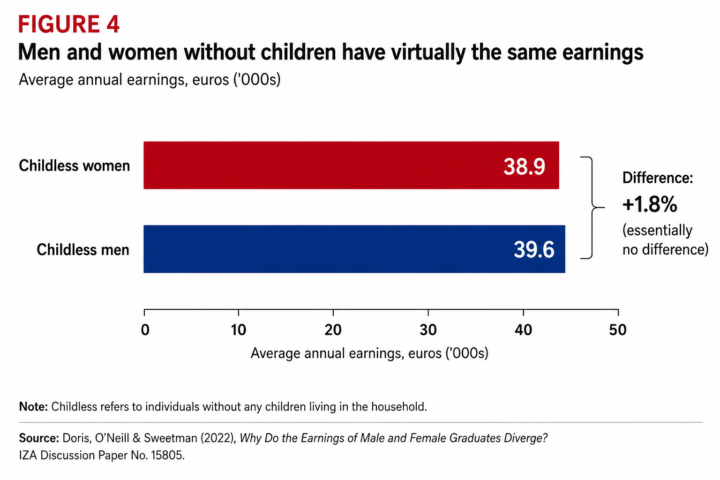
That distinction matters because policies designed to prevent unequal pay are not necessarily the same as policies designed to reduce the economic consequences of parenthood. As illustrated by the data, men and women without children display minimal overall differences in average annual earnings, with childless men earning just 1.8% more.
Conclusion: Are We Asking the Right Question?
The phrase gender pay gap has become firmly established in political debate, but these two Irish studies suggest that it describes the outcome more accurately than the principal mechanism producing it. Men and women begin their careers on broadly similar earnings, and educational choices explain relatively little of the long-term divergence. Instead, the largest earnings differences emerge after parenthood, widen as families grow and fall most heavily on mothers.
This does not diminish the importance of tackling inequality. It does, however, suggest that public debate should distinguish more clearly between unequal pay for equal work and the broader earnings differences associated with parenthood. Conflating the two risks directing attention towards the wrong problem and, consequently, towards less effective policy solutions.
If public policy is to be genuinely evidence-based, it should focus on where the earnings gap actually emerges. These studies indicate that the principal turning point is parenthood and the unequal economic impact it continues to have on mothers and fathers.
Perhaps, then, we are asking the wrong question. Rather than asking simply why women earn less than men, we should ask how society values and supports the work of raising children.
A family is not a competition between a husband and a wife over who earns more. In most cases, it is a partnership in which two people make different, often unequal, economic sacrifices to achieve a shared goal: raising the next generation. If parenthood is the principal source of the earnings gap, then policies that strengthen families, reduce the financial penalties associated with having children, and give parents greater flexibility may do more to narrow that gap than policies aimed solely at workplace inequality.
Key Takeaways
- Equal pay for equal work has been protected in Ireland since the Anti-Discrimination (Pay) Act 1974.
- The gender pay gap measures average earnings across the workforce, not whether men and women receive equal pay for the same work.
- Doris, O’Neill and Sweetman (2022) found that graduates begin their careers with only a 3.1% earnings gap, which grows to 18.8% after ten years.
- Approximately 91% of that gap develops within the same fields of study, suggesting educational choice explains relatively little of the long-term divergence.
- Mothers experienced an immediate 27% earnings reduction after childbirth and remained around 35% below their pre-birth earnings six years later.
- Bari (2024) found that the motherhood penalty increases with family size, while fathers often receive a fatherhood wage premium.
- Both studies identify parenthood—not labour market entry—as the principal turning point in long-term earnings divergence.
- The evidence suggests that much of what is commonly described as the gender pay gap is more accurately understood as a parenthood pay gap, while recognising that multiple factors—including childcare, workplace structures and family choices—likely contribute to that outcome.