A UCC academic who has advised the national curriculum body on SPHE – and who said that “fears around childhood innocence” act as barrier to effective RSE, and that it was a “problematic assumption” that children were “free of sexual knowledge” – is now leading a survey in schools on LGBT issues.
Dr Aoife Neary, a lecturer in sociology in UCC, has also written that “in early childhood, most children’s relationships to gender and sexuality are fluid and many children of primary school age are identifying as LGBTQ+” – and insists that “discourses of ‘childhood innocence’ and ‘age appropriateness'” restrict primary school approaches.
She says that “children of primary school age are considered to be “innocent,” “pre-sexual,” “pure” beings and questions of educating about gender and sexuality often spark concerns about the potential to “corrupt childhood innocence” or “prematurely sexualize” children” – but that “many have pointed out that this concerted investment in “childhood innocence” is laden with contradictions.”
The academic is leading a “Children’s LGBTQ+ Equality and Rights” survey which is targeted at children and young people under 18 and is commissioned and funded to the tune of €80,000 by the Ombudsman for Children’s Office. Dr Neary is the Project Principal Investigator and the project is supported by Belong To LGBTQ+ Youth Ireland.
A notice regarding the survey was sent to parents in a primary school by email from the school, Gript was informed, targeting parents of children aged 13 and under who ‘identify as LGBTQ+’.
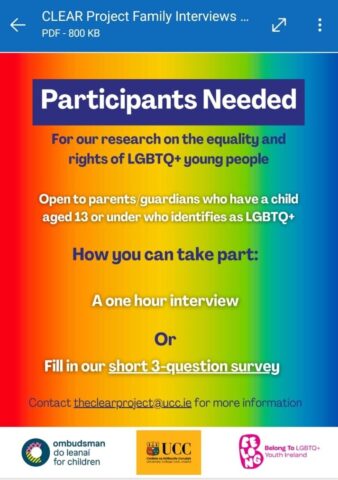
But parents have expressed concern at what they say is a lack of scrutiny around the views expressed by Dr Neary in regard to childhood innocence, with one parent telling Gript that she believed such assertions needed to be challenged, and questioned the suitability of anyone holding such beliefs being involved in surveying schools.
Dr Neary has published research where she notes: “a truly queer approach to childhood studies” would also “involve a queering of childhood innocence itself” – claiming that “the age-appropriate timelines” articulated by some parents and teachers point “to the continuing underlying problematic assumption that children are somehow free of sexual knowledge until introduced to sexual knowledge by adults”.
She is currently a lecturer in the School of Education in UCC – having spent ten years in the University of Limerick, where she was a Senior Lecturer in Sociology.
She was previously co-opted by the national curriculum body, NCCA, to be a member of their Post-Primary Development Group for Relationship and Sexuality Education (RSE) Post-Primary Development Group.
NCCA, which is currently embroiled in controversy over its draft new curriculum for Leaving Cert Maths, was also previously sharply criticised by parents who felt that it was ignoring the concerns expressed by thousands of parents in regard to what was being developed for the SPHE curriculum in schools.
Explicit SPHE content and the inclusion of transgender ideology as fact in classroom lessons has continued to cause controversy since that consultation.
“FEARS AROUND ‘CHILDHOOD INNOCENCE’ ACT AS A BARRIER”
Dr Neary appeared before a Joint Oireachtas Committee on Education in 2018 where she argued that changes to RSE must “Firstly .. take account of how fears around ‘childhood innocence’ act as a barrier in ways that don’t account for the capabilities of children or the wants of parents.
“To be effective, comprehensive RSE must begin in early years — from as young as three — in partnership with parents,” she said.
Neary said that “the recent developments in RSE in Wales and the recommendations made by the expert panel outlined in Renold and McGeeney’s (2017) report should serve as an exemplary signpost for changes to RSE in Ireland” – and added that “many of their recommendations are echoed across my written submission”.
In the report linked by Neary in her opening statement in Leinster House, Renold and McGeeney, in arguing for changes to the Welsh RSE curriculum, insisted that children 0-5 express sexuality and that this is natural and healthy.
They say children’s “learning and experience of sexuality and relationships” begins “as soon as they enter the social world” – adding “frequently children and young people are viewed as ‘innocent’ or ‘pre-sexual’ beings, sparking unproven concerns within schools about the potential for SRE to ‘corrupt childhood innocence’ or ‘prematurely sexualise’ young people”.
“Yet expressing sexuality through sexual behaviours and relationships with others is a natural, healthy part of growing up. For example, for children aged between 0-5, behaviours such as holding or playing with own genitals, curiosity about other children’s genitals, interest in body parts and what they do and curiosity about sex and gender differences reflect ‘safe and healthy development’ (see Brook 2015)”, they wrote.
The report also insists that there should be a statutory requirement that children in Wales, aged 3-16, be taught RSE, and that parents should not be allowed to remove their children from the lessons.
Neary has published papers on topics around education including Marriage Equality Time: Entanglements of sexual progress and childhood innocence in Irish primary schools.
In the latter, she writes that “queer theory has long attended to how discourses of innocence constrain and restrict childhood”, quoting research that argues that the ‘rhetoric of innocence’ offers a refusal to ‘calculate the child’s future before it has the opportunity to explore desire’.
In that paper she claims that “the persistence of notions of childhood innocence ensures that education about sexuality and gender diversity continues to be seen by school staff and parents as a much more explosive topic than bullying prevention”.
A ‘QUEERING OF CHILDHOOD INNOCENCE’
And she notes: “a truly queer approach to childhood studies” would also “involve a queering of childhood innocence itself” – claiming that “the age-appropriate timelines” articulated by some parents and teachers point “to the continuing underlying problematic assumption that children are somehow free of sexual knowledge until introduced to sexual knowledge by adults”.
The hope of Neary and her fellow researcher, Mary Lou Rasmussen, as expressed in their paper, is that “discussions about children, education and sexuality might be imagined otherwise”. They quote Prof Kathryn Bond Stockton’s work on the ‘brutality of the ideal of the innocent child’ and “growing sideways”.
Bond Stockton’s book exploring children “growing sideways” was described as a “fascinating look at children’s masochism, their interactions with pedophiles and animals, their unfathomable, hazy motives (leading them at times into sex, seduction, delinquency, and murder), their interracial appetites, and their love of consumption and destruction through the alluring economy of candy”, according to a review on Duke University Press.
Neary references Bond Stockton’s idea of growing sideways again in another paper entitled, Trans children and the necessity to complicate gender in primary schools, in which she is critical of the “violence of gender norms” and discusses the need to reimagine “violently cisgendered standards of gender”.
In another paper (2023), Neary says that age-appropriateness is an arbitrary concept – and that “assumptions about childhood innocence” are “tightly regulating children’s access to knowledge about sexuality and gender”.
“In this way, we can see how ‘innocence’ ‘is something that adults wish upon children with the powerful concept of age-appropriateness having a distinct impact on the shape of sexuality education in primary schools,” she writes.
She says that insights from children are required to break through “the arbitrary politics of age” – and that otherwise, “adult assumptions and panic-driven moral judgements around concepts such as ‘childhood-innocence’ and ‘age-appropriateness’ will continue to hold back progress and fail in realising the basic human rights of all children to have their lives and families reflected and meaningfully included in sexuality education”.
SUITABILITY QUESTIONED
Dr Niamh Regan, who works with the Natural Women’s Council, and who has researched the introduction of gender ideology in schools, said that she found Dr Neary’s views in regard to childhood innocence “very troubling”, adding “these assertions needed to be challenged – and I question the suitability of anyone holding such beliefs being involved in shaping curricula or surveying schools”.
“This lecturer told the Oireachtas Education Committee that effective sexual education should start at age three – and that she believed fears about childhood innocence was a barrier to teaching RSE in primary schools, yet she has been given another grant – this time of €80,000 – and is surveying primary schools,” Dr Regan said.
“Parents are the primary educators of their own children, a right the Government has a constitutional duty to uphold. Yet time and again, parents have been obstructed, blocked, belittled and ignored by schools, the Department and even patrons when asserting that right,” she said. “It feels like our education system has been captured.”
Another parent, Sam Poynter, told Gript that “no parent believes that childhood innocence and age appropriateness is socially constructed. ”
“We have an abundance of anecdotal and empirical evidence that exposing children to sexual experiences or content can cause real and long-lasting harm, especially if it is introduced too early for their psyches to process, resulting in acting out behaviours on peers,” she said.
In her submission to the Oireachtas Committee, Neary also argued that “given that many young people are already engaging in sexual activity”, she favoured exploring topics such as pleasure, reproductive rights, pornography in addition to consent and the use of social media/technology.
Neary says in her bio that much of her work has been funded by the Irish Research Council, and that she leads and teaches teacher education modules.