Close of business Friday, July 31, marks the deadline for submissions to be made on the proposal by Fingal County Council to plant an 18,000 unit – mostly apartment – development which will accommodate 45,000 people into the green zone between Finglas and Blanchardstown.
Unless, of course, the deadline is extended in response to growing demand by local communities backed now by the six Councillors representing the Finglas ward on Dublin City Council. Five of them belong to parties whose Councillors on Fingal voted in favour of the plan.
- Fingal has made no effort to engage with the local community.
- Fingal did not tell any residents or their elected representatives in Dublin North West that this consultation had been published. People only found out through neighbours.
- To get a printed copy of the Dunsink Area Plan you need to pay Fingal €100. You needed to get to Fingal offices before 3.30pm to make payment in person
- The deadline for submissions is the 31st of July when the majority of people are on their holidays and will be unaware that this consultation has been published.
The several hundred submissions that were received up until now are overwhelmingly negative. An observation in one of the few positive contributions was that there need to be enough bars and restaurants.
I may be prejudiced but the opposition is rather less superficial.
It is as well, before we do look at the submissions, to place the proposal in context. As I pointed out before, many people around the country are beginning to think and utter what was beyond the pale not so long ago.
Namely, that the vast expansion of immigration fuelled housing, most of it high rise, is not the unquestioned Good that is claimed by the establishment from Fine Gael to People Before Profit, and from the bosses union IBEC to the workers unions in the ICTU.
The Environmental Assessment prepared for Fingal County Council has a section entitled ‘Population and Human Health’ which accepts the need for a socially engineered ‘new city’ because “in the period between 2022 and 2040 it is expected that there will be roughly an extra one million people living in the country.”
As part of this the authors of the report, Brady, Shipman, Martin, note that those entrusted with the administration of Dublin “should therefore plan to grow at a targeted rate of just above the projected national average to 2040, i.e. by around 20% to 25%. Given Dublin’s scale, this means planning for at least 296,000 more people in the City and suburbs by 2040.”
‘NEW COMMUNITIES’ TO BE MOSTLY IMMIGRANTS
All of course in “new sustainable communities.” Made up mostly – as the official population projections admit, but which the report does not mention – by persons who will have come to Dublin and other parts of the state as part of the 90% of population increase made up of immigrants.
If the bulk of the submissions on the Dunsink plan are anything to go by, there are increasing numbers of people who no longer accept that building new housing units, particularly in large and incongruous bulk, and thus “helping to solve the housing crisis,” is an excuse for everything.
Some of the submissions refer directly to the demographic crisis which is the root cause of the shortage of housing but the connection is mostly implicit. There are many references to the greatly added congestion, pressure on transport, schools, health care, and the increased risk of anti-social behaviour.
Dubs well recall the disaster that has been high rise with several references to the now demolished Ballymun tower blocks: “Ballymun was deemed a failed housing project and the elements in this plan have exactly the same principles that Ballymun was built on. The 1960s planners put people in large apartment blocks to fix a housing shortage at the time,” one submission notes.
There is a visceral nay-saying to the proposition that all of this will be good for the people amongst whom it will be placed:“Finglas residents will experience years of disruption without clear evidence of corresponding local benefits,” with another local person stating that “Fingal’s own proposal of “compact living” will mean a new suburb of 18,500 units will be a high rise concrete jungle.”
If there is a theme note, then perhaps it is struck by the resident who declares that “You will also destroy our Finglas heritage by eradicating our lanes, our walkways, our wildlife, and most of all the soul of Finglas.”
Quite a number of the submissions refer to the historical and environmental heritage of the area. That desire to place the conservation of one’s own community and environment places north county Dubs on the same step as English conservative Roger Scruton who urged “vigilant resistance to the entropic forces that threaten our social and ecological equilibrium.”
LEFT ABANDON “ECO-SOCIALISM” WHEN IT SUITS
This is diametrically opposed to the actual position of the left who conveniently abandon “eco-socialism” when it is trumped by their support for mass immigration and “diversity” undermining the society they seek to destroy and replace with a ‘Better World.”
It also puts us on the opposite side to ‘conservatives’ who think that anyone who objects to any ‘project’ out of which people will make money regardless of the social consequences is a communist. These are ‘conservatives’ who are behind the current Government’s plans to speed up dystopian projects like Dunsink because ‘deregulation’ is one of their icons.
Their own rootlessness blinds them to the fact that the social phenomena they proport to oppose are first and foremost the consequences of the ‘free movement of Capital and Labour’ and not some Marxist plot. What they share in common with the left is their ignorance of the forces at work.
National Party Councillor Patrick Quinlan has posted a photograph of the proposed site overlain with sites of archaeological importance spanning a period of thousands of years; from the Bronze Age and Iron Age, through the pre-Conquest Gaelic era, medieval Christianity, Norman castle works, up to more recent historic times.
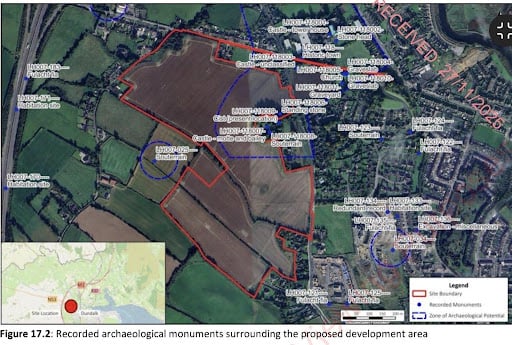
Among the later heritage sites are the world-famous Dunsink Observatory that was built in 1785 and apropos of which one submission states: “Given Dunsink Observatory’s inclusion on Ireland’s UNESCO Tentative List, greater protection should be afforded to its setting, heritage significance and dark-sky environment. The proposed density and intensity of development have the potential to undermine these important heritage assets.”
There is also the natural habitat which in many ways is unchanged in hundreds of years and can claim to be unique anywhere close to Dublin city centre. That was already recognised in the planning and laying out of the Tolka Valley Park. However, as at least one submission points out, the Dunsink City plan will require the destruction of part of the park in order to widen Scribblestown Lane which has been there, virtually untouched other than a coating of tar, for centuries.
Another submission goes into great detail about the importance of the Tolka and the associated wetlands and woodlands. These are the habitat for native trees including the ash, oak, willow, alder, hawthorn and birch and these in turn provide homes for a wide variety of birds, insects, bats and fungi, as well as a range of small mammals.
Among the birds that live here are the Grey Heron, Kingfisher (one of Ciara’s delights as a child), Grey Wagtail, Little Grebe, Moorhen, Mallard, Mute Swan, Cormorant, Buzzard, Kestrel, Sparrowhawk, Long-tailed Tit, Goldfinch, Bullfinch, Song Thrush and Blackcap.
Among the smaller mammals there are the Fox, Irish Hare, Hedgehog, Rabbit, Bats (including pipistrelle species) and even some otters have been spotted along the river. There are also frogs which occasionally hop into gardens of a wet evening and there are Brown Trout found in the River Tolka.
All of these should be entitled to the protection of the Wildlife Acts and the EU Habitats Directive.
As for myself, I value all of the historical sites and the historical heritage and the creatures who we are blessed to have live close to us more than some multinationals’ ‘need’ to have its foreign workforce close at hand, neatly stacked and five minutes on the LUAS from the data centre.