“Stop looking out the window”, a teacher told her little pupil. “I’m not looking out the window”, he replied, “I’m thinking.” Thinking, or more appropriately thinking logically and objectively, is undervalued in the Irish education system. So with thinking exempted from Irish schools, unlike the UK, France, Morocco and other countries where philosophy and critical thinking are on the curriculum, one has to wonder, while teachers can be great in a classroom, if they are the best people to manage a country.
My AI spy tells me currently there are 19 TDs who are teachers, most notably our current Taoiseach and recently Taoiseach Enda Kenny. This number doesn’t include the many would-be teachers who completed arts and science degrees on the path to teaching.
An objection to a teaching class in charge of the State is that the perfect person for a teacher is someone who sits up, listens up, works up, pays up and at times shuts up, because they have the information and it is they who will impart it to us.
Daniel J. Mahoney’s book The Statesman As Thinker: Portraits of Greatness, Courage and Moderation therefore is a timely, authoritative and well researched book on a subject whose time has come. If one were to think of the word “statesman”, who would come to mind in the present age? Within our own country we can consider the following: a taoiseach who grossly fumbled Fianna Fail’s presidential candidacy, has claimed talk of national autonomy is passé and who, along with former leader of the Greens, Eamonn Ryan, walked out of a press conference when Taoiseach Leo Varadkar (who also walked out) was asked “What is the definition of a woman?”; we have a Minister of Finance who is unaware of the effect of inflation on the bailout loan to PTSB in 2008 and its subsequent sale, resulting in a loss of €1bn (inflation since 2008 is 27%) rather than having “made a little extra” as he claimed, who as Minister for Health thought the recent pandemic was called Covid 19 because there were 18 previous corona viruses, and who now expounds on international and maritime law because of his animus for Israel and only Israel; Sinn Feiners who lack an identity, and, like rebels without a cause, would fight with their toenails; and the confused Greens – what’s left of them – are more red than green.
And what of Europe? Ursula von der Leyen –“Queen Ursula” to many in Europe – it has been argued, has resisted all attempts to uncover her role in the Pfizergate scandal. Then there are the lawfare and democracy shields which undermine the European project and democracy.
To begin, let’s acknowledge it is impossible, contra Maria Walsh MEP and An Taoiseach Micheál Martin, to have a statesman without a State and it is impossible to have a State without having borders, and without borders there can be no democracy.
Mahoney dedicates six chapters to six examples of statesmen who are not just statesmen, but thinkers. In the Introductory Note he tells us the book “centers around Cicero, Burke Washington, Tocqueville, Lincoln, Churchill, de Gaulle, and Havel while making collateral reference to Solon, Pericles, Jefferson, Pyotr Stolypin, Mandela, Reagan and Thatcher.” That’s the who. The why he informs us is because they are the “rare and admirable souls who embodied magnanimity tempered by moderation, who embodied the cardinal virtues in a morally serious and realistic way, and whose rare combination of thought and action partook of the philosophical.”
To explain his position, Mahoney chooses Napoleon as an example of someone who was not a statesman and great thinker. “While not a tyrant . . . he revealed the false allure of greatness shorn of the cardinal virtues first discerned by the ancients and further developed by Christian thought; courage, prudence, justice and temperance. These virtues are the core of authentic political greatness.” (p. ix)
Great individuals show their strength of character in a crisis, and Mahoney illustrates this: “Solon addressing civil strife and class conflict in Athens in the sixth century BC; Pericles steering a middle path between imperial grandeur and prudent restraint in resisting the Athenian Empire at the beginning of the Peloponnesian War; Cicero using all the arts of rhetoric and statesmanship in an ultimately failed attempt to save the remnants of Roman republicanism from the threat of Cesarean despotism; Burke eloquently warning defenders of liberty against the proto-totalitarianism of Jacobin France; Washington leading the American people to their rightful station among the peoples of the earth and governing the new republic with an austere republican dignity; Lincoln preserving the Union and putting an end to chattel slavery; Churchill eloquently and firmly defending liberty and law and all the achievements of the ‘English-speaking peoples’ against the dreadful barbarism of Nazism.
“Classical authors were right to understand such statesmanship as an elevated standard against which all political action can be judged.” (p. 2) The American Founders we learn read their Cicero and Plutarch.
Alexis de Tocqueville, a Normandy parliamentarian and Foreign Minister of France from 1848-1851, deservedly has a dedicated chapter, “is another outstanding example of a great-souled man who lived his life at the intersection of thought and action, a statesman-theorist who combined magnanimity and moderation with due attentiveness to the requirements of modern liberty.” (p. 79)
Tocqueville, Mahoney assures us, “will be remembered for his three master works, Democracy in America (1835-1840), The Old Regime and the Revolution (1856), and the Souvenirs or Recollections, posthumously published in 1893. . . In contradistinction to many other figures in this book, we might more accurately call Tocqueville ‘the thinker as statesman’ and not the other way around.” (p. 80)
What is notable about Tocqueville is that when he published Volume I of Democracy in America, he “burst onto the stage as a thinker of the first order and was only thirty years of age.”
Mahoney, writing with the insight and authority of a great scholar who knows his philosophy, politics and history reminds us in these days of leftwing lunacy: wokery, identity politics, anti-Semitism, reverse racism, transgenderism, anti-free speech, ‘hate crime’ laws, diversity, etc., “Too many intellectuals think of revolution in theatrical terms, as something that will lead to vaguely defined ‘emancipation’. Tocqueville’s Recollections continue to provide a powerful antidote to this revolutionary illusion that appears to be a permanent temptation in late modernity.” (pp. 93-94)
Mahoney, no lover of socialism or leftwing politics – whatever they now mean – says, “In a beautiful and discerning speech from September 12, 1848 (‘The Speech on the Right to Work’) . . . Tocqueville attacks socialism for its ‘persistent, strenuous, and immoderate appeal to man’s material passions’ (seen in the revolutionary greed and envy on the part of the poorer classes) and its ‘unrelenting’ assault on ‘the very principle of individual property’. . . . He, for one, saw socialism as at best the road to a ‘schoolmaster state’ (what we today would call the “nanny” state)” (pp. 95-96), and which brings to mind President Reagan’s warning about what he called the nine most terrifying words in the English language: “I’m from the government, and I’m here to help.”
Churchill was opposed to socialists on property rights also, Mahoney informs by quoting Churchill: “Socialists want everyone to be tenants of the State rather than owners and thus true citizens with a stake in the social order.” Socialism for Churchill was a gospel of envy, “ignorant of the true sources of prosperity and productivity.” (p. 17)
Another problem with socialist thinking is the delusion that everyone is entitled to everything so long as everyone else pays. Surprisingly, I once met a socialist who put his hand into his own pocket!
As Churchill demonstrated in his many fine and inspiring speeches, notably the Finest Hour Speech of June 18, 1940 and the “Iron Curtain” speech of March 5, 1946, his “language was much broader and deeper than the reductive contemporary language of ‘human rights.’ Churchill was the consummate British patriot but also a ‘good European’ and the most civilized of men.” (p. 151) Mahoney then informs us that the great philosopher Isaiah Berlin, writing in 1949, “rightly concluded that Churchill was ‘an orator of prodigious powers, the savior of the country, a mythical hero who belongs to legend as much as reality, the largest human being of our time.’” (p. 152)
For Mahoney, Charles de Gaulle was the most impressive statesman-thinker of the twentieth century. De Gaulle was a contemplative man but a man of action who presided over progress in France. Today, Emanuel Macron, the French President, claims de Gaulle’s memoirs provide continuing political inspiration. “Macron undoubtedly loves the trappings of the French presidency, but he is hardly a partisan of the ‘greatness’, ‘independence’ and ‘rank’ of France in the manner of de Gaulle”, Mahoney states, adding: “De Gaulle would probably be appalled by Macron’s easygoing accommodation to the behemoth of the European Union and the dictates of a politically unaccountable Brussels.” (p. 180)
Although a statesman and military officer de Gaulle had a special relationship with his daughter Anne, born with Down Syndrome. “She brought the best out of de Gaulle as father, husband and Christian”. De Gaulle, who attended daily mass in London during the war, “welcomed the trial of Anne’s diminished condition and suffering also as a gift that encouraged him to ‘always to aim higher’ (as he once was overheard saying to one of her doctors).” (p. 190)
De Gaulle, a man of honour and integrity, worked to restore good relations with Germany post-war by inviting Konrad Adenauer, the chancellor of Germany, to France. The two made state visits to each other. In July 1962 on a state visit to Germany, de Gaulle delivered fourteen sterling speeches in exquisite German.” The Franco-German reconciliation was symbolized “by these two Catholic statesmen coming together for prayer in the cathedral of Rheims, a city much contested in previous Franco-German wars and conflicts.” (p.195)
Closer to our time is a chapter on the Czech writer, anti-communist dissident, anti-totalitarian theorist and president of Czechoslovakia twice (secondly as president of the Czech Republic), playwright Václav Havel. Havel is remembered especially for his essay The Power of the Powerless. Mahoney says Havel’s genius was to see, like Solzhenitsyn, the ideological lie as the glue holding together a totalitarian or post-totalitarian regime. In that essay is a greengrocer “who thoughtlessly raised the sign ‘Workers of the World Unite’ above his produce stand was ‘ritualistically’ reinforcing the hold that the regime of the lie had on human souls.” (p. 204)
Havel’s biographer Michael Zantovsky speculates in his Havel: A Life that Havel never received the Nobel Peace Prize because of his principled opposition to appeasement and pacifism. Relevant for today, Mahoney writes: “Havel reminded us of the indispensability of civility, grace, courage, and responsibility in a postmodern world that increasingly mocks truth and greatness.” (p. 207)
This brings us to some thoughts Mahoney shares on Ronald Reagan and Margaret Thatcher. Neither were statesmen-thinkers in the “elevated and capacious sense” he explored in the earlier pages. Nor were they “great-souled” in the classical meaning of the term. Rather, Mahoney sees them as inspired conviction politicians who were dedicated to good, even noble, principles and ideas. Both were tough-minded in the face of communism that threatened human freedom and dignity. “Thatcher unapologetically defended national sovereignty and a vision of Europe deeper than the transnationalism championed by contemporary advocates of the European project in its present form.” She envisioned a “Europe of cooperating but independent and self-respecting nations.” (p.220) How disappointed she’d feel today!
Mahoney concludes by reassuring us, “We can again see the likes of the great statesmen-thinkers chronicled in this book if we dare to repudiate repudiation [i.e. repudiating our Western culture built on the classics, Judeo-Christianity and Greek philosophy] and once again open ourselves to human excellence in all its forms.”
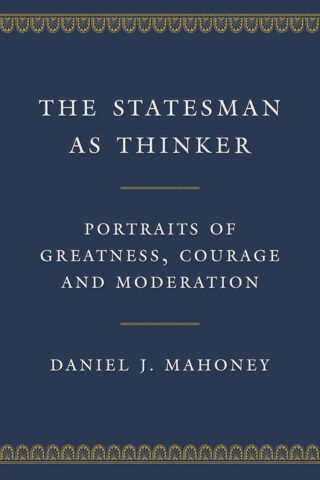
- The Statesman As Thinker: Portraits of Greatness, Courage and Moderation.
- Daniel J. Mahoney
- Encounter Books
- 231 pages
Stephen Blendell