A major independent review has found that cancer screenings have been missed and criminal convictions overlooked because of how official data had been collected, with a switch away from recording individual’s biological sex to their gender identity.
The report also warned that a failure by the NHS to record biological sex on patient records could have “potentially fatal consequences for trans people” – saying that trans patients have already not been called in for screening for conditions which may affect them due to their sex.
The review, led by Professor Alice Sullivan of University College London, sought to identify obstacles to accurate data collection and research on sex and on gender identity in public bodies and in the research system – and examined over 800 administrative and research datasets, surveys, and data collection policies.
Prof Sullivan said “a confusion between sex and transgender and gender diverse identities” had developed in recent years – and attempts had been made to “merge these two things into one variable”.
“While people can legally change gender, they can’t change biological sex. This means a woman who transitions to become a man may still need cervical smears and transgender women may need prostate checks,” she told BBC.
“What I’ve argued in this report is that sex is really important, we should be recording it by default – transgender and gender diverse identities can also be recorded where that’s appropriate,” she said.
RISKS
It noted that allowing individuals to change gender markers carries risks to patient safety and places an undue administrative burden on NHS services – saying that in the case of children, it also poses a safeguarding risk.
“There is no minimum age at which a child’s gender marker and NHS number can be changed. Parents can change the gender marker and NHS number of their child via their GP. Paediatricians have raised this with the Review as a safeguarding concern,” the review said.
“The NHS should cease the practice of issuing new NHS numbers and changed ‘gender’ markers to individuals, as this means that data on sex is lost, thereby putting individuals at risk regarding clinical care, screening, and safeguarding, as well as making vital research following up individuals who have been through a gender transition across the life course impossible,” the report found.
“In the case of children, this practice poses a particularly serious safeguarding risk, and should be suspended as a matter of urgency,” it also warned.
One case highlighted in the review was where a paediatrician and safeguarding expert provided the example of a case worker having difficulty in engaging Children’s Social Care with a child who was presenting at primary school with behavioural difficulties.
“The child had been brought up in the preferred gender of the mother which was different to their birth assigned gender. She had gone to the GP and requested a change of gender/NHS number when the baby was a few weeks old and the GP had complied. Children’s Social Care did not perceive this as a child protection issue,” the review revealed.
“GP practices are told that when a patient changes NHS number, they should print out the patient’s previous health records, redact the previous name and number, scan all this information and attach to their new NHS number. This slow and cumbersome process creates a significant workload for administrative staff and risks losing crucial health information. Not all health information is shared with GP practices. Patient data connected to the old NHS number will be lost, and this can include information relevant to child safeguarding,” the campaign group Sex Matters said.
SEX MATTERS
“The review finds that public data is in a mess. Many public bodies have stopped collecting data on sex, often replacing it with self-declared gender identity or a confused, undefined hybrid of gender identity and sex. This is the result of a series of successive shifts in public administrative records and surveys, with biological sex first labelled “gender” and then replaced by self-identified identity,” the group added.
“The problems are everywhere, from NHS records that do not record biological sex to police forces that record male sex offenders as women. Conflating sex and gender identity is not a harmless act of kindness but a damaging dereliction of duty,” spokeswoman Maya Forstater said.
CANCER SCREENINGS
The review said that despite the fundamental importance of sex to healthcare and medical research, their research found show a lack of consistency and clarity in recording practices throughout the NHS and in research.
Many different systems are used for recording patients’ data across the constituent parts of the NHS. Although these vary widely, gender identity is consistently prioritised over or replaces sex. Markers originally intended to represent sex are unreliable and can be altered on request by the patient. There are clear clinical risks associated with unreliable or absent sex markers on patient healthcare records, such as not being called up for appropriate sex-specific screening programmes, or the misinterpretation of laboratory results.”
“At the aggregate level, the loss of a robust sex marker undermines the integrity of data used to improve national clinical practice,” the review stated.
The analysis – commissioned by the February 2024 by the Secretary of State for Science, Innovation and Technology – concluded that:
The meaning of sex is no longer stable in administrative or major survey data. This instability is evident across key policy areas including health and justice. This has led to a widespread loss of data on sex.
In some cases, the loss of data on sex poses risks to individuals. This is particularly apparent within health and social care. These risks are especially high in the case of minors.
The review charted the shift in how data was being collected across the UK data service with significant changes in the past twenty-five years. “The loss of data on sex is a relatively recent phenomenon. Our analysis indicates that in the context of data collection, the term ‘gender’ gained traction as a synonym for sex in the 1990s. More fundamental changes have taken place within the last decade, which has seen both the reframing of ‘gender’ as a synonym for gender identity, and the replacement of sex questions with gender-identity questions,” Prof Sullivan’s finding noted.
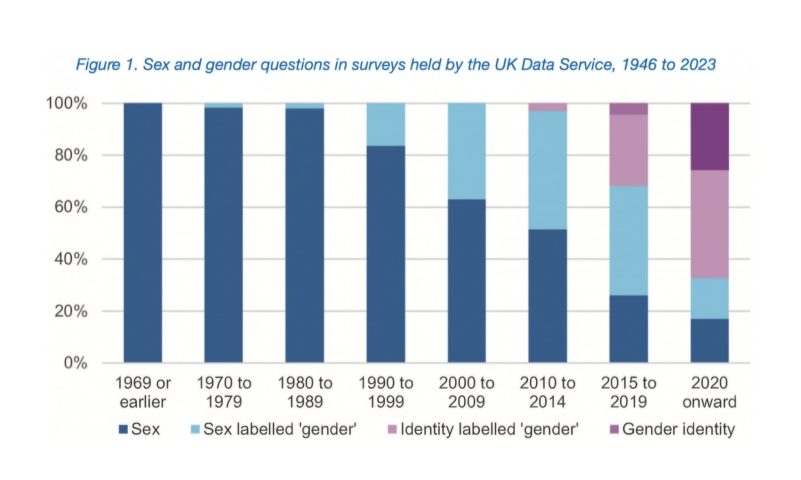
The review also recommended that police forces stop permitting changes to be made to individual sex markers on the Police National Computer.
CRIME
“In relation to crime, In some cases, the conflation of sex and gender identity has been embedded in shared IT systems, posing a barrier to organisations wishing to collect data on sex. For example, a data management system used by rape crisis centres in Scotland uses the following ‘gender’ fields for both victims and alleged perpetrators: Male/ Female/Intersex/Gender queer/Other,” the report said.
“Many police forces record crimes by male suspects as though they were committed by women at the request of the perpetrator or based on how a person “presents”,” Sex Matters said.
“Home Office Standards (ADR 153) on demographic data advise police forces to record sex subject to a gender-recognition certificate. Other mandatory Home Office Standards for police forces state that officers should record perceived gender, as male, female, or “other”. “
The report noted that Police Scotland confirmed that in cases of rape or attempted rape:
“if the male who identifies as a woman were to attempt to or penetrate the vagina, anus or mouth of a victim with their penis, Police Scotland would record this as an attempted rape or rape and the male who self-identifies as a woman would be expected to be recorded as a female on relevant police systems.”
The review raises concerns that the classification of a small number of males within the female category may result in a significant artificial increase in female offending rates. Misclassification by sex may also carry operational risks, for example in relation to the accuracy of search fields. The review points out that guidance notes for officers on the Police National Computer (PNC) system note that:
“It is ‘quite possible’ that an arrested person who has acquired a GRC and not informed that police ‘could be released or otherwise dealt with before any link to their previous offending history is known (through confirmation by fingerprints). This is also likely to be true of those who self-declare a different sex and name.”
The report also called for the UK Statistics Authority to consider “undertaking a review of activism and impartiality within the civil service, in relation to the production of official statistics”.
It also suggested that when the public is asked survey questions, for example in about women’s’ sports, they should instead be asked about the participation of “males who identify as women”.
Professor Sullivan said: “Rather than removing data on sex, government and other data owners should collect data on both sex and transgender and gender-diverse identities. This will help develop a better understanding of the influence of both factors and the intersection between them, and this is crucial for research and policymaking.”
Amongst the report’s key recommendations are:
- That, “in line with the UK Statistics Authority (UKSA) Inclusive Data Taskforce recommendations, data on ‘sex, age and ethnic group should be routinely collected and reported in all administrative data and in-service process data, including statistics collected within health and care settings and by police, courts and prisons’.”
- Data on sex should be collected by default in all research and data collection commissioned by government and quasi-governmental organisations. By default, both sexes should be included in all research, including clinical trials, and sex should be considered as a factor in analysis and reporting. As a general rule (with some obvious exceptions), a 50/50 sex ratio is desirable in studies.
- The default target of any sex question should be sex (in other words, biological sex, natal sex, sex at birth). Questions which combine sex with gender identity, including gender identity as recognised by a Gender Recognition Certificate (GRC) have a mixed target. Sex as a biological category is constant across time and across jurisdictions, whereas the concept of ’legal sex’ subject to a GRC may be subject to change in the future and varies across jurisdictions. Using natal sex future-proofs data collection against any such change, ensuring consistency.
“These corrupted data standards have been set by bureaucrats insulated from the impact of their decisions, and competing for Stonewall awards. The government should swiftly implement the recommendations of the Sullivan Review in order to restore administrative integrity in every place the state collects data on the sex of its citizens,” the Sex Matters group said.