The publication of a new edition of a SPHE schoolbook for 14-15 years olds, includes an “intimacy lesson” which closely resembles an SPHE exercise which caused a furore when teachers said it was being taught as a classroom exercise at a DCU course.
The book also asks 14-15 year olds to list what they do and don’t want their sexual experiences to be – and asks them to consider whether sending nude or semi-nude pictures is intimate or not.
A controversy arose last year around what was being taught to SPHE teachers at a course offered by Dublin City University, a course about which the university said it viewed those participating as being to “the forefront of change” in relation to sex education in Ireland.
Multiple teachers who attended the course were shocked at some of the exercises presented: including a lesson which required students to write a detailed script about a “pleasurable sexual experience” – with “line by line dialogue”, and “notes on actions”, including “physical pleasure”; a video which included a graphic animation showing a woman masturbating, and a word game used to examine porn terms.
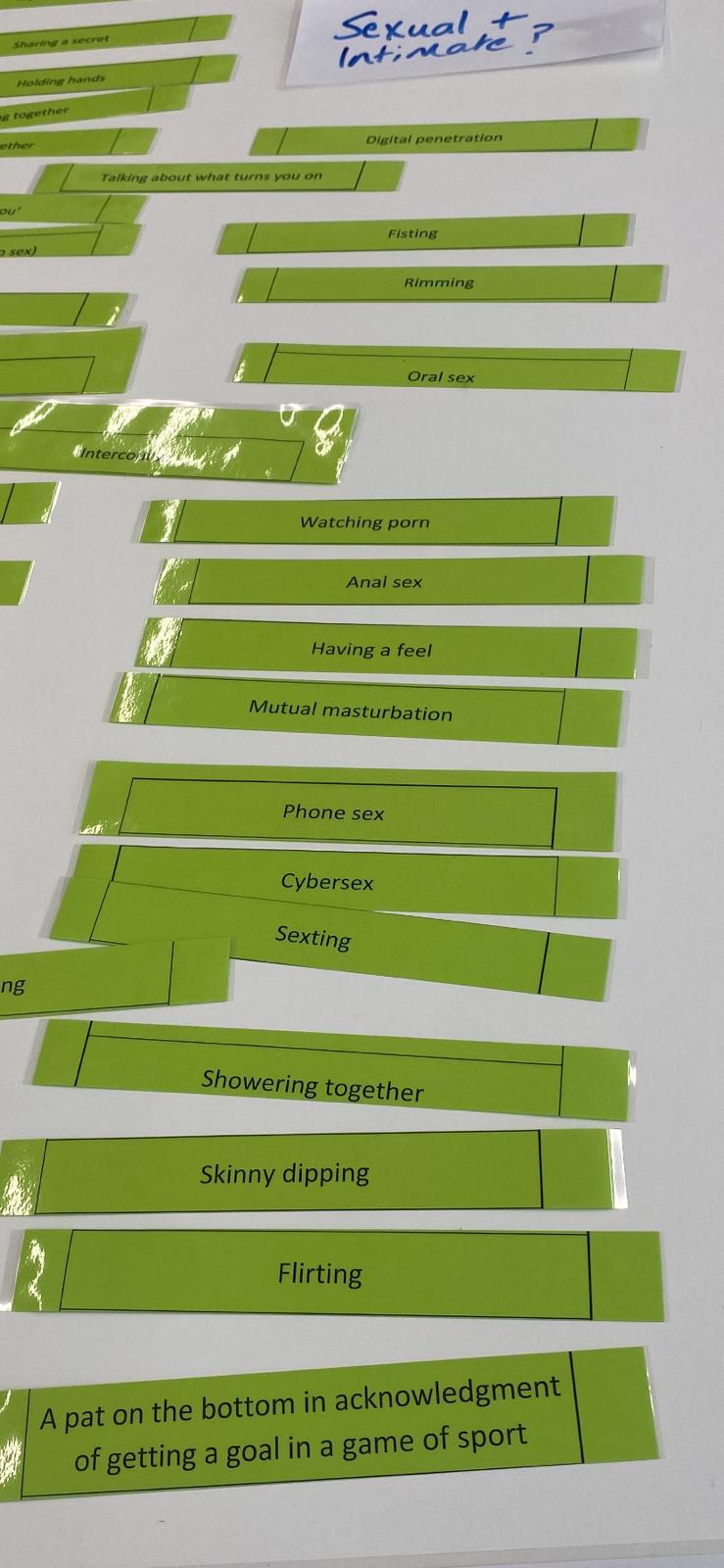
One of the lessons in the RSE module in the DCU course that came under scrutiny was an “intimacy exercise” where students would be asked to rank words as sexual and intimate.
Photos taken by teachers on the course show that the words included “fisting”, “rimming”, “oral sex” and “mutual masturbation”, along with “flirting” and “sharing secrets”.
As the controversy around the course grew, then Education Minister Norma Foley denied that the materials being used in the DCU course were set for the classroom – claiming that there had been “misrepresentation” around the lessons the students had been brought through, and insisting that no graphic or inappropriate materials would ever be shown in a school setting.
DCU hit out at those who they said were “purposefully” conflating “what is taught to teachers on the graduate diploma programme so that they have a broader knowledge of the SPHE/RSE area, and what is actually taught to secondary students in accordance with the national curriculum”.
However, in addition to the testimonies of multiple teachers attending the DCU course, a recording also emerged which showed participants in the DCU teacher’s course openly talking about how “fisting” and “rimming” was discussed with pupils in a school classroom during an “intimacy” lesson. It was great, a guest lecturer said, that the teacher had created the space for the secondary school students to get “dirty”.
Now, a new edition of a SPHE book for third years in secondary school has been published – and it contains an intimacy lesson that closely resembles the exercise seen and photographed by teachers who attended the DCU course.
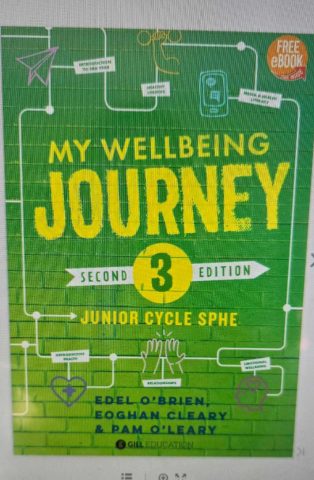
The schoolbook, My Wellbeing Journey 3 (2nd edition) is published by Gill Education – and is written by Edel O’Brien, Eoghan Cleary, and Pam O’Leary. All three also co-authored ‘My Wellbeing Journey 2’ – a book for 2nd years – in which a lesson on masturbation, spanning 8 pages, tells young teenagers that “even babies and young children know it feels good to touch their own genitals” – and that “it’s a biological reward system built into a human’s body before we even start to develop sexually”.
Edel O’Brien, who teaches in Castletroy College in Limerick, wrote the book in the Gill series for first years which tells school children that their sex is assigned at birth based on genitalia, while their gender identity is their deep sense of being “male, female, a mixture of both or none at all.”
Eoghan Cleary, a teacher in Temple Carrig School in Greystones, is a favourite of RTÉ for any discussion on sex-education, and says pupils shouldn’t be stigmatise or shamed for their porn use but instead taught to “critically evaluate” porn.
The third author, teacher Pam O’Leary, has said that “morality shouldn’t come into Relationship and Sex Education”, and attended the DCU course with Mary Creedon and other teachers – but denied in an unchallenging interview with Cork’s 96 FM that anything inappropriate was going to be taught in schools. She teaches in Cork Educate Together Secondary School, where she is also a guidance counsellor.
NEW BOOK
So what did they include in the school book – and why is this relevant to what was taught to SPHE teachers on the DCU course?
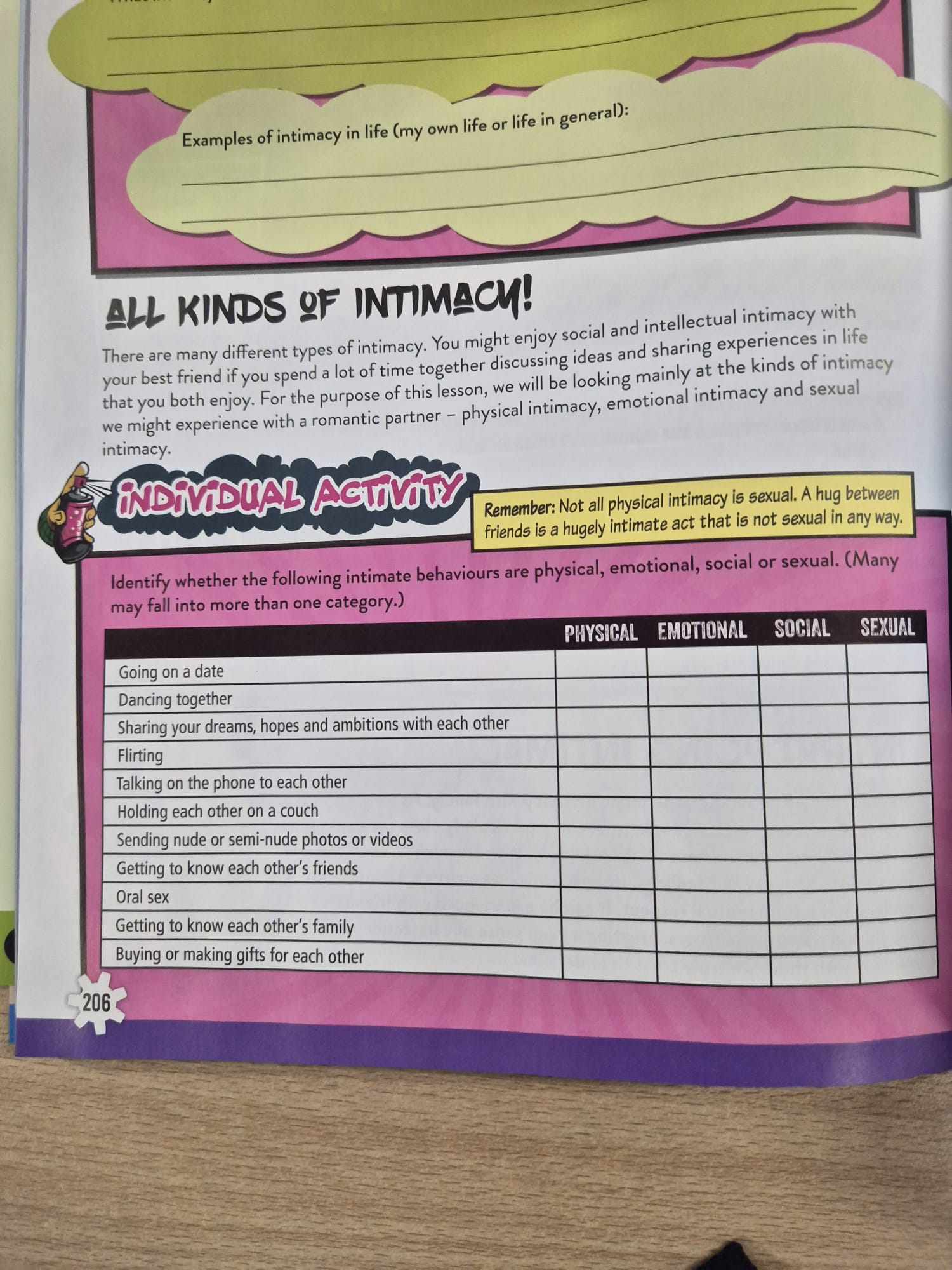
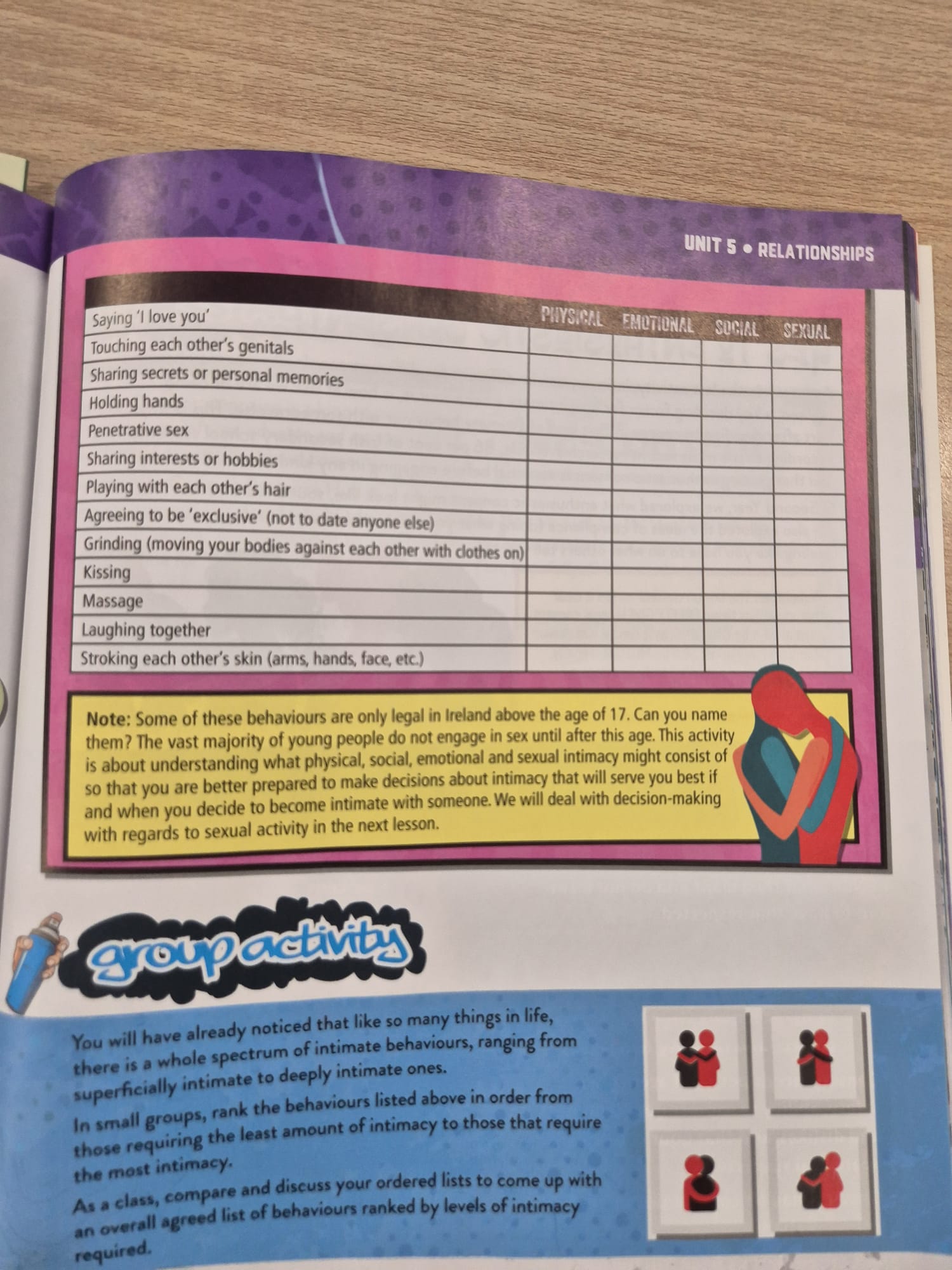
This is the lesson now included in the My Wellbeing Journey schoolbook: an intimacy lesson which asks students to undertake a classroom activity where they identify where a list of intimate behaviours are “physical, emotional, social or sexual”.
The behaviours the 14-15 year olds are asked to consider include “oral sex”, “penetrative sex”, “sending nude or semi-nude photos or videos”, “grinding (moving your bodies against each other with clothes)” – along with “flirting”, and “sharing secrets”.
The school students are told to break into small groups to rank the behaviours from most to least intimate before having a class discussion. The students are also told that some of the behaviours are only legal above the age of 17, and that decision-making regarding sexual activity will be dealt with in another lesson.
The teachers who had come under attack for discussing what they saw on the DCU course now say they feel “gas lighted” by the appearance of the intimacy exercise.
SPHE teacher Mary Creedon, whose exposé of what was presented at the DCU course garnered national attention, said that the lesson was asking children too much of children “at such a young age” and might place young students under pressure in regard to what they might believe was “expected intimate behaviour”.
“It is absolutely not appropriate for 14/15 year olds to consider whether sending nude or semi-nude videos is intimate behaviour,” she said. “This is a safe guarding issue in my opinion”.
“Should ‘penetrative sex’ be given as statements of intimacy to young students?” she asked. “Should ‘oral sex’ be listed as an intimate behaviour in this SPHE text book? Will young girls and boys believe this is expected intimate behaviour and will this place pressure on boys and girls to engage in these behaviours?
“In my opinion young girls and boys are being presented a very skewed version of what it means to be intimate,” she said, adding that school students were also asked in the textbook to give examples of intimacy in their lives. “This is not what parents send their children to school to learn at that age,” she said.
Commenting on the lesson in My Wellbeing Journey 3, another teacher who attended the course told Gript: “This is pretty much the intimacy exercise from the DCU course with watered-down terms. Talk about gas lighting”.
“I very much struggle to understand how any educator or publisher thinks that it is appropriate for third year students (14/15 years of age) to have a discussion in a group and decide if ‘sending nude or semi nude photos or videos’ falls into ‘physical, emotional, social or sexual intimate behaviour’ and then rank that behaviour alongside other activities such as penetrative sex and oral sex in order of their level of intimacy,” the SPHE teacher said.
“I was surprised when I opened the textbook and saw the intimacy exercise listed, albeit with the three worst terms excluded. This is the same exercise that the Minister for Education and DCU specifically said were for adult teachers to discuss in an adult setting and not for use in the classroom. This is surely the very definition of gas lighting!”
PROUD OF THE PENIS
Other sections of My Wellbeing Journey 3 were also examined by the teachers who had attended the DCU course. They noted that DCU and the Department of Education had issued “flat-out denials” which stated that no inappropriate graphic or explicit material should ever be used in a classroom setting” – and that the Department of Education and DCU had “categorically” confirmed that teachers would not be expected to introduce certain explicit and inappropriate topics and materials in the classroom.
Mary Creedon said that she believed lessons on intimacy and others – such as those on being ‘Proud of the Penis’ or on masturbation or asking students to list what they wanted their sexual experience to be contradicted that claim.
“Does the Department really believe that an extend discussion on being ‘Proud of the Penis’ [Lesson 15] which asks students to discuss penis length or circumference or girth of both erect and flaccid penises is not graphic or explicit for 14-15 year olds,” Mary Creedon said.
“It states: ‘when fully erect, the average penis is between 10 and 15 centimetres long and around 10 centimetres in circumference’ – and then asks students to have a class discussion as an activity on ‘Why do you think this is the average size of a man’s penis’,” she said.
“Why are children being asked to have a discussion about an adult’s man’s penis?” she asked.
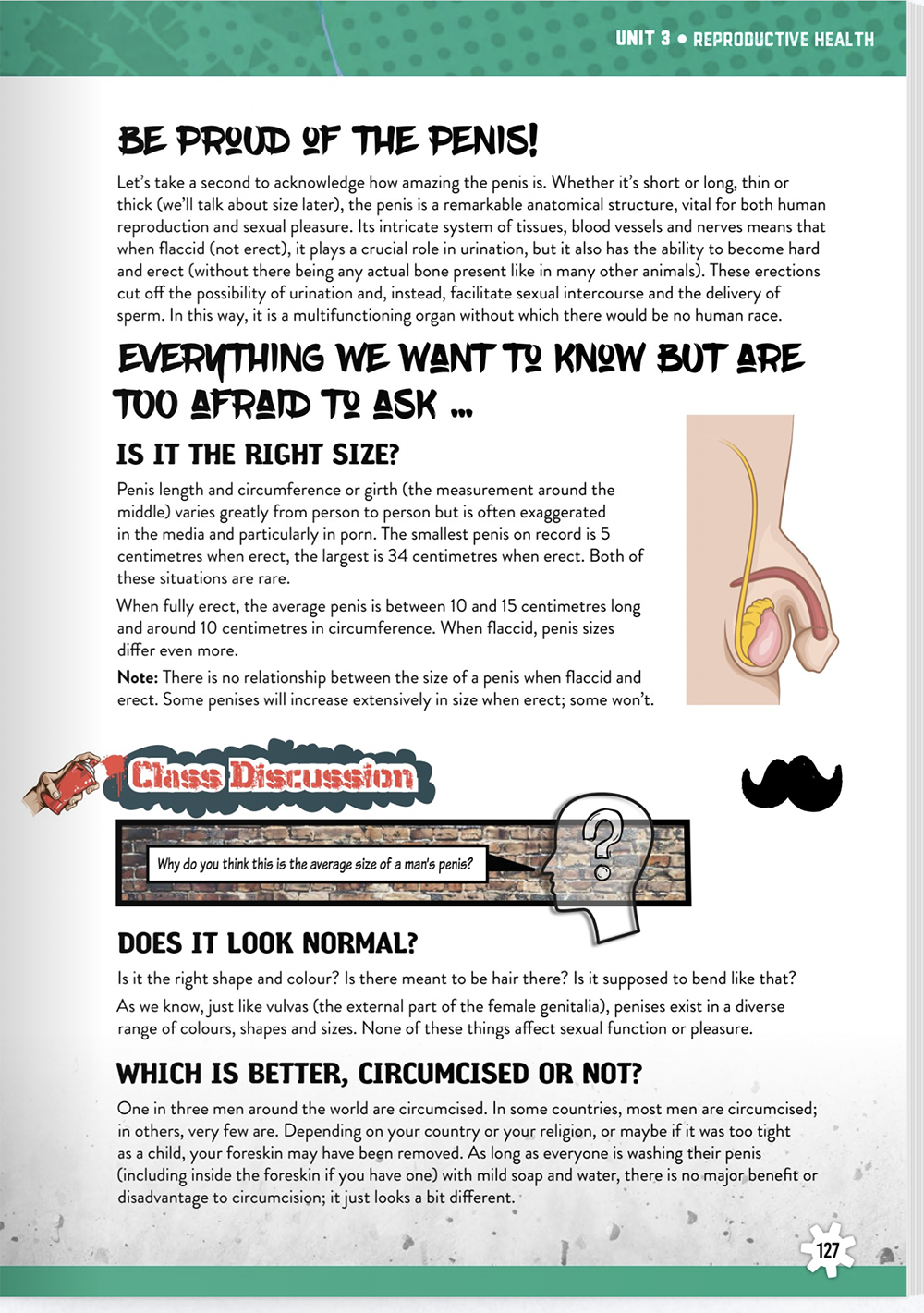
“We now have a situation where a schoolbook is both telling 14-15 year-old students to be “proud of the penis” and discuss the penis as a classroom activity – and also talking to them about whether sending sexually explicit pictures is intimate or not. Where exactly does any reasonable person think that would lead,” the SPHE teacher asked.
Ms Creedon said as part of the DCU course all the SPHE teacher were asked to do an audit in their school – which asked pupils what they wanted in their RSE/SPHE classes. “I found that the school students actually wanted less focus on sexuality – because it made them feel uncomfortable – and less focus on LGBT issues, and more focus on things like friendships and alcohol.”
She said that some other teachers on the course found the same results in their audits – but they were told that the SPHE course would have to be ‘rights-based and inclusive’.
She also pointed to Chapter 28 of the book which focuses on sexual intimacy, and “the ingredients for positive sexual intimacy” – asking 14-15 year-old students how to “figure out what great sexual intimacy look like, feels like, and sounds like.”
A classroom exercise then instructs the students to break into groups and to list what they do and don’t want their sexual experiences to be. “Think of as many as you can,” the students are instructed, “lets see which group can come up with the longest list.”
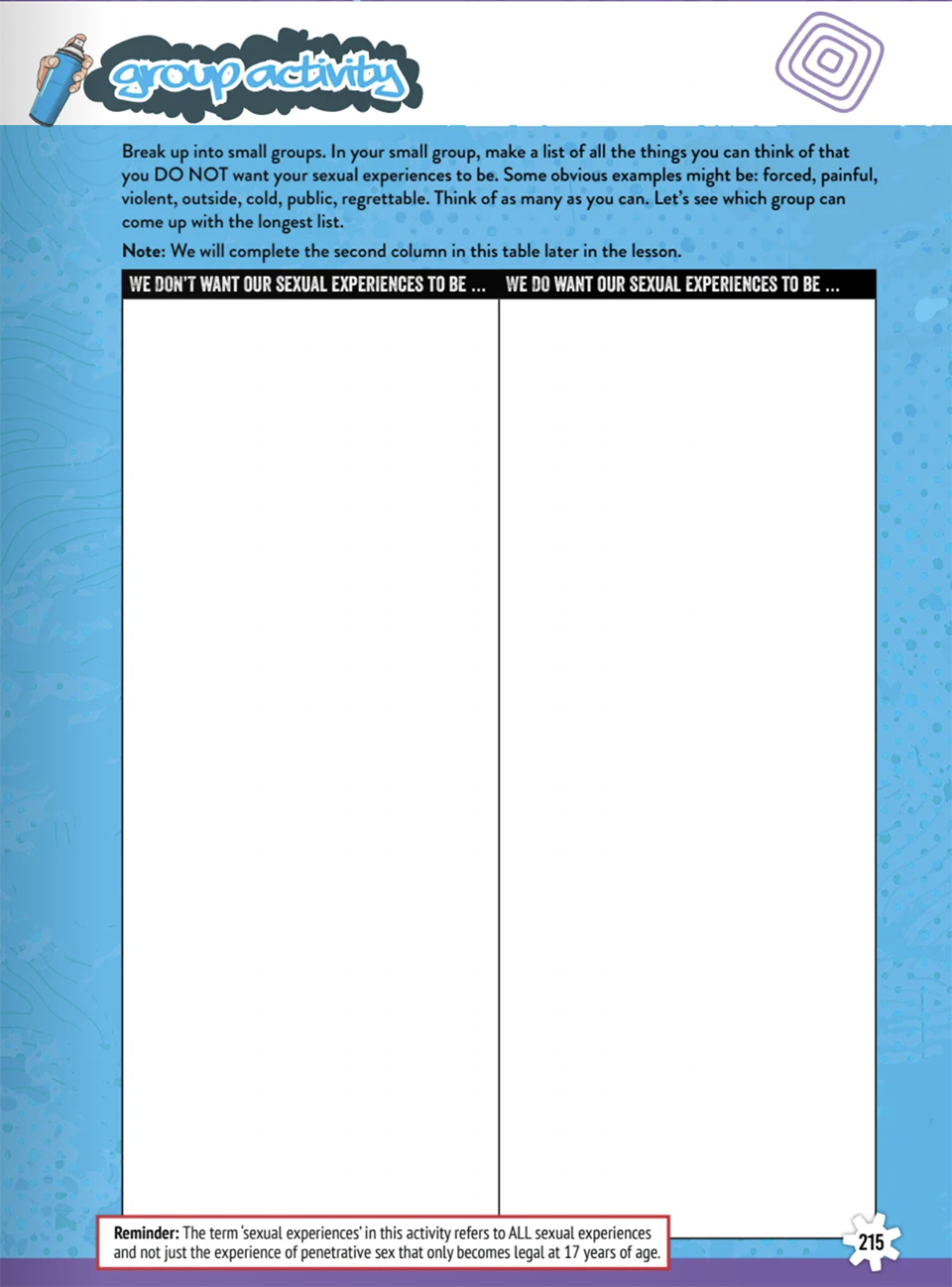
Ms Creedon said that she felt the exercise was “totally inappropriate for 14-15 year olds” and could lead to unwanted pressures coming onto students who might not be comfortable with discussing sexual experiences.
She also said that, in her experience as a SPHE teacher, the primary concerns of 14-15 year olds are mostly around making and maintaining friendships, finding interesting hobbies and sports, worries about exclusion, connections, communications, enjoyment of life, mood and self-esteem.
“There is so much good in the SPHE course,” she said “around mental health, exercise, nutrition, bullying – very important issues. And sexuality is very important too – but I, and a lot of other teachers, feel the new focus is badly skewed.”
Gript contacted Pam O’Leary for this article but she refused to speak to us or to answer questions on email. A spokesperson for DCU said that the university had no involvement in the publication of this book, and that ay queries as to its content should be directed to the publisher, Gill, or the authors.
The university said it “stands by its previous statement on the SPHE course”.
