As the Government was rolling out an unprecedented giveaway budget yesterday afternoon, there was a reminder that while Simon Harris and company intend to put the economy at the heart of the forthcoming general election campaign, some on the opposition benches still think the Government is vulnerable on other topics.
Specifically, Independent Ireland was listening to the economic measures having just announced a very substantial suite of pre-election proposals on immigration. Rather than have me relate them to you, here is what the party says it intends to do, should it be in Government after the election.
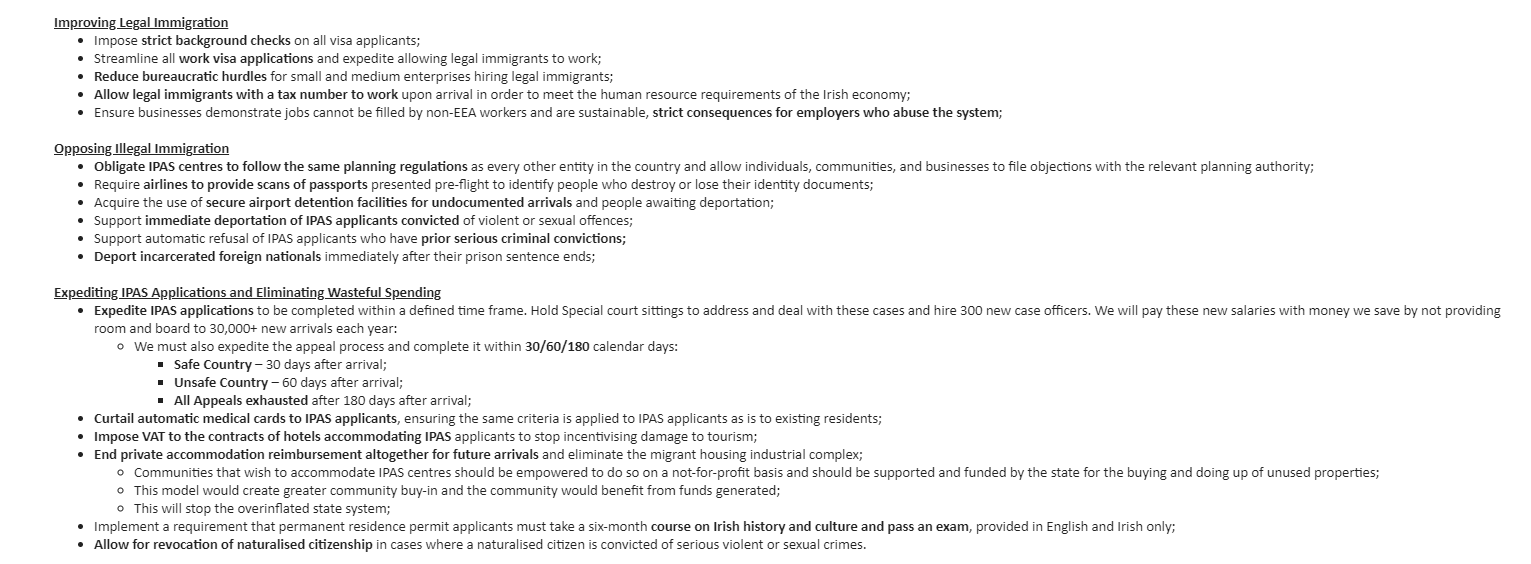
The most significant policy here, clearly, and the one most likely to be ferociously opposed by any partner in coalition negotiations, is the plan to make IPAS centers follow the same planning laws as any other development. The whole reason that this is not the case right now, of course, is that to do so would be to ensure that almost no new IPAS center was ever built in a timely fashion, anywhere in the country. This measure alone, if implemented, would put a Government in an untenable position on immigration, forcing it to either limit numbers coming in, or face having nowhere to put people.
This is married to another policy that would cause significant problems for the Government’s current strategy – imposing VAT on contracts for hotels currently in the IPAS system. The clear and stated aim here is to make providing accommodation to migrants relatively less attractive than simply providing tourist services. Take these two policies together, and you have an attack on the Government’s ability to run its immigration policy as currently constituted.
That is, if you are concerned about immigration, the good. What is the bad?
If one was to nitpick, you might notice that there isn’t really a very detailed plan about how to repatriate people who are not, or should not, be in the country at present, or a detailed plan about how to limit future numbers coming in through legal restrictions on admissions. There is some welcome stuff about speeding up the applications process, holding special court sittings, and so on, and curtailing benefits – all of which are clearly intended to address the “pull” factors attracting migrants to Ireland. But a critic might note that if you take the logical effect of the IPAS policies – fewer hotels available to accommodate people – and do not combine them with an immediate reduction in the number of people coming here – then you are likely to have a glut of people in Ireland who cannot be accommodated, and who cannot legally be immediately deported. There is a risk of yet more tent cities, in other words, with the Independent Ireland approach.
What the policy is arguably missing, in other words, is a compelling case on border control, which is probably more a reflection of how difficult EU law makes that kind of thing, more than it is a reflection on Independent Ireland.
Nevertheless, the document is a clear break from the Government’s approach: The policy is clearly intended to be pitched, politically, at communities, mainly in rural Ireland, who have seen their services re-purposed into migrant accommodation, often provoking serious local upset and disquiet. Independent Ireland’s pitch is clear: We’ll put a stop to that.
Of course, there’s a question with Independent Ireland: Is this a party policy, and will it be whipped? Can voters who vote for what remains a kind of alliance of Independent TDs be certain that all of those they vote for would abide by the policy? I asked Independent Ireland leader Michael Collins those questions, and this is what he said:
“The three sitting Independent Ireland TDs (Myself, Michael Fitzmaurice, and Richard O’Donohue) – developed and negotiated every word of every Independent Ireland policy. It took time, but the electorate can rest assured that we agreed one hundred percent on every single item therein. Therefore, you may consider our policy positions pre-whipped.
Regarding candidates who are running not named Collins, Fitzmaurice, or O’Donohue: we solicited and incorporated feedback on a draft policy document at the Independent Ireland Think-in on August 24 in Limerick. By securing candidate buy-in, we can say loudly and clearly that we are unified on the policy positions contained in our policy documents and will vote accordingly on those issues.
Voters can be certain that every single elected member of Independent Ireland will fight to advance our policies as released, from immigration, to housing, to healthcare, and so on. Finally, to answer your question unequivocally – Independent Ireland TDs and MEPs will vote in accordance with the party’s policies, as they are the people who developed, negotiated, and adopted said policies.”
It must be said, in fairness to Collins – that’s a clearer and more detailed answer than people in my trade generally get from politicians. In short: There’s no whip, but every Independent Ireland candidate has Independently expressed support for the contents of their immigration policy and other policies and will, Collins says, vote in support of them.
Of course, there remains, I think, a problem: It’s one thing to say that you will vote in favour of your own party’s policy document, but presumably that policy document would struggle to make it lock, stock, and barrel into a coalition agreement with another party. And there is a question, therefore, about whether another party could trust Independent Ireland to hang together in Government on tough votes.
But that is a matter, ultimately, for voters to adjudicate on.
What is clear is that between Independent Ireland and Aontu, voters in Ireland who wish to see immigration policy move rightwards will have two clear and electorally viable options on the ballot in many constituencies, in addition to candidates from smaller parties not currently represented in the Dáil. It will be difficult to argue, after this election, that no real choice was provided on the ballot.