The most striking image illustrating the extent of the success of Geert Wilders Party for Freedom (PVV) is the map published by Dutch public broadcaster NOS showing which party received the highest number of votes across each of the municipalities.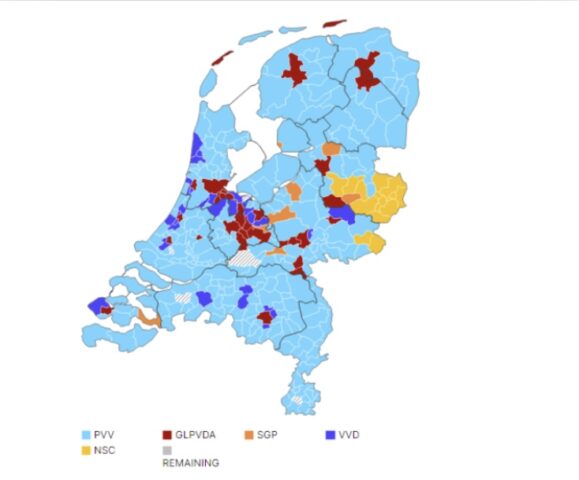
PVV came first in the vast majority, with the green/left alliance GLP/DA pretty much confined to the main urban centres.
The actual vote share, however, shows a much more fractured picture and underlines the difficulty that Wilders or anyone else will have in forming a coalition.
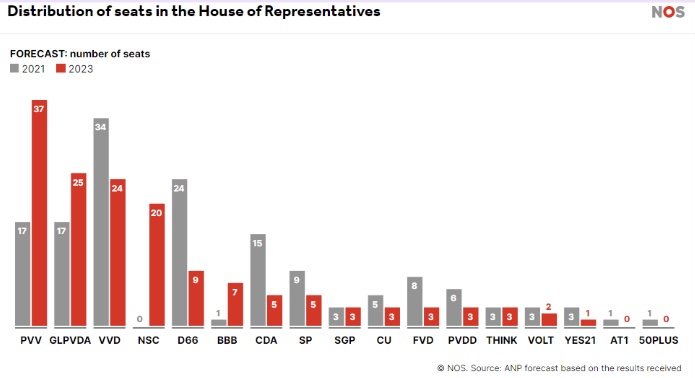
With over 98% of votes counted, PVV had more than doubled its vote to 23.5%. This will give it 37 seats, an increase of 20 on the 2021 results. They are therefore well short of the 76 needed to form a government.
Every other party lost seats other than the BoerBurgerBewegwig (BBB), the farmer/citizen movement which went from one seat to seven and took 4.7%. This will have come as somewhat of a disappointment in that readers will recall that in May, the BBB won almost 20% of the vote in the Senate elections.
Much of that vote had come from people who had previously voted for PVV and most of them have returned to their previous allegiance. In terms of likely government, it would seem that the potential blocs of parties that need to come together in order to form a government have shifted little.
In this, the most interesting thing to watch will be how a new formation, the New Social Contract (NSC) led by Peter Omtzigt who is a former leader of Christian Democratic Appeal (CDA) whose vote collapsed with the loss of 10 of its 15 seats.
Omtzigt’s NSC will now have 20 seats and it looks like they will be key to who becomes Prime Minister.
NSC is old school Christian Democrat. It is “Eurosceptic” and its economic and welfare policies reflect the sort of social thinking that once influenced the Christian Democratic parties before they mostly succumbed to liberalism. During the campaign Omtzigt ruled out support for Wilders, but left that prospect open.
Interestingly, polls showed a very large number of BBB voters from May planning to switch to NSC.
One of Omtzigt’s objections to PVV was that party’s position on “rule of law,” a clear reference to Wilder’s promise to ban the Koran. Hopefully, if Wilders abandons that stupid proposal, the NSC, PVV, BBB could form a strong nucleus that might draw in others on the right and ensure that the parties who were clearly the target of the electorate are not allowed sneak back in under what some of the Irish mainstream ludicrously described as a potential “centrist” coalition given that it would have to include extremists on the far left.
It ought to be noted too that Omzigt – who is clearly influenced by Catholic social teaching – holds far better positions on issues such as abortion, euthanasia, and transgenderism than Wilders.
He has been described as marrying “relatively left-leaning economic policies” – such as higher taxes on the wealthy and improved workers’ rights – with pro-life and pro-family views.
He also supports strict limits on migration with a cap on numbers, as yet unspecified.
A plausible effective right needs to harness the energies of all of the three main parties on the right in this election.