Policy makers across the EU and USA are signalling intentions to spend billions to restructure their fossil-fuel dependent economies to meet net zero goals by 2050. The plan is to replace fossil fuel reliance with renewable energies, thus reducing the amount of C02 in the atmosphere to combat climate change. The two largest contributors of CO2, China and India have pledged to follow suit in 2060 and 2070 respectively.
It’s a big ask to meet a big task. The latest UN IPCC report warns that if we don’t act now the damage to the climate will be irreversible. According to the António Guterres, the UN Secretary General,“This report must sound a death knell for coal and fossil fuels, before they destroy our planet.”
The task at hand is nothing short of a complete transformation of the global economy given that everything from food production, trade and logistics, home heating and the majority of the electricity grids powering the global economy are currently dependent on fossil fuels. Renewable energies (wind, solar, hydropower and biomass) contribute 30% of total energy consumed globally, while nuclear energy’s share has decline to just 10%. Fossil fuels still account for 60% of global energy consumption. The rise in renewables is wonderful news, but the global consumption of fossil fuels continues to rise in tandem with increases in global demand for energy sources.
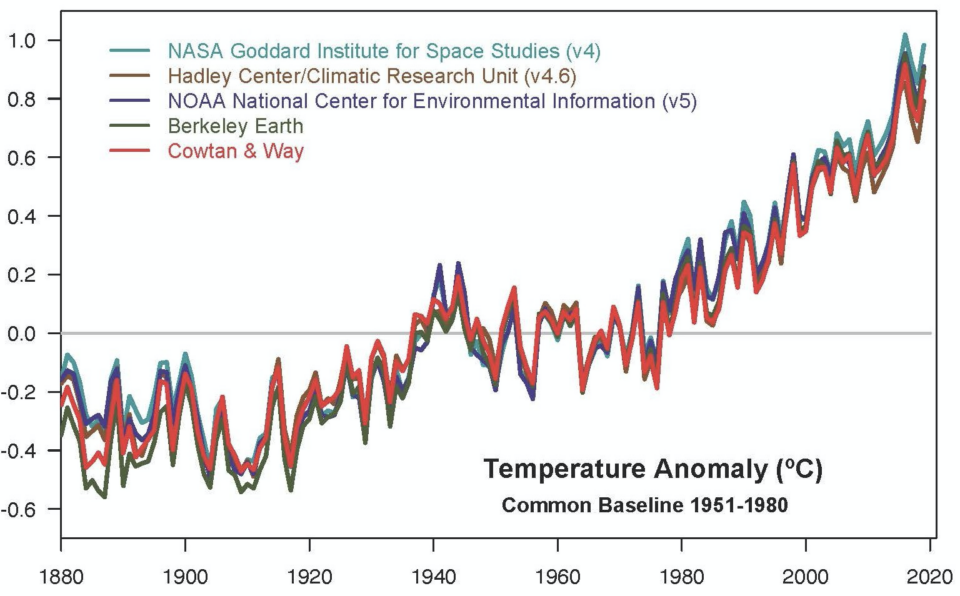
Source: World Meteorological Organization
_ _ _ _ _ _ _ _ _ _
The UN IPCC proposes that with a huge joint effort we can mitigate climate change. In other words, we can stop the climate from warming and save the planet.
The increase in global surface temperatures from 1880 to 2020 is approximately 1.3ºC. If you are wondering whether the IPCC’s proposed solution is proportionate to the problem at hand, remotely feasible in the timetable proposed, or fear that the economic and human cost may well be far worse than any potential threats from climate change, you are not alone.
There are many prominent scientists, policy experts and politicians proposing a different path. Not one argues against global warming. We are living in an era during which the climate is gradually warming. The question at hand is what does that mean for humanity and, what should we do about it?
Most critics of the net zero approach suggest that we do what humans have done for time immemorial – respond to the challenges presented by the changing climate and natural disasters through adaptation and innovation. Suggesting that we can stop the climate from changing or control the pace of change is a fairly radical position. Policy makers should focus, instead on the old reliables: physical security, energy security and food and water security along with natural disaster readiness and response.
The first order of business is to stop the fear-mongering. Despite the steady drumbeat of media reports linking every recent tragedy to climate change, weather-related natural disasters are as old as human history. Furthermore due to advances in safeguards and responses to natural disasters, weather-related mortality has actually fallen 99% in the past century. “People are safer from climate disasters than ever before” according to Bjorn Lomborg, author of False Alarm.
Much of the rationale for climate hysteria rests on the predictive power of the climate models. Climate activists insist that their statistical models and computer simulations demonstrate that CO2 is the primary cause of warming and the same models predict a climate crisis. They truly believe in the predictive power of their models and in the urgency of a future crisis.
Not everyone, however, is convinced of the climate models infallibility. Judith Curry, the former Chair of Earth and Atmospheric Sciences at the Georgia Institute of Technology and author of Climate Uncertainty and Risk warns that the climate models do not adequately reflect long- and medium-term climactic shifts, volcanic activity or the impact of the sun. Nobel Prize winner John Clauser, a member of the co2coalition, has criticised climate models for the well-recognised difficulty in modelling clouds, a major failing due to their importance in regulating temperature. Steve Koonin, author of Unsettled: What Climate Science Tells Us, What it Doesn’t and Why it Matters argues that the current climate models’ difficulty explaining the past centuries climate is further evidence of their fallibility.
In a lively and lovely interview with Yale Environment 360 eminent physicist Freeman Dyson argued that attempts to model a system as large and interconnected as the global climate and predict future outcomes are futile.
Dyson recalled the beginnings of climate science in the USA explaining that it evolved from a multi-disciplinary meeting of the minds of earth scientists, biologists and physicists to understand the multitude of forces that impact the climate (volcanic, earth carbon stores, plant life, solar and atmospheric) to a narrower exercise in modelling the hydrodynamics of the oceans and atmosphere. Dyson warned against the predictive power of the models and scare-mongering:
“They are models, but they don’t pretend to be the real world. They are purely fluid dynamics. You can learn a lot from them, but you cannot learn what’s going to happen 10 years from now. You sit in front of a computer screen for 10 years and you start to think of your model as being real. It is also true that the whole livelihood of all these people depends on people being scared. Really, just psychologically, it would be very difficult for them to come out and say, “Don’t worry, there isn’t a problem.” It’s sort of natural, since their whole life depends on it being a problem.”
My own journey towards wariness of the climate orthodoxy started with questions about certainty. There is always the potential for measurement error in research. Furthermore, the task of measuring global surface temperatures is extrordinarily complex and the shifts in average temperatures are minute (on the scale of tenths of a degree). The raw data from a variety of sources is adjusted to remove known biases and issues with data collection. Despite the complexity of the process and adjustments for biases, there is little discussion of the margins for error for either current or historical records, which ultimately represent a fraction of a blip in the history of the global climate.
Another red flag is the UN IPCC’s insistence that natural disasters caused by CO2 emissions are the most urgent risk to humanity, which strikes me as simplistic and patently untrue. Early warning meteorological services, where they exist, can mitigate suffering in many natural disasters caused by atmospheric climate events. The largest human toll from natural disasters in my lifetime have emerged from the earth’s core. Devastation cause by earthquakes has certainly cost more lives and created more devastation than atmospheric climate events. Furthermore, despite the narrow focus on CO2, seismic and volcanic activity play a role in the global climate. Curry proposed that the eruption of an Hunga Tonga-Hunga Ha’apai underwater volcano last year likely contributed to the sharp spikes in temperatures this year.
Another red flag for me is that modelling clouds continues to be an area of intense research and uncertainty. Pursuing a better understanding of the function and behaviour of clouds in the atmosphere is a worthy pursuit, there’s nothing wrong with that. But it’s not clear, to me anyway, that you can insist that the ‘science is settled’ while doing so.
Finally the third and perhaps most glaring red flag in my opinion is the stringency of the orthodoxy itself. It is no secret that the climate orthodoxy does not brook dissent.
Examples of eminent scientists being blacklisted, maligned, and de-platformed abound. Curry asked “How many skeptical papers were not published by activist editorial boards? How many published papers have buried results in order to avoid highlighting findings that conflict with preferred narratives? I am aware of anecdotal examples of each of these actions, but the total number is unknowable.”
I have no doubt of the sincerity of many climate scientists’ concerns, but when activism and censorship supplant the traditional standards of rigour, debate and objectivity critical to the scientific method, we all lose. For science to work, scientists need the freedom to pursue hypotheses, debate methodology and evidence openly and freely. Silencing and censoring scientific debate is a significant step backwards for humanity.
There can be no doubt that climate science has also become highly political. The UN, EU and prominent leaders of the Democratic Party in the USA are actively promoting the climate change orthodoxy and the pursuit of net zero.
Politicians love a crisis which, as Covid taught us, can result in vast increases in political power and a thorough trampling of fundamental human rights. ‘Saving the planet’ has already served as a very attractive blank check to impose new taxes and regulations all the while avoiding pesky risk/cost/benefit policy debates.’Saving the planet” is also just the kind of crisis that could be used to silence opposition with enhanced powers to banish ‘misinformation’ from the internet.
It is truly a time for choosing and largely up to the electorate. Are we going to stop the climate from changing or choose to adapt and innovate, pushing forward with renewable energies where and when it makes sense.
Will we allow fundamental freedoms to evaporate in the hot air of the ‘world’s on fire crisis’ or press policy makers to have those pesky cost/benefit discussions and protect citizens’ basic needs — housing, energy, food and water security.
This is a debate playing out throughout the EU at the moment. Poland has led the charge with a lawsuit challenging the EU’s authority to impose climate laws and regulations that threaten Poland’s economy and energy security. Germany, on the other hand, recently passed hugely unpopular legislation to phase out oil and gas heating systems.
Will Ireland go the way of Poland moving towards lowering fossil fuel reliance while protecting our economy and energy security or the way of Germany with coercive legislation to force compliance? Where do your local politicians stand on this issue? It’s likely time to find out.
Clare Frances, M.B.A, M.Sc Applied Social Research, writes on the nexus of research and public policy at The People’s Guide to Research