Who would have thought it would be Ryan Tubridy, of all people, who’d put an end to the age-old debate about whether men and women are fundamentally different? In a poll for the Sunday Times, published yesterday, the womenfolk of the country proved it once and for all:
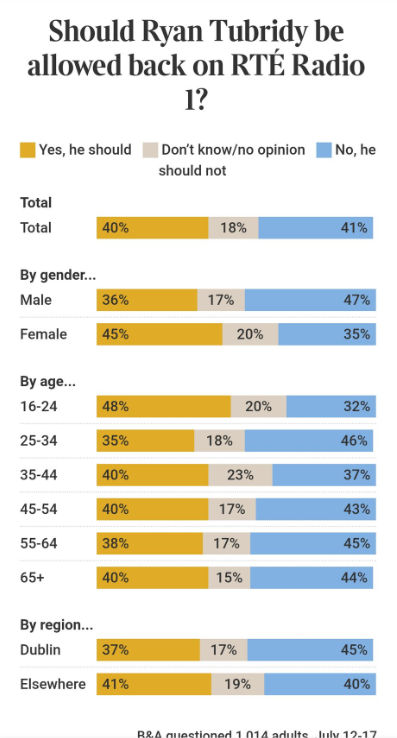
I was talking to a female friend about this, yesterday, and – being the unforgiving jackass that I am – naturally asked her to explain this state of affairs on behalf of the women of Ireland. Her answer was straightforward enough: If it was Sharon Ní Bheoláin or Gráinne Seoige, the numbers would be reversed. People always hold the opposite gender, she said, to a much lower standard than they hold their own gender.
Fair’s fair – I thought it was a decent answer. But it’s not entirely true, either.
In fact, it’s been the opposite of true in other cases in recent years. There was little enough polling data on the cases of either George Hook or Kevin Myers, but in both instances there was convincing anecdotal evidence that most of their support came from men, not women. On the flip side, polling does show that in the UK, Meghan Markle draws much more ire from women than she does from men – and women have always seemed to be much more inclined than men, for whatever reason, towards skepticism about the parents of Madeleine McCann. Equally, men are vastly more likely to be internet trolls towards fellow men. The evidence for my friend’s statement is not convincing across the board.
So what explains the notable gender divide on support for Tubridy. Allow me to advance a theory, to begin with:
Research has consistently found that men cheat more than women – and not just in the sexual sense. A german study in 2017 found that:
This paper experimentally analyzes the determinants of the honesty norm in a lying game. The findings confirm common gender differences, i.e., men cheat significantly more than women.
The same study also found that cheating and dishonesty was distributed differently between people with individualist, and communitarian views of the world: If you’re somebody who believes in personal responsibility and looking after yourself, you are more likely to cheat in a game. If you are somebody who believes in the value of community and looking after each other, you are less likely to cheat. Repeated studies have shown that men are much more individualist than women, presumably for reasons of reproduction.
This, presumably, colours our perceptions a little bit as genders: Communitarian societies are built on trust – one reason they tend to fall apart is that this trust can easily be exploited. Individualistic societies tend to be built on distrust, which sounds terrible until you realise that distrust is the essence of accountability.
My theory, therefore, is this: Women are more inclined to trust Tubridy’s version of events, which amounts to him being scapegoated by RTE for the wrongdoing of others. Men are more likely to believe he’s bullshitting, because they’re more capable of bullshitting like that themselves.
This also tends to explain the contrary examples I set out above: Hook and Myers’ perceived crimes – emphasise perceived – were crimes against a communitarian, female view of the world. In Hook’s case, he directly promoted individual responsibility for one’s own safety in a way that was (in my view wrongly) taken to mean that the criminal was absolved. In Myer’s case, he said something you shouldn’t say – which is always and everywhere a crime against communitarianism.
All of this is another way of saying that Tubridy’s essential values have always been more in tune with a view of the world that is more female in outlook (as a generalisation) than it is male. All that blather about us all being in it together during covid; all of the “I just care about the children” stuff at the committee – he speaks the language of a set of values that are more female than male. Add to that generally higher levels of integrity amongst women, and go figure that they trust him and want to give him a second chance.
But on this one, the men are definitively correct, and we know it, because Tubridy is one of us. In recent years, the online dating world has seen the rise, for example, in “wokefishing” – where young lads looking for love position themselves to women as rainbow-bedecked third generation feminists, talking about privilege and intersectionality to get a date. Try as you might, and you’ll find very few young women posing online on dating sites as men’s right’s activists. Gender-based bullshittery is in our DNA.
Of course, we’re talking about likelihoods here, not absolutes: The poll clearly shows significant support for Tubs from men, and significant opposition from women. If you’re a bloke or a woman reading this and getting all offended, then I’m not talking about you – I’m talking about the differences at the margins that may explain numbers like these.
If you’ve got a better one, the comments are below.