The Ambiguity of the Evidence
Friedrich Nietzsche was among the first philosophers to wrestle seriously with the implications of Charles Darwin’s theories. In Daybreak (1881), Nietzsche considered the metaphysical consequences of Darwinian evolution:
Formerly one sought the feeling of the grandeur of man by pointing to his divine origin: this has now become a forbidden way, for at its portal stands the ape, together with other dreadful beasts, grinning knowingly as if to say: no further in this direction! One therefore now tries the opposite direction: the way mankind is going shall serve as proof of his grandeur and kinship with God. But this too is in vain!
Unlike modern atheists such as Richard Dawkins and Christopher Hitchens, Nietzsche did not believe science could ever provide salvation or meaning. On the contrary, he prophesied in The Birth of Tragedy (1872) that scientists would eventually collide with undecidable questions, raising perplexities that the scientific method itself was unequipped to address.
Nietzsche’s prophesy is now coming true. The Atlantic published an article last year titled “Life as We Know It Hinges on One Very Small Decimal.” The article concerned a number called the fine-structure constant, which quantifies the strength of electromagnetic interaction between elementary particles. The constant’s value is close to 1/137. If it were slightly different—closer to, say, 1/138—elemental carbon could not form in our universe. Life as we know it could not exist. But no theory predicts the value of the fine-structure constant. It doesn’t have to be what it is: it just happens to be precisely situated in the narrow sliver of values amenable to life. And the fine-structure constant is only one of many constants which appear minutely tuned to support life. A more accurate title for the article in the Atlantic might have been, “Life Hinges on Twelve Different Constants, All of Which Appear Precisely Calibrated to Allow Life as We Know It.” But such a title would have invited the question: why? The likelihood of so many different constants being delicately balanced to allow our form of life—by random chance alone—is infinitesimal. How can we explain the fine tuning?
* * *
These questions are raised by philosopher of science Stephen Meyer in Return of the God Hypothesis: Three Scientific Discoveries That Reveal the Mind Behind the Universe. The director of the Discovery Institute’s Center for Science and Culture, Meyer argues that the science itself now compels us to consider the God hypothesis, which, as its name suggests, is the hypothesis that an agent characterized by “transcendence, omnipotence, creative power, free will, and intelligence” established the laws of physics, created the universe, and assembled the elements of life. The materialist’s usual explanation for our universe’s 12 perfectly tuned constants is that there exists an infinite or nearly-infinite number of universes, each one exhibiting a different combination of values for these constants. We happen to find ourselves in a universe where the constants just happen to allow the existence of our sort of life—not because of any Grand Designer, but merely because life as we know it could evolve only in a universe where the values of the constants just happen to be so aligned. We cannot observe other universes. So no experiment—even in principle—can provide evidence to refute or confirm the multiple-universe hypothesis.
Meyer finds such appeals to imagined and unobservable worlds unscientific. Early on, he cites the 13th-century theologian William of Ockham, known for his oft-cited but poorly understood “Razor.” Ockham’s Razor is the rule that if multiple phenomena can be explained either by a single hypothesis or by multiple independent hypotheses, then the single hypothesis should be preferred. The single hypothesis of an intelligent God can accommodate the creation of the universe from nothing, the fine-tuning of the elemental constants, and the origin of life. Explanation without recourse to God requires multiple hypotheses, some of which are untestable—such as the hypothesis that there is an infinite number of unobservable universes—to explain the same phenomena.
The multiple-universe theory is not the only domain in which Nietzsche’s prophecy has been realized. I earned my bachelor’s degree in biology at MIT and both my doctorates at the University of Pennsylvania. As a student, more than 40 years ago, I read the theories that were being proposed to explain the origin of life on earth. I found them unsatisfactory and unpersuasive. When I returned to this topic recently, I was surprised to find that no progress has been made since I read the literature as a student. Or, more precisely: the progress made has been largely negative. Greater understanding of the complexities involved in even the simplest form of life have led leading researchers to question how the first life could ever have emerged from non-living matter. Nobel laureate in chemistry Ilya Prigogine concluded that the odds of information-rich biomolecules developing by random chance are “vanishingly small,” even over billions of years. According to information theorist Hubert Yockey, the widespread conviction among scientists that life could arise spontaneously from non-living matter “is simply a matter of faith in strict reductionism and is based entirely on ideology” rather than evidence. Francis Crick, the Nobelist who famously helped discover the helical structure of DNA alongside James Watson, likewise saw no possibility that life on earth could have arisen spontaneously from the primordial slime. In his book Life Itself (1981), Crick argued that life on earth must have been seeded by aliens from another solar system.
* * *
Forty years have passed since Crick published Life Itself, and the prospects for solving the mystery of life’s origin seem bleaker than ever. Today it is clear that the genetic code is a code: a sophisticated marvel of information-processing nanotechnology whereby three-letter nucleotide codons are translated into amino acids which are assembled into proteins. Even if scientists could succeed in showing how the prebiotic soup could generate a rich mixture of nucleotides (the building blocks of RNA and DNA), such a mixture would be roughly equivalent to a bucket full of English letters. The unanswered question is how a random scoop into the bucket could ever generate the equivalent of Hamlet or Huckleberry Finn. Even the simplest living cell contains more than 400 genes, each composed of dozens or hundreds of codons and every one of them essential to life—that is, if any one of those genes is deleted experimentally, the cell will die. No theory currently on offer satisfactorily explains the origin of this genetic information. Researchers have responded with vague ideas such as “self-organization” and “prebiotic natural selection.” But as Nobel laureate in physiology Christian de Duve noted, such theories “presuppose what is to be explained in the first place,” namely: where did the information come from?
Read the rest of the article here
Leonard Sax
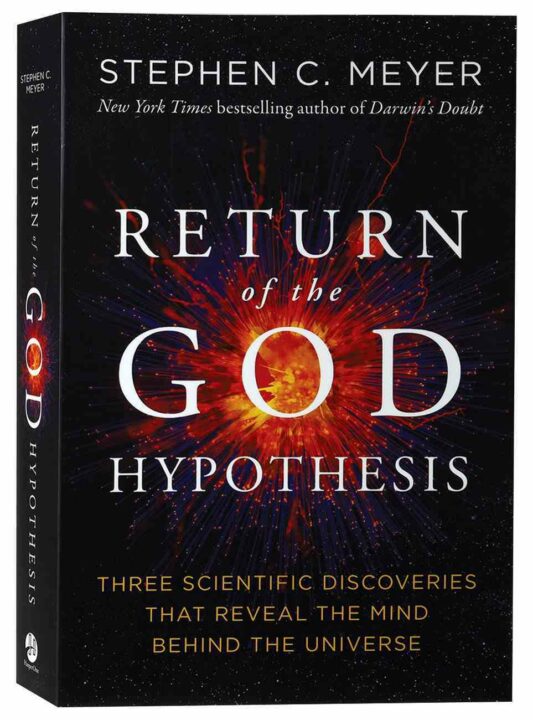
The Return of the God Hypothesis: Three Scientific Discoveries that Reveal the Mind behind the Universe
- Author: Stephen Meyer
- ISBN 0063087626
- EAN 9780063087620
- Department Academic
- Category Science
- Publisher Harperone
- Publication Date Apr 2021
Watch this interview with Stephen Meyer