A response to a Freedom of Information request from a reader of Gript has revealed that the number of people presenting at Dublin Airport with false documentation or no documents will remain at around the same level as 2024.
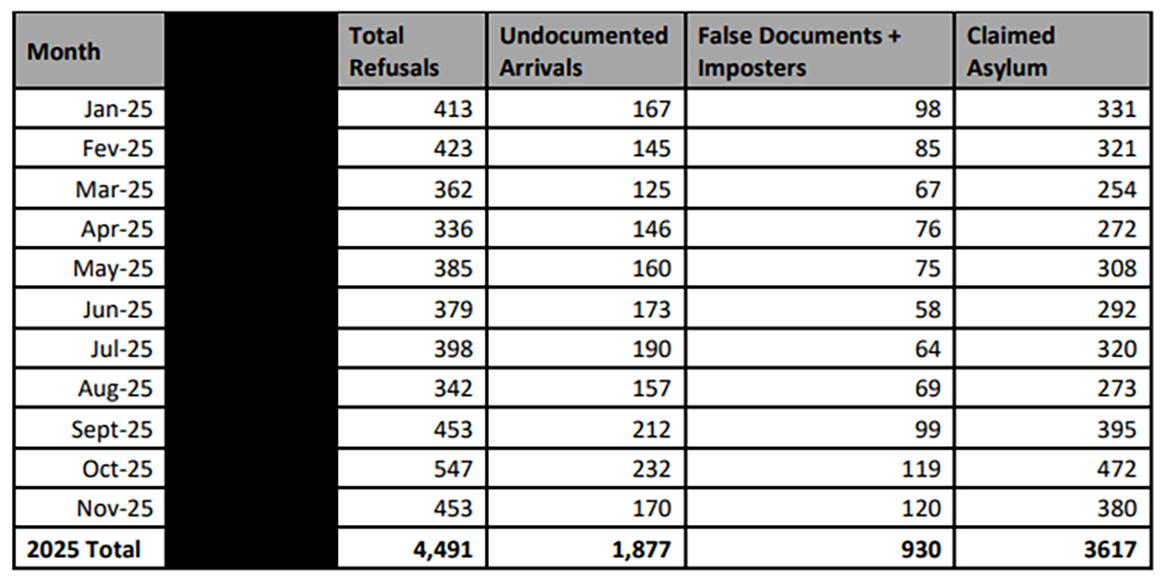
The overall number of refusals to the end of November was 4,491 compared to 5,255 in 2024. The monthly average is slightly down.
The total number of refusals for people arriving into the state with either false or no documentation up to the end of November was 2,807 compared to 3,370 for the whole of 2024. If December follows the same pattern, then the monthly average for 2025 will be down by 26, a modest decline.
The figures do, however, represent a noticeable fall from 2022 when the monthly average of persons refused for presenting at Dublin Airport with false or no documentation was 483 and the annual total was 5,800.
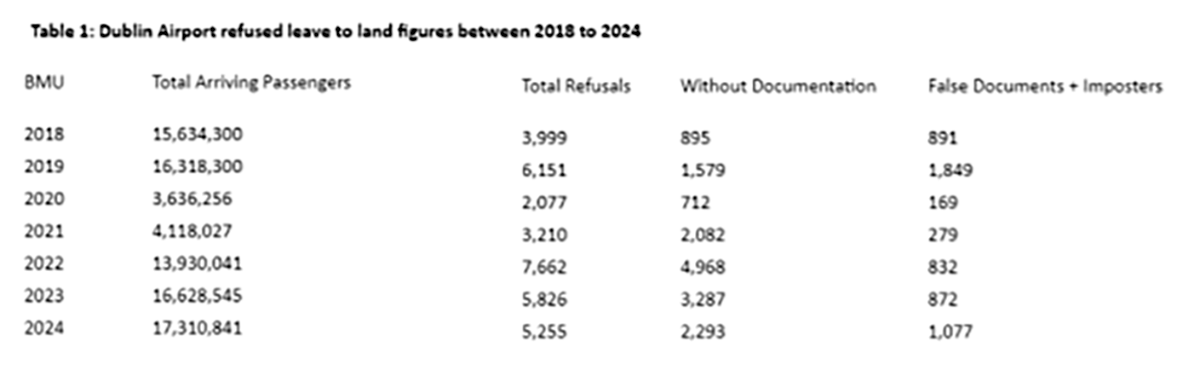
The proportion of the number of people refused entry who are then allowed to apply for asylum is also on course to remain as it has since records began in late 2021. While records on the numbers of persons refused who were allowed to apply for asylum only began in October 2021, on average more than 75% have been permitted to do so.
To the end of November this year, of the 4,491 who were technically refused entry into the State at Dublin Airport (2,807 for failing to produce any documents or for presenting false documents) 3,617 were nonetheless allowed to apply for asylum with the International Protection Office. That represented 80% of those refused.
The State itself has now accepted that over 80% of those who make applications for asylum enter the Irish state by crossing the border and therefore having transited through at least one other state where they ought to have made any claim for protection. There are no records on how many of these present with similar lack of documentation.
In combination with the large numbers attempting to enter the state through Dublin Airport in those circumstances it indicates that the Irish state is allowing a large proportion of asylum claims to be made by people who are clearly attempting to claim asylum under false pretences.
Which would suggest that preventative measures ought to be at the discretion of the domestic authority and not a function of the prevailing EU criteria. A sovereign state ought to be able to decide who does or who does not enter its jurisdiction and refusal of entry ought to mean speedy assessment and speedy return for persons who arrive with no passports, or false passports, nor any other type of identification or proof of travel or origin.
Which places Minister for Justice Jim O’Callaghan’s ‘tough line’ on illegal immigration into perspective.
Yesterday he was reported widely as having rightly pointed to the European Court of Human Rights as placing undue restrictions on the State’s ability to deport. (It might of course be argued that the Irish legal profession and advocacy NGOs who sponsor and take immigration appeals are an even greater barrier.)
O’Callaghan is on the same page regarding this as Denmark which currently holds the EU Presidency and which has ‘walked the walk’ to back up its left of centre Government’s decision to curtail illegal immigration despite any EU criteria that would theoretically prevent them doing so. Unlike the Irish state, Denmark has not signed up to the EU Pact on Asylum and Migration which was pitched by the Irish government as a means to tackle illegal immigration.
It ought also be noted that O’Callaghan was referring specifically to problems regarding the deportation of criminals from other countries. This is simply common sense and is shared by all of the 26 EU and other states who made a joint statement backing the Danes.
The signatories include EU states such as Denmark, Italy, Hungary, Poland and Slovakia which have been regarded as critical of the overall EU position on the role of the ECHR. Significantly absent from the list are Germany, France, Portugal, and Spain. In that respect perhaps it does represent a shifting away by the Irish government from the more centralist and liberal EU states on this issue at least.
The joint statement points to “the challenges in expulsion of foreign criminals, migration management and co-operation with third countries regarding asylum and return procedures,” which it says demand that there be “a right balance has to be found between the migrants’ individual rights and interests and the weighty public interests of defending freedom and security in our societies”. That ought to include the right of expulsion even of foreign criminals with long term residency.
The Minister for Justice would have public support for such a policy, as he would for implementing proper and speedy action in response to the continued level of attempts to enter the state illegally. Once such attempts have been identified – as shown in the statistics – those identified need to be removed quickly.