The Citizens’ Assembly is often pitched to the public as though it is the Irish equivalent of the ancient Athenian Agora in which people arrive with no preconceptions about an issue and then make up their minds after listening to a wide range of opinions
It can plausibly be argued that the reality is somewhat different. What has happened is that since 2016 when it was established, the Citizens’ Assembly has been tasked with considering issues which the political establishment has clearly wished to push in a certain direction.
The first of these was abortion and it is clear that the Assembly and the manner in which the debate was channelled played a key part in the decision to both hold a referendum to overturn the constitutional protection of the unborn, and in setting the terms of that debate. The same could be said of its later deliberations on climate change and proposals to further amend the Constitution.
Currently before the Assembly is basically a proposal to legalise to a greater or lesser extent the use of drugs. The terms of reference on the face of it appear to be quite open, viz: “to consider the legislative, policy and operational changes the State could make to significantly reduce the harmful impacts of illicit drugs on individuals, families, communities and wider society, and to bring forward recommendations in this regard; the Assembly shall consider,” but the items to be considered are all implicitly selected around the notion of recommending how best to set about “reforming legislation.”
The media reportage of contributions, as well as public comments from the Chairperson Paul Reid, have also pointed in the direction of liberalisation. Reid was interviewed on RTÉ Drivetime last Thursday and the whole thrust of the discussion, from both the interviewer’s side and Reid, was that we “can’t keep doing the same things.” Reid spoke of a “strong sense” from the Assembly that there needs to be “reform” in the direction of decriminalisation for personal use.
In that context Reid referred to Assembly members having been taken to visit the “self-injection” centre at Merchants Quay which was given temporary permission to proceed at the end of 2022. He pitched this as being a “safe space” for the addicts. Gript had previously reported on the lack of local consultation and the opposition of many in the community, including the management of St. Audeon’s primary school to what some locals described as a “shooting gallery.” Of course, it was welcomed by smiley NGO types who most likely do not have such a wonderful “safe space” on their road.
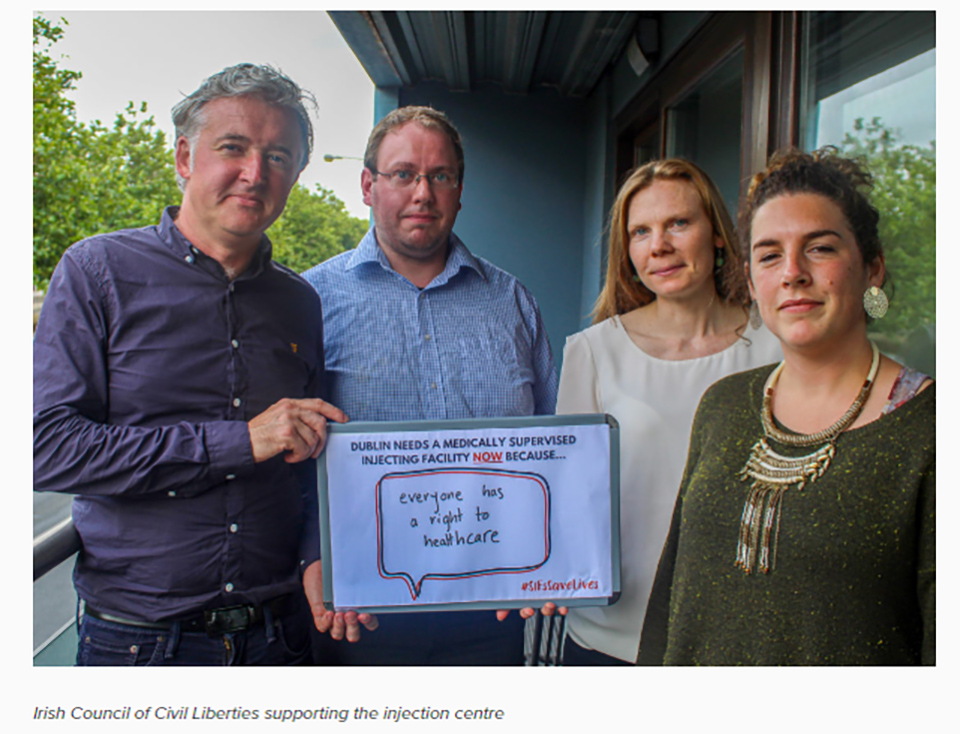
Reid also gave a nod to the claim by The Wheel which we reported on last week that the NGOs who are dealing with drugs and the “marginalised communities” in which most drug abuse takes place are underfunded and finding it hard to retain staff. So, part of the “solution” is yet more money for NGOs who are clearly not having much of an impact if the problem is getting worse, and whose main contribution to the debate seems to be to advocate the decriminalisation of drug possession for personal use.
Ah yes. The wonderful world of the Irish liberal elite. One hand washes the other and the referential circle pats each other on the back and creates a “consensus” that allegedly reflects public demand, and which will then be passed on to the politicians who are mostly too terrified to cross them, as indeed has been recently pointed out by Fianna Fail TD Eamonn Ó Cuiv.
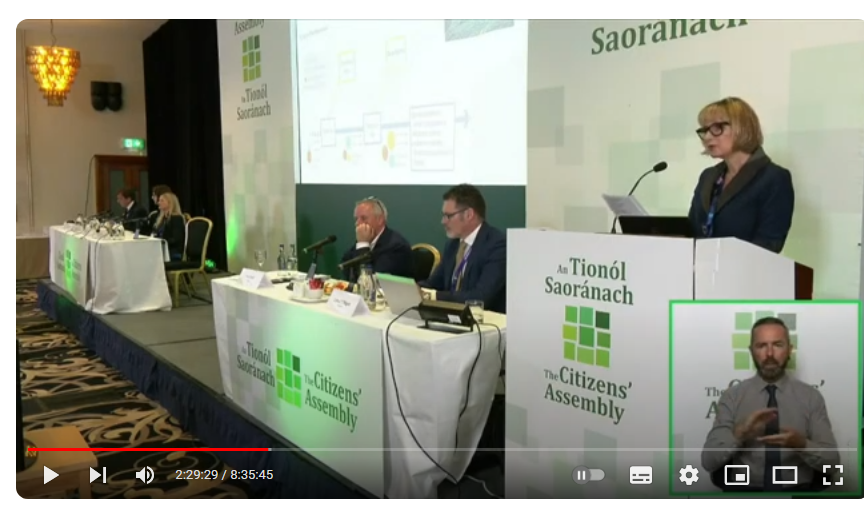
You can watch the contributions to Saturday’s session here. It is over eight and one half hours long, so pack some sandwiches. One of the few contributions to perhaps shed a more sober light on the problem came from Chief Medical Officer Breda Symth who you can catch at around 2:23:00
Smyth referred to the high level of cannabis use, with 8% of the population being regular users and 20% of those having developed a misuse disorder. There are over 50,000 drug related hospital cases each year and drug use was implicated in 409 deaths in 2020, she said.
She made it clear that drug use is a significant public health problem. Smyth stated baldly, and contrary to one of the myths peddled, that cannabis is indeed addictive. She related the prevalence of drug use to levels of degradation in Dublin, and the connection to poor parenting and abuse.
She pointed out that cannabis use has become more prevalent and is used on a daily basis by increasing numbers – something that is obvious to anyone who goes into almost any public space in Ireland. I have seen people smoking cannabis behind the goal in Croke Park and Thurles; on buses, in pub smoking areas, and even once at a funeral.
Children suffer, and half of those presenting with cannabis misuse are parents which exacerbates patterns of bad parenting. The prevalence of cannabis use is also a major contributory factor in influencing children to start to smoke the stuff. That is apart altogether, one imagines, from the health impact of having to live in the constant smog and stench of the “weed.”
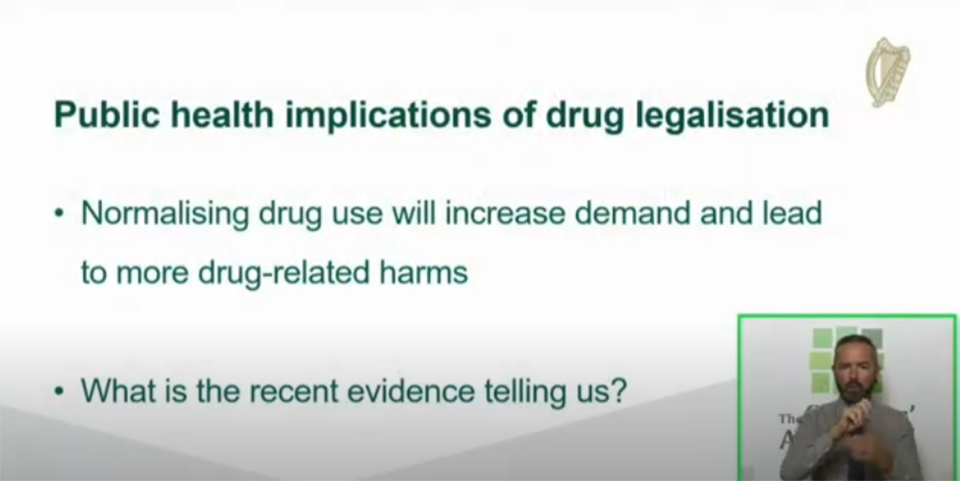
Smyth made it quite clear that legalisation leads to the perception that drug use and indeed drug abuse is “normality.” The emphasis instead needs to be on prevention and education. She concluded by pointing out that evidence from Ontario for example proves that legalisation leads to greater use of cannabis, and all the related problems associated with it in terms of health and dysfunction.
Other medical experts have previously warned the Assembly of the mistakes of other jurisdictions in legalising drugs.
Psychiatrist Prof Bobby Smyth who works in adolescent addiction services said he was just one of a group of 25 senior doctors concerned about efforts to legalise cannabis – saying that dependency on the drug “derails young lives, is associated with significant mental health issues and damages family relationships”.
He also warned that legalisation of cannabis in jurisdictions in the US was now being recognised as a mistake – and described the idea of drug legalisation to get rid of organised crime groups as “a fantasy”.
The counter argument is all around decriminalisation which was the point stressed by Maynooth criminologist Dr. Ian Marder who made the rather strange argument that court is damaging for the victim. He prefers “restorative justice” which to many seems to be a handy way to avoid making somebody pay for having harmed another. You might be able to “restore” a sum of money or a bicycle, but how do you “restore” the often life-altering impact of a mugging or a burglary?
Marder urged the Assembly to make their proposals as radical as possible as they would be watered down anyway – though this is not, in fact, what tends to happen after the Assembly passes on its recommendations.
Much of the decriminalisation argument is ultimately grounded in an avoidance of personal responsibility. The stoner parents described by Smyth choose to place their own personal gratification before their responsibility of care. So do many people who drink too much. One is hardly a justification for widening the use of the other as Smyth states does happen when cannabis is legalised.
Outside of the “marginalised” there are many not in the least marginalised who choose to hand over a significant part of their personal income to murderous scum in return for their nose candy. In doing so, they are supplying the means for said scum to murder, torture and intimidate. Its corrupting effect might be less evident around Donnybrook than Darndale, but it is there and it has corrupted the highest levels.
As for the argument that drug use and supply cannot be dealt with by the state, that is both defeatist and wrong. The seizures last week prove that effective measures can be taken against the drug gangs, as has also been proven by Garda success against the feuding drug gangs of Dublin and Limerick.
It is also a strange argument on the part of liberals who are increasingly insistent upon government intervention to prevent protests, speech and even prayer, that their secular god The State might not be able to at the very least reduce the impact of criminal drug use and supply.