Art has the power to inspire us, to challenge authority and to provoke debate. But it can also be used to promote a social or political ideology or influence public opinion. When publicly funded art appears to carry an ideological message, taxpayers have every right to question it.
One way to recognise potential propaganda is through the deliberate use of a political movement’s visual language. Idealised characters, revolutionary imagery and carefully chosen colours and symbols can evoke powerful associations.
The colours of a flag of an ideological movement or nation, political party may be used to establish an emotional connection with the viewer before the message itself has been considered. It can work subliminally on our psyches.
These visual choices do not automatically make a work propaganda. Context matters, and artists of course are entitled to explore political themes. However, it is equally important that viewers are free to question symbolism without being dismissed simply because their interpretation is unpopular.
A Dublin mural raises questions
A Dublin artist recently raised concerns about a breastfeeding mural funded and promoted by Dublin City Council. The artist, who says they commented anonymously for fear of professional repercussions, interpreted the work as depicting a disconnected, synthetic-looking young woman apparently distracted by her phone while breastfeeding.
They also perceived possible references to the trans flag in the use of pink and blue, and ideological undertones in the style of the two hands offering food which to them were reminiscent of communist propaganda.
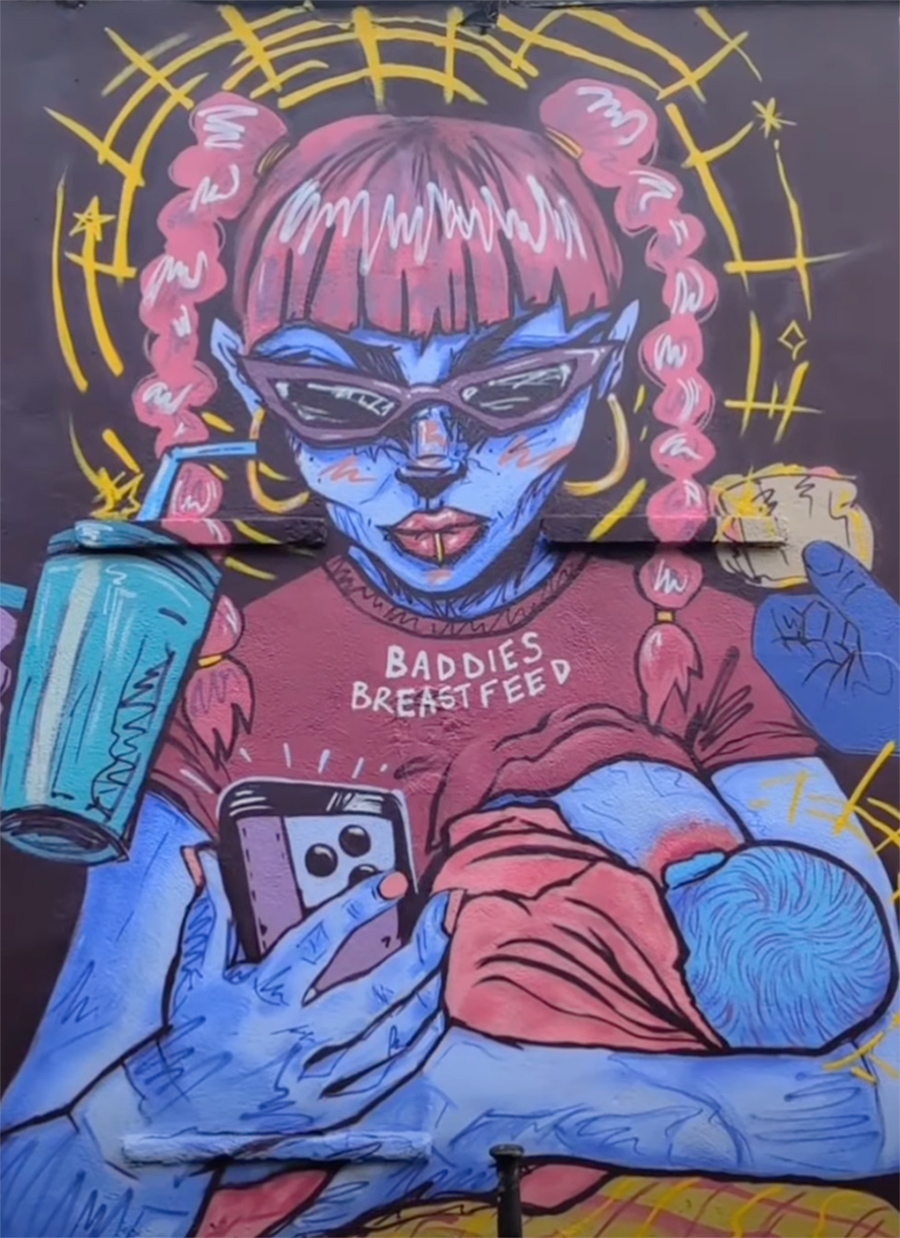
The artist claims their comment was hidden by the council. They could see it from the Facebook profile they posted it from, but if they looked at the thread from a different profile, it was hidden.
If the suppression of comments that the funders of public art find unfavourable is happening, that raises a legitimate question: when public money is used to commission art, should citizens not be free to debate its meaning?
The recent Caslin mural in Dublin might also be considered propaganda by some in its promotion of contested ideas and medical practices and in the use of the imagery reminiscent of St Sebastian who was historically depicted bound to a stake and pierced with arrows after Emperor Diocletian ordered his execution for being a Christian. People will of course have all sorts of different interpretations of the artwork, and that is a good thing as long as all views can be aired.
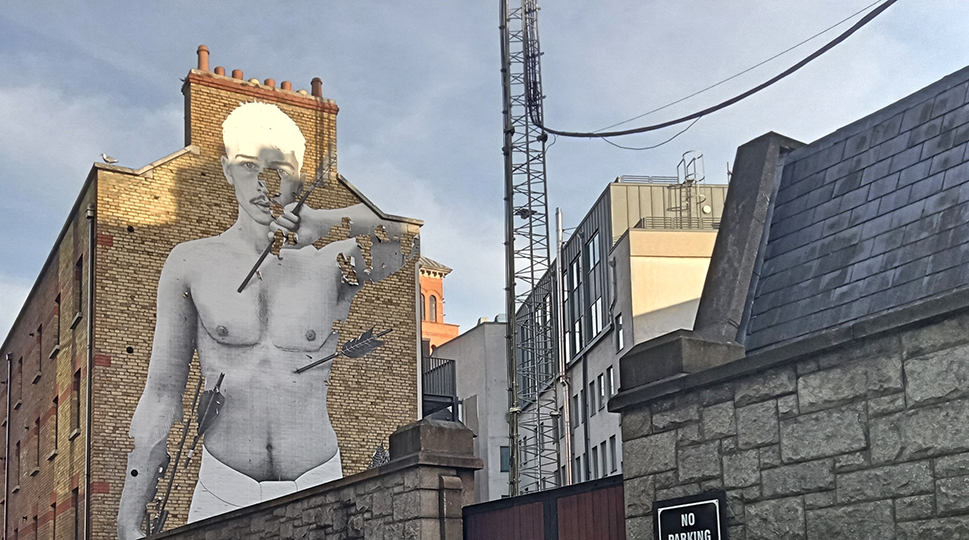
Public institutions should be willing to engage with reasonable criticism rather than discourage debate simply because a particular interpretation is unwelcome.
Public funding should not mean political persuasion
There is a clear distinction between supporting the arts and funding propaganda. Public investment in galleries, libraries, cultural heritage and independent artistic expression can benefit everyone. Using taxpayers’ money to promote a preferred political ideology, however, raises serious questions about fairness and accountability. Public bodies including arts offices and libraries are supposed to remain politically neutral.
State-funded propaganda is a terrible idea, whether it leans left or right, globalist or nationalist. Taxpayers hold a myriad of diverse beliefs and opinions about these issues, and should not be expected to finance political messaging simply because those in power support it. In a properly functioning democracy, this principle must apply equally to every ideology, including those with which we personally sympathise.
This does not mean public art must be politically neutral in subject matter. Art should be free to challenge governments, question social conventions and explore controversial ideas.
The issue is whether public institutions support artistic independence and diverse perspectives, or use cultural funding to advance a particular worldview. I don’t suppose a gender critical artist (i.e. an artist in favour of protecting women’s rights, single sex spaces and concerned about the harms to children from trans ideology etc) would get a penny of funding from the state.
Likewise a person questioning climate change or the possible harms of solar farms, wind turbines etc. Only one perspective appears to get any funding or traction at all. One merely has to take a look at the opportunities for artist’s funding to see that this is the case.
Is this fair?
Is it right?
Is that what we want for our arts sector and public spaces?
To be told by the state what art messaging is allowed and what is not, to be told what to think or create and to think or create otherwise makes you an outcast? Art should be free to criticise the very institutions that finance it. It should allow for many perspectives.
What matters is whether funding decisions are transparent, fair and free from ideological favouritism.
The right to question
If an artist feels compelled to remain anonymous to express an opinion about publicly funded work, that concern also deserves consideration. We cannot assume that professional repercussions would necessarily follow, but a healthy artistic culture must allow dissenting views to be expressed, and indeed art to be made, without intimidation.
Dancer Rosie Kay in the UK has done some invaluable research on this phenomenon in her ‘Freedom in the Arts’ report published earlier this year. The findings were that artists were not overtly cast out for expressing differing opinions to the orthodoxy, but rather, their opportunities quietly dried up. The invitations became fewer. The phone simply stopped ringing. Which is rather chilling.
Kay’s report would also be useful for Irish artists in regard to these issues and contains some invaluable advice for artists facing cancellation.
Ultimately, recognising propaganda requires us to look beyond colours and symbols and ask who commissioned a work, what message it communicates and whether alternative interpretations are welcomed.
Public art belongs to the public, and public money demands public accountability. Citizens should be able to question what is funded, why it is funded and whether the process serves the wider community rather than a particular political agenda.
Art should encourage independent thought and creativity, not dictate it. Taxpayers should fund artistic freedom, not be compelled to finance propaganda, from the left, the right or anywhere in between.
Patricia Fitzgerald