Having assiduously, and mostly successfully, avoided meaningful press contact since the whole Jonathan Dowdall business took a new turn with the tapes presented in the trial of Gerry Hutch, Mary Lou McDonald has decided to bite the bullet.
Now, it is not exactly Frost v Nixon but Friday night live on the Late Late Show with Ryan Tubridy does represent an opportunity for the Sinn Féin leader to win back some of those whose concerns are perhaps reflected in the recent poll showing that support for her party had slipped by 4%.
It might not be panic stations yet, but it’s the sort of blip that will definitely have led to concern among the Sinn Féin kitchen cabinet.
Those concerns have been exacerbated by the ongoing protest in East Wall over the placing of a migrant centre unannounced in the area, as well as indications that communities around the country are becoming anxious over the impact which the surge is refugees is having.
That anxiety is not confined to Sinn Féin voters, of course, but the fact that East Wall is part of Mary Lou’s own Dublin Central constituency – where a second seat will be crucial to their ambitions to be in government – adds a certain urgency.
Mary Lou took 36% of the vote in 2020, but even that might not be enough for the party to take the second seat. That was last achieved in 2007, when Fianna Fáil took two seats with 46% of the first preferences. The fact that Sinn Féin performed disastrously in this constituency in the 2019 local and European elections is evidence that two seats is by no means a sure thing, and if it is not achieved it will be regarded as a failure on the part of the party leader. The local election candidate whose specific area was East Wall only took 5.7% of the vote in 2019.
It is figures like that, particularly when they show evidence of unpredictability, which cause party bosses and number crunchers sleepless nights. The current concern and the fact that both the East Wall controversy and the Jonathan Dowdall issue are taking place on Mary Lou’s doorstep adds further to that anxiety. They also echo a similar crisis within Sinn Féin that followed the loss of one of their five seats in the 2007 general election.
The election that year was in May but it took months of navel gazing after the loss of that seat before Sinn Féin partly aired their lessons learned at an internal conference in December. One of the key issues that had been identified as responsible for the disappointing result was the over-emphasis on a more open door for refugees and migrants – a stance driven by some north American staffers who had been taken on by the party in the aftermath of Sinn Féin’s close relationship with the Clinton Democrats.
That had been epitomised by the near-obsession of Dublin South Central TD Aengus Ó Snodaigh’s office with the issue. It had foolishly led him to become a virtual spokesperson for the Afghan hunger strikers in St’ Patrick’s Cathedral, one of whom apparently cited his reason for being here that he was fleeing a rape charge in Afghanistan. Ó Snodaigh was fortunate to hold on to his seat, with his vote down almost 2,000 on the Sinn Fein vote in the 2004 local elections, and his intervention was thought to be one of the factors that had undermined the party vote overall.
At the conference, the party press office briefed journalists on what was going to be said, and while there were some nods to the other sacred cows of American left liberalism – including one ludicrous prediction that the Irish potato crop would disappear due to climate change by 2050 – this is what the press people managed to persuade the Irish Times to highlight:
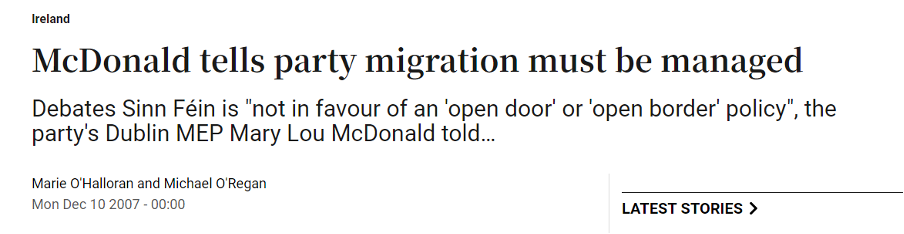
Not everyone was happy with this and Helen McCormack, who later took less than 4% in the Clontarf ward in the 2009 local elections, wrote a report on the relevant section of the conference for An Phoblacht that managed to not mention Mary Lou’s speech at all; preferring instead to indulge in a paean to “inter-culturalism.” Some people were not best pleased.
The interesting thing about that internal debate, and it was reprised following the disappointing 2009 European elections when Sinn Féin won no seats in the 26 counties and in which Mary Lou herself lost the seat in Dublin, was that things more or less continued on as they had been.
Following the European elections, Toireasa Ferris, who had just missed being elected in Munster, wrote a piece for An Phoblacht in which she referred to the “disproportionate emphasis on the worthy causes of refugees” as one of the reasons for the continued slump in Sinn Féin’s electoral fortunes.
However, while the republican leadership took some of that on board, the critical mass within Sinn Féin was shifting towards those whom one former IRA prisoner described in a 2007 interview as “people [who] would be better working for a charity like OXFAM.” The fact is that as Aengus Ó Snodaigh had told Agnes Maillot for her 2005 book, that the ideological positioning of Sinn Féin on the liberal left had to be pursued even at the cost of losing people with “impeccable republican credentials.”
That, apart from some aging old timers, has largely been achieved. The bulk of Sinn Féin TDs, MLAs, councillors, staffers and activists are now post bellum liberals and leftists who genuinely believe in the same sort of things that unites every liberal left party in Ireland, and that is basically all of them at this stage. The party has also colonised what was once the preserve of the Labour Party and the former official republicans in the trade unions, NGOs and media.
The 2020 general election appeared to confirm that this was the way to go. Further purging of people opposed to abortion had been the cherry on top for the more militant newcomers and the older bosses were prepared to give them their head because it had been proven to be electorally successful. For them the achieving of power by that means is the only thing that matters.
The thing is, however, that as the Dowdall issue proves – and with the lingering ghost of a defunct IRA wafting about in the wings – Sinn Féin is vulnerable to its past coming back to haunt it. While the IRA’s history prior to its tame retreat from the stage is pretty much ancient history to most people, the Dowdall thing is not. Whatever Dowdall’s chat with Gerry Hutch might have been about – and it appears to concern anti-Sinn Féin dissidents rather than the Provos – if any party leader was mentioned in such a conversation it would also be news, and they would be asked about it.
Mary Lou has thus far managed to avoid that conversation, but it is likely to be had tonight. Assuming of course that Ryan Tubridy has not reached the Kent Brockman stage of preparing to welcome his future overlords and will broach the matter in an interrogative fashion. He may even perhaps ask Mary Lou about the ongoing protests in East Wall.
Many people still watch the Late Late Show so tonight may prove to be a crucial juncture in Mary Lou’s and Sinn Féin’s so far successful effort to simultaneously ride the coltish horse of edgy republican protest as manifested in working class direct resistance to strike breakers, British soldiers, drug dealers and water charges – and make no mistake that is the ideology if there is one of East Wallers – and the gelding of soft liberalism.
Some would say they are incompatible and will force the coachperson to go one way or the other or risk being offloaded one day unceremoniously into a ditch. I might even tune in myself …