In a report of the recent launch of the GAA’s North American Continental Youth Championships for 2024 two interesting points were made. The first was in relation to the large number of young people who have emigrated to the United States, Canada and elsewhere in recent years, and the second was to the large numbers of players who were born overseas who participate as members of the more than 500 clubs based outside Ireland.
That means, in crude terms that young Irish people who might have stayed in the country and had children have moved overseas and had children, a significant number of whom play hurling, football, camogie and handball. They are part of a new diaspora who for whatever reason have left our shores but who are clearly attached still to Ireland and its culture.
The emigration figures speak for themselves. Since 2009, there have only been four years in which the return of Irish nationals to live here has outstripped the numbers leaving. Two of those years were the exceptional Covid panic years of 2020 and 2021, when there was a net inward migration of Irish people of 8,000.
Over the entire period since 2010, net outward migration – that is the extent to which people leaving is greater than those returning – of Irish people has been more than 135,000. Bearing in mind that the vast majority of those leaving are young people, often well educated and often with jobs, then it paints a picture of a society in which something is sorely amiss. Even apart from the difficulties of getting a place to live, is there an existential crisis afflicting the Irish race?
For anyone interested in reversing current trends in the demography of Ireland the question is how that might be reversed, but to even suggest that it could or should be reversed is seemingly beyond the pale for some. It has been suggested that providing tax and other incentives might help to reduce the barriers to women of working age deciding on whether or not to have children.
The Hungarian governments led by the Civic Alliance/Fidesz since 2010 have implemented a whole host of such measures which not only bely the claim that the “right” is synonymous with unrestrained free market liberalism but have significantly improved the lot of working families whether in the traditional working class or the middle class.
The poverty levels that remained following decades of Communist and then democratic leftist governments have been drastically reduced. The proportion of the population at risk of poverty has fallen from among the third worst in the EU in 2014 to 18.4%, which compares to the EU average of 21.6% and an Irish rate of risk of 20.7%.
One of the key factors in this was reversing the situation where, under both the Communists and soft left, larger families were most at risk of falling into poverty. That was identified by Hungarian nationalists as the main reason, along with the leftist promotion of abortion, for the declining birth rate. To address this the Fidesz governments, having shaken off the inheritance of the leftist imposed IMF austerity regime, set about incentivising families with children.
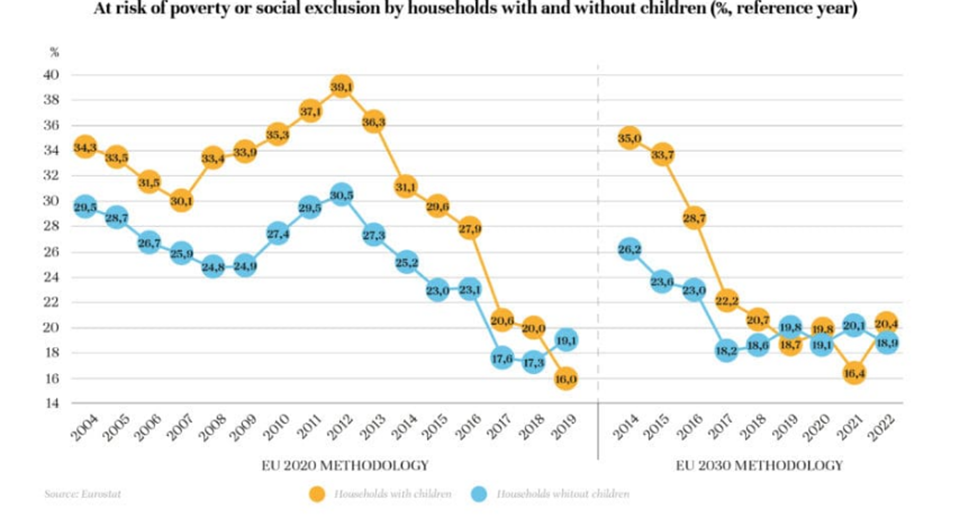
Those measures, the impact of which are illustrated above, include the following:
- Mothers receive full average wage from the last month of pregnancy until the child is 6 months old.
- There is a maternity allowance of 66,000 Forint (approx. €167) per month.
- Mothers receive 70% of minimum wage, €527 per month, while their child is between 6 months and 2 years old.
There are also full tax credits for mothers with 4 or more children and tax exemption for all mothers under the age of 30. The state also provides a Baby Waiting Loan of €27,900, and there are preferential loans for families who are building their own home, of up to €127,000. There are also subsidies for families buying a car, for home renovations and for childcare.
The state also has a baby bond which has an interest rate of 3% and is payable at the age of 18. People under the age of 25 are also exempt from tax on all working income up to the average wage. The state clearly wishes to encourage not only the birth of young Hungarians but their entry into adult working life.
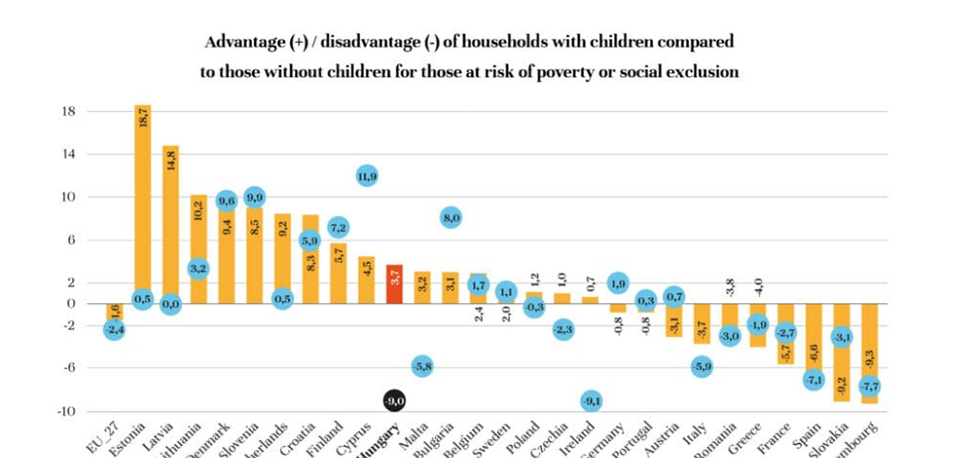
The table below illustrates the difference that this has significantly turned around a situation in which families with children were much more likely to be at risk of poverty. The Irish figures are interesting in that they show that this state had the worst record in this regard in 2009. That has since changed to a situation where it is a marginal advantage but not in the way that it is in Hungary and other countries.
To skip back to where I began – with the report on the burgeoning popularity of the GAA in North America and in other parts of the world where Irish emigres have settled, and where many of their children and indeed grandchildren participate in our games.
Can we even imagine accomplishing two related things? Implementing the sort of economic and social policies that will encourage young people to remain and work and have families in Ireland? And secondly, encouraging members of the diaspora to return here, even into the second and third and fourth generations if need be, if Irish-based capital is in such desperate need of “young well-educated English speaking employees.”
Time to dare to dream again perhaps?