Ongoing research and the release of official statistics confirm that there is a clear connection between the ‘housing crisis’ and the increased demand mostly by immigration.
As most immigration is of people who come to work and who often bring their dependents, most of the impact is felt within the private sales and rental market.
However, there is another theme that is emerging that is connected to the number of people who have been granted International Protection here. It is my opinion that this is now a key factor which explains the high and disproportionate number of persons from outside of the state who are in emergency accommodation and who are on local authority housing lists.
While the demographic statistics on allocations of social housing are sparse, last week I showed how in the Fingal local authority area that more than 40% of allocations to date in 2026 have been to households headed by persons born outside the state.
Where are all the former IPAS residents being housed?
As readers will know there has been a marked fall off in the number of new IPAS centres that have been opened over the past two years. Indeed, several have been closed or not had their contracts renewed.
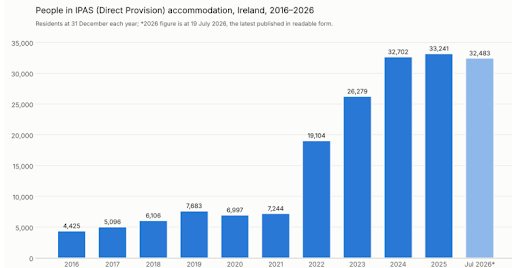
However, while numbers living in IPAS direct provision have clearly levelled off with some 32/33,000 places occupied, and are down in the first half of 2026, the absolute numbers of new applicants for International Protection in the state has increased.
The question is where are those they have replaced being accommodated?
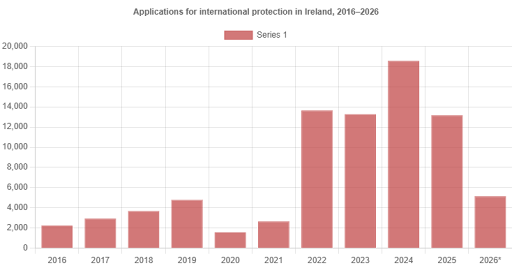
The table above shows that while the number of applications has fallen since the record of 18,561 in 2024, that another 20,972 persons have arrived since the beginning of 2025. Yet the number of people in IPAS direct provision has fallen by 219.
That is rather odd and represents a sudden reversal of the trend up to 2024 when there was clearly a close correlation between the 5,284 new applications made and the 6,423 extra people who were accommodated in IPAS centres.
No response from official sources on IPAS housing connection
Attempts by myself and others – including Carol Nolan TD who has had questions in the Dáil refused – to get answers on all of this have run into a brick wall.
No-one, whether in the relevant Departments, local authorities or Approved Housing Bodies has responded to queries regarding the placement of former IPAS residents.
In the absence of that, I must rely on my own calculations and surmise based both on the available statistics that can be extracted from a wide range of sources, and evidence that I have of the role of AHBs and local authorities in apparently (and clearly in the documented case of De Paul and Fingal County Council) prioritising persons born outside the state.
Former IPAS residents adding to numbers in homeless accommodation
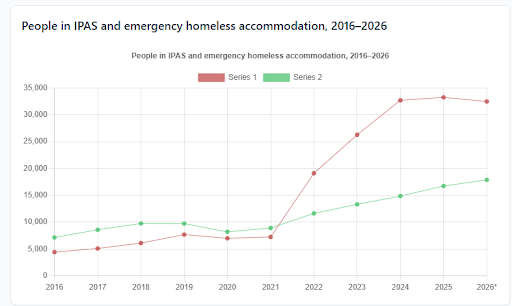
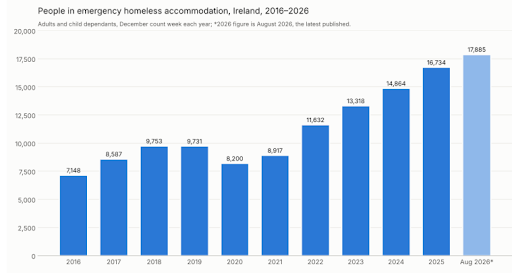
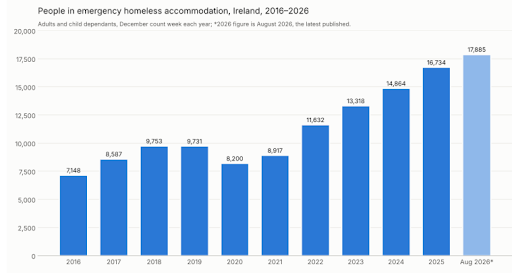
The graph below shows the relationship between the numbers in IPAS accommodation (red) and the growing numbers of people in emergency homeless accommodation (green). Both followed very similar trajectories up to the Covid period. Since 2021 the growth of both has been sharper.
The fact that the number of persons from overseas in emergency homeless accommodation has continued to rise while the numbers in IPAS have slightly fallen strongly implies that even greater use than heretofore is being made of emergency homeless accommodation to house former IPAS residents.
We know from the most recent statistics that 50% of those in emergency accommodation are non-nationals. Of those on the local authority housing list, the corresponding figure is 29%.
The figure for both categories is 7/8% higher when the number of persons born outside the state but who have acquired Irish citizenship is included.
Which means that close to 60% of households in emergency accommodation and over one third of those on the social housing waiting list are headed by a person who was born outside the state.
Figures suggest significant part of increase are former IPAS
According to the statistics in the table below 4,140 applicants for International Protection were given leave to remain in the state since 2021. Over the same period the number of persons in emergency accommodation increased by 8,968.
Given that we know that more than half of those in emergency accommodation now are from outside the state that might suggest that a large proportion of those given leave to remain and who left an IPAS centre then moved into emergency accommodation.
From there they can apply for social housing and, for De Paul and other AHBs, they evidentially constitute a priority category who take precedence over other applicants.
Figures from the Dublin Region Homeless Executive (DHRE) partly confirm this. Their figures show that 1,719 former IPAS residents entered emergency homeless accommodation between 2021 and 2025.
The overall increase in the numbers in emergency accommodation over the same period was 6,045. Which would mean that 28% of the increase was accounted for by former IPAS residents.
What is most significant given the figures for IPAS accommodation is that the number of former residents entering homeless accommodation significantly increased in 2024 and 2025. Which corresponds with my surmise that the leveling off in IPAS numbers indicates that much of this is accounted for by moving into emergency accommodation and from there into private HAP subsidised rental and social housing.
Former IPAS residents accounted for 33% of those who were given emergency accommodation in Dublin in 2024 and 2025. There are no figures on the number of former IPAS residents who have been allocated social housing but there is a clear pathway to that which is facilitated by the AHBs and which by implication has added to the disproportionate allocations which we are now familiar with.
Official estimates are vague
The official estimates of the numbers who have left IPAS are hard to pin down but one estimate claimed that around 11,000 have moved out since the beginning of 2023.
The Department of Justice has claimed that the “vast majority” had no need to avail of homeless services but have provided neither a breakdown of the numbers or a definition of what constitutes homeless services which may or may not include Housing Assistance Payments (HAP).
The HAP numbers are important for they show another disproportionate number of persons born outside the state and are key to people acquiring rental accommodation with a large subsidy paid which benefits both tenant and landlord.
Incidentally the 11,000 figure for those claimed to have left does not tally with the 44,998 new applicants between 2023 and 2025 who would initially have required IPAS accommodation but which only increased by just over 7,000.
The sums simply do not match but then again that is a common feature of everything to do with immigration of whatever variety in the Irish state. Nonetheless, we shall keep trying to make some sense of it all….