The Final Report of the Citizens’ Assembly on Gender Equality, which was chaired by Catherine Day, states that the Assembly deliberately went beyond the mandate provided to it by the Oireachtas. The Assembly decided that restricting their work to “women and men, boys and girls” as the Oireachtas resolution which created the Assembly ordered them to do, was unacceptable, and could “be seen as excluding non-binary and transgender people.” The Assembly “took a broader view” and determined that “gender” should refer to “any and all options in terms of gender identity.”
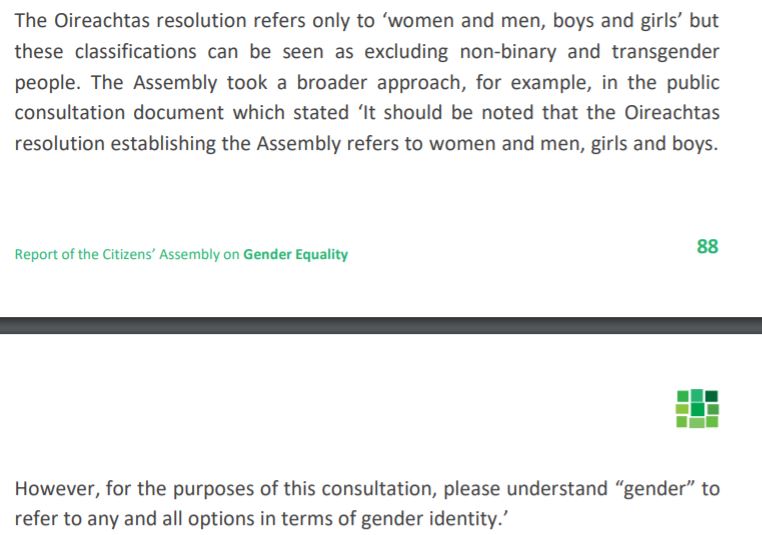
The Oireachtas Resolution which created the Assembly on Gender Equality states that the Assembly is “to advance gender equality by bringing forward proposals that: challenge the remaining barriers and social norms and attitudes that facilitate gender discrimination towards girls and boys, women and men.”
Undoubtedly some will take that expansion of their remit as a positive step, whilst others will take that expansion as an attempt to minimize sex-based rights. However, regardless of one’s views on the matter it is beyond doubt that the Assembly deliberately, and materially, decided to move outside the clear and unambiguous limits placed upon it by the Oireachtas.
Critics have long argued that the Assembly, which has 99 members, is an undemocratic institute which clothes itself in an air of democratic participation but makes little attempt to be representative or fair. Effectively making it just a shoddily designed focus group.
In 2018 it was found that seven of those who had taken part in the Assembly were improperly recruited. That led RedC, the company responsible for recruiting people to the Assembly, to conduct a review of the issues surrounding membership of the Assembly. The review stated that RedC had informed the Assembly that it was “extremely difficult to ensure” a sample of 99 people “however well recruited, could be representative.” Their concerns were ignored and they were told to proceed anyway.
That review also noted that the refusal of the Assembly to pay cash incentives, of some small amount, to those who agreed to take part was not likely to lead to negative consequences. RedC said that such a refusal could led to a situation in which the only people who agreed to become a member of the Assembly were “those that have a strong interest in the process” and “those who are interested in political debate and discourse.” In practical terms it appears that RedC were of the view that the Assembly was, by design, biased towards activists and those with strong views on the matters to be considered rather than general members of the public. Their concerns were largely ignored.
Supporters of the Assembly have generally sold it is a tool of participatory democracy which is limited in its scope to those areas the Oireachtas deems to be worth investigation. The latest move by the Assembly, to simply decide to ignore the will of the Oireachtas, and by extension the citizens of Ireland, has just made that a much harder argument to make. If this Assembly is capable of ignoring provisions within the Oireachtas Resolution which created it, acting as if it were a law unto itself, what is there to stop a later Assembly from doing the same?