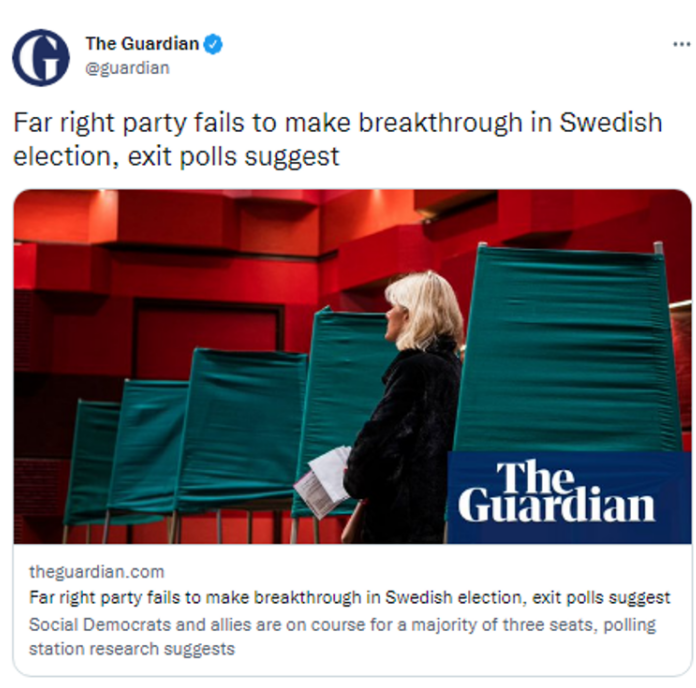
Several hours after polls had closed in the Swedish general election yesterday, The Guardian and other media outlets were celebrating what they believed to have been a victory for “their side.” Even had the right bloc not eventually secured a majority, as seems certain now, the headline would still have been a rather subjective take on the result.
With 94.37% of the vote counted, the state electoral authority’s official count gives the right bloc a total of 176 seats compared to 173 for the left alliance led by the Social Democrats who increased the number of seats won but mostly at the expense of the far Left Party which lost five seats.
There is still a very small chance that the remaining votes to be counted might swing the result back to the left, but that is thought unlikely. The focus after Wednesday will then shift to the formation of a new government and if the seat distribution remains unchanged then it is likely that the Moderate Party leader Uif Kristersson will be asked by the Speaker to form a coalition or an agreement among the other three parties of the right to form a working majority.
Sweden Democrats are the largest party of the putative alliance with 73 seats and almost 21% of the vote, but will have to be content it seems to accept a minor role in any government, and may not even formally join a cabinet formed by Kristersson.
Indeed in his speech last night Sweden Democrats leader Jimmie Akesson spoke of his party’ determination to form a majority government and prior to polling had laid down strong conditions for the party taking part in or supporting any government including the centre right. It is not certain these will be met.
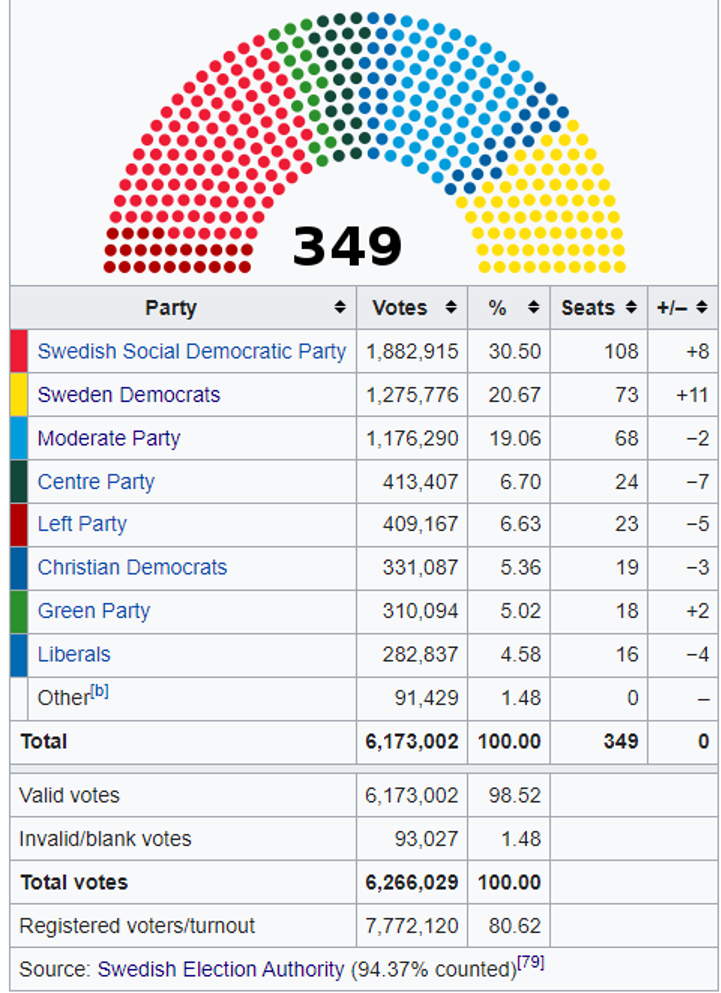
2022 Swedish general election – Wikipedia
Central to those demands will be action to tackle the escalating crime levels that most people, including the current Social Democrat Prime Minister Magdalena Andersson, accept are largely a consequence of mass immigration from outside of Europe of people who have refused to be integrated and who are largely dependent on the state.
The problem the left has, however, is that they are hugely dependent on the votes of immigrants, well over one million of whom had a vote on Sunday. The overwhelming majority of those votes, two thirds, go to the parties of the Left, with 38% of them voting for the Social Democrats. The same pattern can be seen in Britain in the changing demographic of the Labour Party. It is also clearly a calculation that has been made by the parties of the left in Ireland who support uncontrolled immigration.
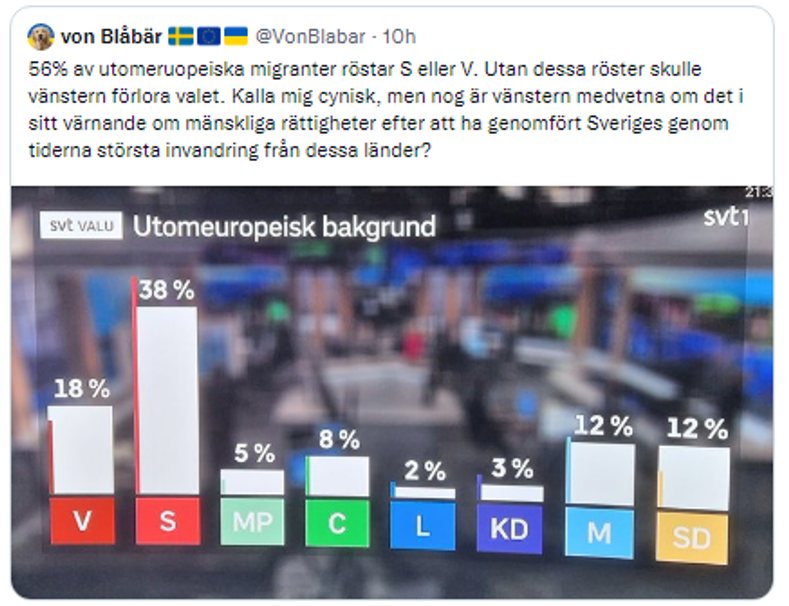
“56% of overseas migrants vote S or V. Without these votes, the left would lose the election. Call me cynical, but surely the left is aware of it in its protection of human rights after having carried out Sweden’s largest immigration of all time from these countries?”
The problem with that, is that the parties of the European left – and all the Leinster House parties are on the “left” with regard to immigration – risk losing their own traditional “white” working class constituency to the parties of the nationalist right who are prepared to address concerns that are impacting most strongly on working class constituents.
The reason for this is simply that European social democracy, including the type of provision that we have in Ireland, is not functional in the context of mass immigration, particularly where large numbers of immigrants are likely to be long term state dependents and likely to form dysfunctional communities divorced from the rest of the community.
Proof of the consequences of this are found in today’s Red C poll for the National Youth Council which found that more than 70% of Irish people between 18 and 24 are considering emigrating. Most of the respondents referred to difficulties of coping economically including the massive barriers preventing young people buying their own home even when they have a reasonably good job and have accumulated savings.
The NYCI is citing the poll as support for its pre-Budget submission. One of the key themes it is claiming to pursue is the need to “address inequality.” Yes, but what type of inequality? The people who are considering emigration are certainly victims of unequal treatment. They are educated people, obviously with ambitions. And thus almost certainly not “entitled” to a whole range of social welfare and other provisions that the Irish state is spending billions on for people who come here from other countries – many of them with no intentions of ever working. Some of them being housed in accommodation that almost nobody in the country could afford on a normal wage.
The age profile of likely voters and past voters for the Sweden Democrats demonstrate that in a country where emigration is not as much of an option as it has “traditionally” been in Ireland for a whole variety of reasons, that young people are staying and voting for people who they believe will do something to redress “inequalities” that no longer feature in the playbook of the European left.