A new study has projected that one in four members of Gen Z will likely never have children, based on current trends.
The paper, Choice or Circumstance: Rising Childlessness in Ireland, comes from Christian, pro-family think tank the Iona Institute, and examines trends in childlessness by generation, starting with women born in 1955 (‘baby boomers’).
The report finds that just 13.5 percent of this cohort were childless by the time they turned 45 – a figure that appears set to rise to almost a quarter (24.2 percent) for Gen Z women, who were born in the late 1990s.
The projected surge in childlessness by the age of 45 is the report’s central finding, the author commenting that “Gen Z Irish women are on course for an historically high level of childlessness”.
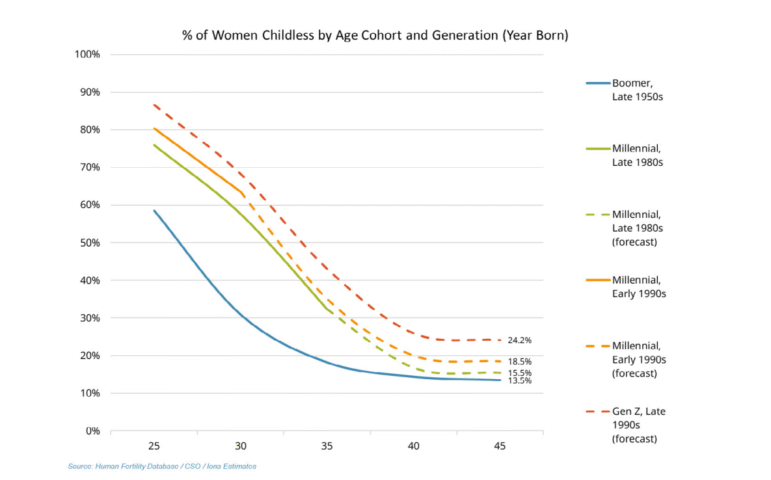
However, the report also charts the surge in childlessness at the age of 30 over the generations. Among those born in the late 1950s, just over 30 percent were childless by the time they reached 30 years of age, whereas among those born in the early 1990s, the number had doubled, to over 60 percent of women (63.6 percent).
The report describes multiple causes of rising childlessness, including later marriage (or no marriage at all) which is described as being among the “most significant structural drivers”.
“Ireland is also experiencing the broader Western pattern of educational and career prioritisation delaying family formation, alongside rising housing costs that make family life more economically precarious. The decline in religious affiliation removes a cultural driver that historically encouraged earlier marriage and childbearing. These forces compound each other across generations,” the report reads.
A distinction is made between voluntary and involuntary childlessness, with the acknowledgement that the available Irish data does not allow for distinguishing between these groups.
“Voluntary childlessness is a valid personal choice while involuntary childlessness is often a source of significant personal distress. Both are increasing, and the policy response to each differs,” the report says.
A 2022 poll commissioned by the Iona Institute found that 85 percent of people want to have at least two children, while only two percent expressed a wish for no children, the results not being affected greatly by age category.
Spokesperson for The Iona Institute Breda O’Brien said upon release of the report that “we used to worry about people having more children than they planned, but now we need to start worrying much more about them having fewer than they wish for, and in many cases, having none at all, and consider the amount of pain and distress this will cause”.
“A situation in which people are having fewer children than they planned for, and in a growing number of cases will end up childless, is a personal tragedy, but also has very significant social and economic consequences because of the effects of an ageing population and growing loneliness,” Ms O’Brien said.
She called for a society-wide debate on the causes of rising childlessness, saying that “one way or the other, it is a phenomenon we should discuss far more widely if our aim is to help people to achieve their eventual life goals”.