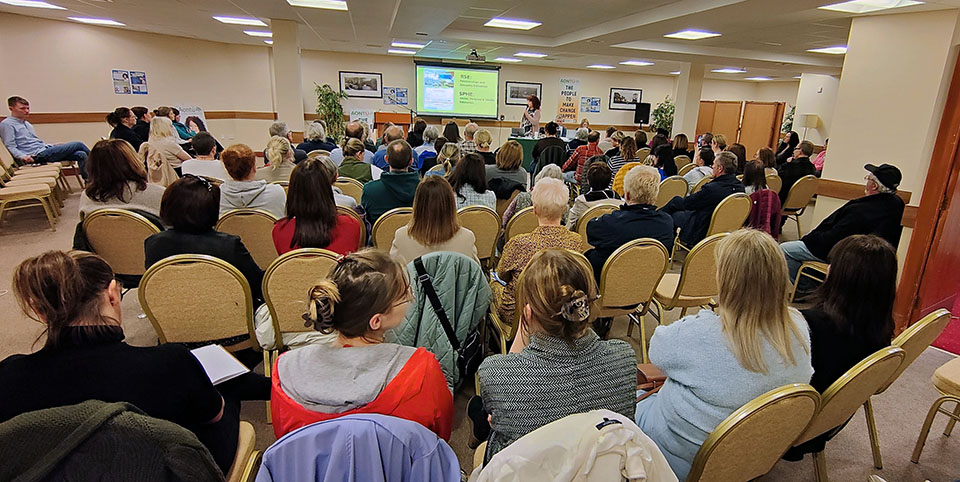
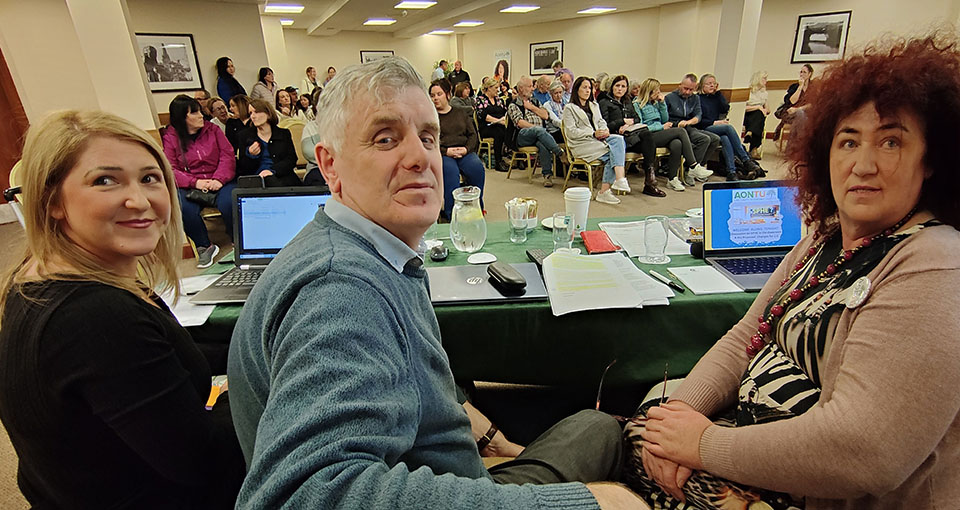
An Aontú candidate in Donegal in the upcoming election says that a packed meeting in Letterkenny showed that parents are “deeply concerned” about what is coming into schools under the SPHE curriculum after several controversies had arisen in recent months.
Mary T. Sweeney said that she had called the meeting in the Station House Hotel last Wednesday because “graphic over-sexualized content intended for children as young as 12 years of age is an issue of deep concern for me”.
“It is wholly and completely improper for this age group, and I share the apprehension of many people across Donegal who have contacted me to express their grave disquiet about this. Nobody is suggesting that children shouldn’t be taught about sex. Of course they should, but it has to be age appropriate and this clearly is not,” she said.
She said that parents were “deeply concerned” and that more than 100 parents and teachers had attended the public meeting last Wednesday to air their concerns about the current and proposed Social, Personal and Health Education (SPHE) curriculum for the Junior Cycle in secondary schools.
“I’ve been aware of the proposed content of this course since 2018, when the World Health Organisation (WHO) released a document about sexuality education in the classroom, and I highlighted it at the time,” said Ms Sweeney speaking to the Donegal News.
“At that stage we thought it might never happen, however it is happening and these books are in our classrooms now,” she added.
Teachers who spoke at the meeting – where pages of textbooks for classrooms were shared with the room – advised parents to contact their principals and boards of management in regard to the matter.
“The graphic and over sexualized content proposed for junior cycle students is of ‘deep concern’ and is promoting ‘harmful ideology’ that could have severe and lasting ramifications for young people, some who are still writing to Santa,” Ms Sweeeny said.
“The next steps are that parents who are concerned should contact their principal and their board of management to find out what’s being taught to their children, to check their children’s textbook, particularly those on the free books scheme, and to make themselves aware,” she said.
Recent controversies over SPHE textbooks include an 8-page lesson on masturbation for second years, an exercise where school students were asked to advice a teeanger who felt “stupid, with stupid breasts” in a section on transgenderism, and the portrayal of a traditional GAA-loving, Fleadh-going Irish family as narrow-minded bigots.
Guest speakers on the night included Mary Creedon, the SPHE teacher who made a “whistle-blower” video regarding what had been presented to teachers on a SPHE course in DCU – a course that was promoted and funded by the Department of Education.
Ms Creedon told the meeting that many elements of the SPHE Curriculum for Junior Cert are very important for students to know such as recognising and managing bullying, online safety, personal hygiene, alcohol and substance use, physical , social and emotional changes during adolescence, respectful communication, how food, physical activity, sleep / rest contribute to health and Wellbeing and more.
She said that a newly adopted Holistic approaches is now shaping Social Personal & Health Education in Ireland and Internationally – and that “Holistic sex education is a sex positive approach which encompasses the psychological, social and cultural aspects of sexual health and wellbeing, where gender is a social construct and sex education should be taught without shame or morals so its very much a sex for pleasure approach with consent being the only moral ground to consider.”
Ms Creedon referred to her recent video and said she was very disappointed that the Department of Education and Minister Foley would release a statement to principals in the Irish school system refuting what she said.
She said it was never made evident at any stage in writing or verbally that the materials used in the DCU course were for adults, as the intent was that these were potential resources that could be used in the classroom. She added that she “categorically stands over” all she said in the video, which has been seen some 700,000 times.
Ms Creedon’s also said that she believed the revised programme was intended to smash the understanding of gender as male/female and boy/girl and instead promote gender as a social construct, adding that in her opinion aspects of the SPHE programme are moving in a direction that she feels could be detrimental to many children.
Mary T Sweeney said that it was important to have “sensitivity and support for children and their families who are experiencing gender dysphoria”, but added that parental concerns were being ignored by the Deptartment of Education and have “been ignored since the whole process of the new SPHE specification came into being”.
“Over 4,353 parents made submissions to the NCCA and it is widely believed that the vast majority of those submissions were extremely concerned about elements of the proposed curriculum,” she said.
At the meeting, Rebecca Mc Daid from A Parent’s Right said “parents and educators alike strongly feel this material is clearly not at all suitable for young adolescents who are only beginning to navigate their way through their formative years. “I believe it is vital that more parents are made aware of what their children are being exposed to in the classroom. They are facing an onslaught of misleading and unscientific ideology that is being pushed in our schools,” she said.
Mary T. Sweeney said that she knows that “many teachers feel uncomfortable with the prospect of teaching this material and are deeply worried for their young pupils. Parents and teachers have a right and a duty that factual and scientific evidence is taught to children”.
She said that the controversy “raises questions over the NGOs that are involved in putting this curriculum together and who I believe have inordinate power. The Minister for Education, Norma Foley has serious questions to answer. This is a wholly inappropriate curriculum and she needs to be held to account for it.”
“I am of the view that parents have a vital role in encouraging meaningful discussions about these topics at home with their children. I am a firm and committed advocate for a curriculum that aligns with the values and comfort levels of both parents and educators, ensuring a safe and appropriate learning environment for all students,” she said.
““I am urging parents of young teenage boys and girls to take an active role in understanding the changes in material for this new curriculum and do their own research. I believe it is essential that they look into it themselves in a bid to be properly informed about what their children are being taught, Also, go in person to your local politicians and meet with them and discuss your concerns ” Ms Sweeney added.
Last year, a new Junior Cycle Social, Personal and Health Education (SPHE) curriculum was introduced for all first-year students.
A Department of Education spokesperson told Gript that “Over the three years of Junior Cycle, students will learn a variety of skills. These include how to communicate respectfully and effectively, understanding the importance of setting healthy boundaries, and recognising the effects of stress and how to manage it. They will also learn about the dangers of alcohol, smoking, and other addictive substances.”
“In a time when young people are bombarded with often distorted online information, the curriculum is designed to give them the tools to help them navigate this new world safely. It is to support them to lead fulfilling and healthy lives, and to have respectful relationships.”
“The SPHE curriculum has been designed to be appropriate for the age and stage of development of the students, whether they are in first year, second year, or third year. Therefore, no inappropriate or explicit content is used to teach SPHE.”
“When the new curriculum was being drafted, students, teachers and over 4,000 parents contributed via a public consultation. If a parent or guardian is concerned about what their child will be taught, they should speak to their local school who will provide information.”
“A parent or guardian can also opt their children out of classes if they feel the content conflicts with their personal beliefs.”