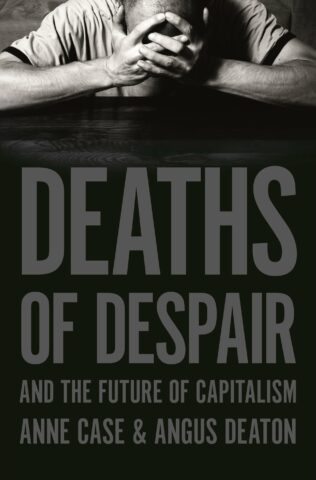
Described by Martin Wolf of the Financial Times, as a book ‘of the highest importance’, Deaths of Despair is a genuine attempt to understand what is fuelling the rising deaths from suicide, drug overdose and alcoholism that has been tearing through the United States, particularly amongst white middle-Americans.
Deaton and Case are both economists and despite this they manage to create a very readable narrative that navigates a complex subject matter, avoiding statistical jargon but presenting, comparing and justifying positions with data where useful.
The big story is well known by now – the epidemic of deaths that started in the US in the 1990s and was killing 158,000 Americans each year by 2018. 158,000 deaths a year caused by depression, alcohol and drug addiction. And this is particularly affecting white (non-Hispanic), less-educated and in particular among people without a four-year college degree.
The story resonates with other discussions, such as The Tyranny of Merit, although from a different perspective, with more rigorous statistical analysis, it points in the same direction. There is a real problem around loss of recognition amongst working/lower class white populations in the United States, and to such an extent that it is causing huge loss of life and suffering.
The interesting part of the book is that it takes three separate issues and is able to find a common line for all three. The same populations are suffering from early death due to alcohol abuse; suffering deaths from drug overdoses; and dying from suicide. Deaton and Case try to unpick, using statistics, rather than anecdotes or assumptions, what is driving this.
The background: ‘deaths of despair’ rose from 30 per 100,000 in 1990 to 92 in 2017 for white men and women aged 45-54. Suicide mortality rates for this group increased in every US state between 199 and 2017; in all but two states, alcoholic liver disease increased for the same group; and deaths from drug overdoses increased across the board. Such is the extent of the mortality that these three causes are overcoming all the gains in mortality and life expectancy accrued for this group. For all other groups, things continue to improve – though the authors fire a warning, particularly in relation to deaths due to drugs for other groups.
The initial assumption is, of course, poverty. But the affected group are not the poorest in America. African-Americans are. The cause is far less easy to pin-point, and the authors discover (to my disappointment) there is no single reason and no easy solution.
The authors touch on the collapse of social norms – decline in marriage, children out of wedlock, declining religion – as being relevant to the discussion, but look beyond this – to what has contributed to these changes that have ‘eaten away at the foundations that characterised working-class life’.
The risk of dying a ‘death of despair’ increased markedly for those without a four year college degree. Although a degree in itself is not a life saver, having a degree offers protections from threats that those without a degree are vulnerable to, because of the type of work they are doing or have the opportunity to do. Opportunities for those without a degree are narrowing with job flight and remaining jobs they can attain are low paid and with low esteem. People in this trap tend to marry in the same cohort while the wealthier mix among themselves, creating more stratification in society, silos and parallel lives. A cold statistic is that, for those born in 1980, whites without a degree are four times more likely to commit suicide than those with.
Fundamental to the story is the erosion of the possibility of the working class leading meaningful and dignified lives. What has caused this?
This is where the second part of the title of the book comes into it: the future of capitalism. Deaton and Case are not anti-capitalists at all but point towards the flight of productive jobs from middle-America leaving only much less well paid jobs in their place as the only option for people/communities that used to contribute to the industrial heartland of the United States.
The authors are not of the view that high tax-rates for high earners are needed but that there is a serious issue of unfairness as big business becomes rent-seeking, driving up profits for the rich at the expense of wage stagnation for the regular workers. Corporations, according to the authors, continue to keep wages low while profits increase for the company, shareholders and executives, effectively refusing to share any of the dividends of success as generational purchasing power amongst the lower-middle class, blue-collar work decreases.
Getting the rich to pay more taxes is not the solution but fundamentally addressing the unfairness that big business is able to perpetuate. Connected to this is one particular business area – that of pharmaceutical industries who were directly responsible for the increase in drug overdoses (the Food and Drug Administration is not entirely innocent either) particularly due to Oxycontin (essentially legalised heroin).
The authors also look at the health system in the United States and central to the question, most interestingly, is the issue of pain. The authors noted that the population that voted for Donal Trump in 2016 correlated with those suffering most from pain. Those suffering most corresponds with those populations suffering from deaths of despair. And those with degrees seem to suffer less with pain than those without. Pain is correlated with alcoholism, with drug addiction (particularly with highly addictive pain relief drugs) and ultimately with suicide as well. Yet, the authors discover that pain cannot be the sole cause, as something insulates Black Americans from deaths of despair relative to whites, even though they suffer much the same pain issues (for those without a degree).
And of course, there is the US health system itself – so expensive, yet so ineffective for so many. Not part of the statistical analysis the authors understand that the way the system works disproportionately affects the disenfranchised and it needs over-hauling – not necessarily to be like the NHS, but as economists the authors are of the view that you cannot rely on the market system to deliver effective and affordable health services. It disfavours the poor and the ill. The author strongly state that the current system in the US is extortion and that the government is complicit.
The analysis goes on as the authors search for possible answers, ruling out specific, simple answers as they go. Ultimately, without a fixed cause, it seems that, although declining wages play a role, it is ‘the destruction of a way of life that we see as central, not the decline in material wellbeing’, – decline of family, community and religion.
The authors offer no easy solutions to address the issue. No silver bullets but a final chapter addressed at what is to be done. Sort out the opioid epidemic and don’t let it happen again. Fix healthcare. Different corporate governance. Wage policies. Anti-trust policies. Fix rent seeking.
Easy.
Although the authors fail to find an easy solution, Deaths of Despair is a hugely informative and important whistlestop tour through a huge amount of heavy discussions. One of the pleasures of the book is that you can sense that the authors really care about the issue at hand. They want to understand. They want to find solutions. They want to make things better for a population sub-group that is much maligned and often considered to be ‘deplorables’ by the rich and famous.
The authors are not ideologues. Although from time to time, they indicate preferences that might not be backed up by statistic, their efforts are based on evidence to the greatest extent possible.
- Publisher : Princeton University Press (2 Mar. 2021)
- Language : English
- Paperback : 336 pages
- ISBN-10 : 0691217076
- ISBN-13 : 978-0691217079
- Dimensions : 13.72 x 2.54 x 20.57 cm
Dualta Roughneen